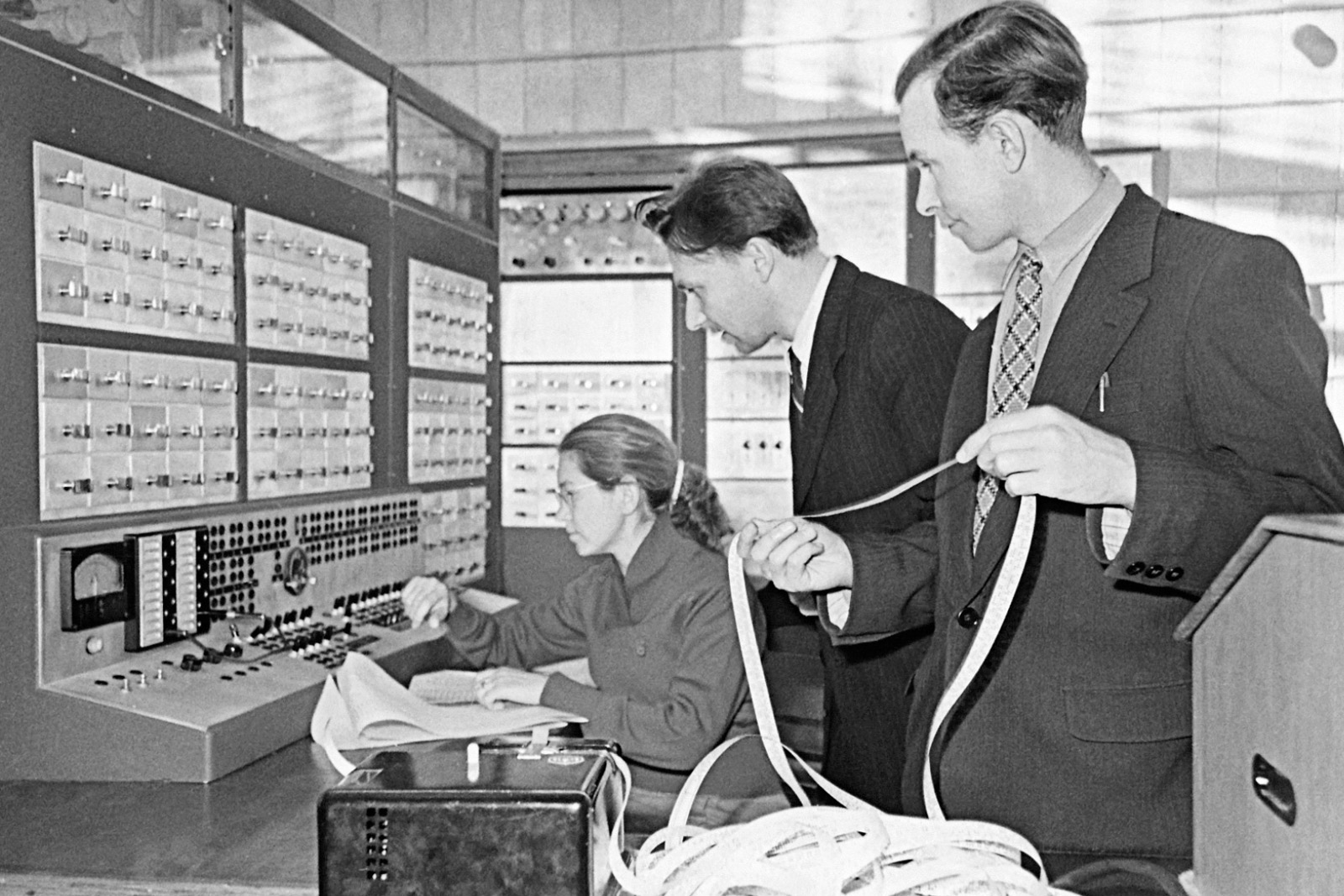
Look at the photograph.
It is February 15, 1946. The U.S. Army is unveiling ENIAC – the Electronic Numerical Integrator and Computer – to the press and the public at the Moore School of Engineering in Philadelphia. The machine fills an entire room: 17 468 vacuum tubes, 70 000 resistors, 3000 switches, and miles of cable. In the photograph, men in suits stand in front of the machine. They are identified in the caption. J. Presper Eckert. John Mauchly. The engineers. The builders.
But there are women in the photograph, too. They are not posing. They are working – manipulating cables, setting switches, interacting with the machine in ways that suggest they know exactly what they are doing. The caption does not name them.
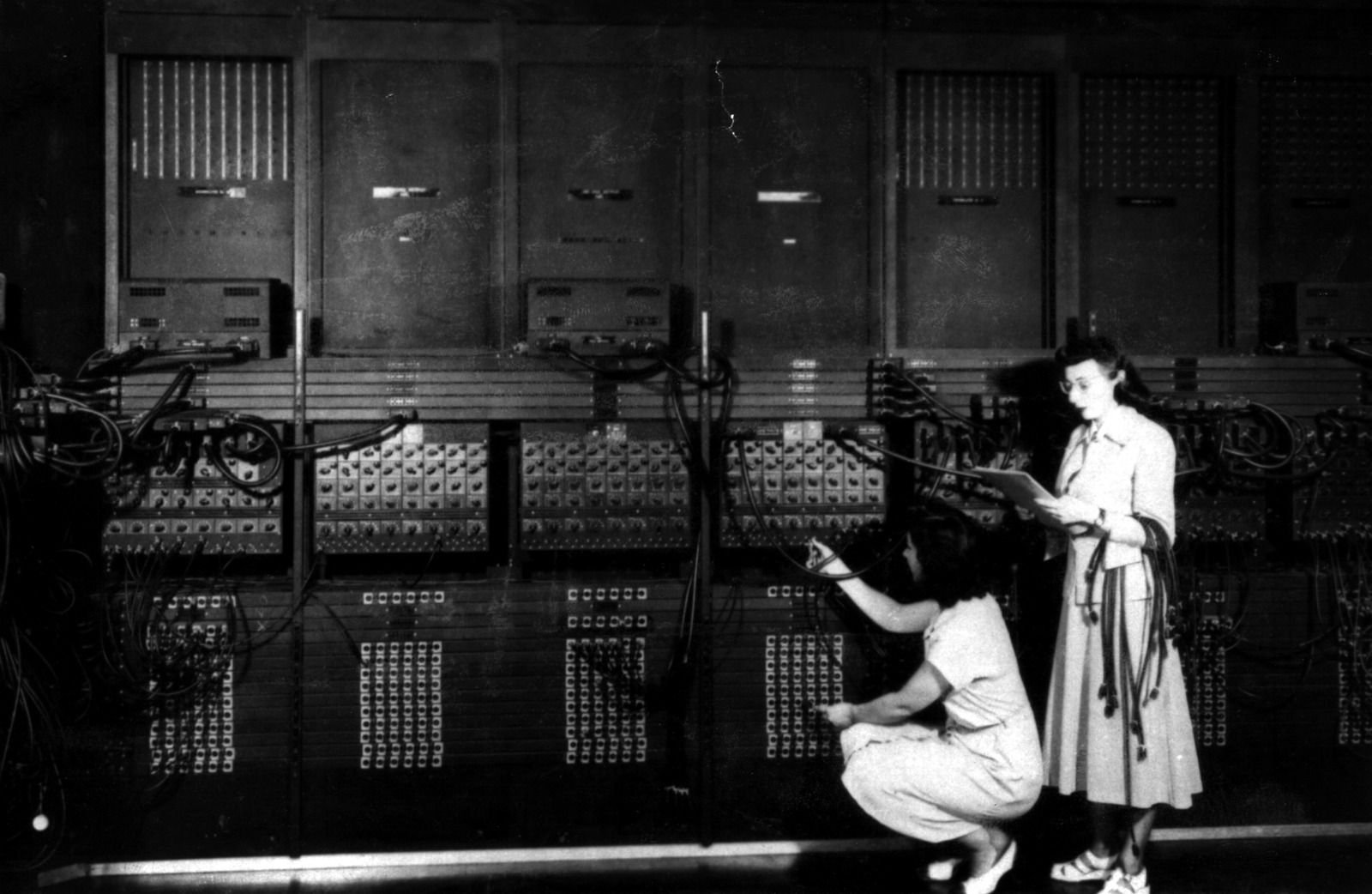
For nearly fifty years, nobody did ask.
The first demonstration that day had been led by two of the six women programmers – Marlyn Wescoff and Ruth Lichterman. The six women had developed the logic behind ENIAC’s programming, creating subroutines, nesting, and other fundamental programming techniques. They had successfully wired the machine to perform a ballistics trajectory calculation in 20 seconds – a problem that took a human computer 40 hours to solve by hand. The demonstration was a sensation. But when the Army released the photographs, the captions identified only the men. Contemporary accounts treated programming as “clerical” work, unworthy of mention alongside the “real” achievement of building the hardware.
The photographs circulated. The captions stuck. The women became invisible.
In the mid-1980s, a Harvard undergraduate named Kathy Kleiman was looking for female role models in computing. She found old photographs of ENIAC showing both men and women. The men were identified. The women were not. When Kleiman asked computer historians who the women were, she was told they were “Refrigerator Ladies” – models hired to pose in front of the machine to make it look good in publicity shots.1
But Kleiman noticed something. In photo after photo, the women were not posing. They were working. “It looked like they knew what they were doing,” she said.1
She made it her mission to find out who they were. She tracked them down. She interviewed them. She recorded their stories. What she discovered was not a footnote. It was the missing chapter of computing history – a story of six women who programmed the first general-purpose electronic computer, and a wider story of women across the early computing world who did foundational work and were systematically written out of the record.
This post tells their stories. It is the longest post in this series, and it is the one I should have written first.
The Six
During World War II, the Moore School of Engineering at the University of Pennsylvania hired approximately 200 women as “computers” – human calculators who computed ballistic trajectories for the Army’s Ballistic Research Laboratory. The work was grueling: differential equations solved by hand with desk calculators, each trajectory taking up to 40 hours. The women were classified as “subprofessionals.” Men with the same qualifications received “professional” titles.
In 1945, six of these women were selected to program ENIAC. They were the first programmers of the first general-purpose electronic digital computer. There was no programming manual. There was no programming language. There was no precedent. The women taught themselves ENIAC’s functions by studying its logical and electrical block diagrams and by interviewing the engineers who had built it. Programming meant physically setting 3000 switches and routing data through telephone switching cords and patch cables. They had to understand the machine at the hardware level – every vacuum tube, every accumulator, every data path. Timing accuracy had to be precise to 1/5000th of a second. When something went wrong, they debugged by tracing wires through the machine’s guts, sometimes crawling inside it on their hands and knees.
There was one more thing. Adele Goldstine, who had trained them as human computers, had not yet finished writing the ENIAC technical manual. There was no documentation. The six women learned to program the first computer from the blueprints and from asking questions. They were pioneers navigating without a map, and the map would later be written based on what they found.
These were the six:
Kay McNulty Mauchly Antonelli (1921-2006)
Born on February 12, 1921, in Creeslough, County Donegal, Ireland – on the night of her birth, her father, an IRA training officer, was arrested and imprisoned in Derry Gaol. The family emigrated to Philadelphia in 1924. At three years old, Kay spoke only Irish. She would remember prayers in Irish for the rest of her life.
She graduated from Chestnut Hill College in 1942 with a mathematics degree – one of only a few math majors in a class of 92 women. Hired at the Moore School as a human computer at $1620 a year, she computed artillery trajectories on desk calculators before being selected for ENIAC. In the summer of 1945, she trained at Aberdeen Proving Ground on IBM punched card equipment. Her key contribution: she invented the subroutine to solve capacity constraints during trajectory computations – the idea of breaking a program into reusable components, a concept that would become foundational to all programming.
She later married John Mauchly himself, ENIAC’s co-creator, in 1948 – “against the wishes of her parents.”1 They had five children. She survived him by 26 years and spent her later life giving lectures and interviews promoting recognition of the ENIAC programmers. In 2019, the Irish Centre for High-End Computing named their primary supercomputer “Kay” in her honor. She died of cancer in Wyndmoor, Pennsylvania, on April 20, 2006.
Betty Jean Jennings Bartik (1924-2011)
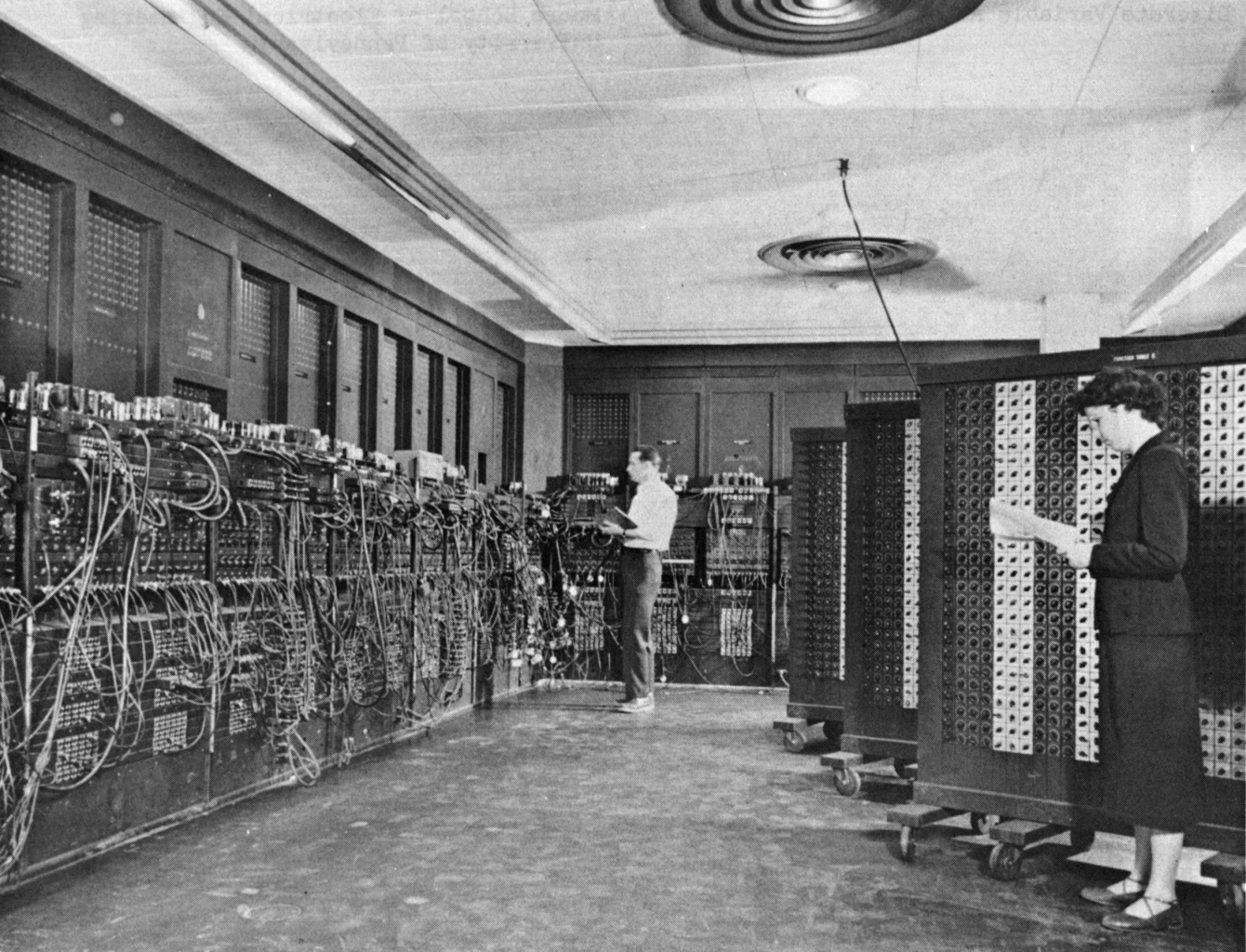
Born December 27, 1924, in Alanthus Grove, Gentry County, Missouri. A farm girl. Sixth of seven children. She attended a one-room school and was known locally for her softball arm. She graduated from Northwest Missouri State Teachers College in 1945 with a B.S. in mathematics – the only mathematics graduate in her entire class.
The Army recruited her in 1945 for ballistics calculations at the University of Pennsylvania. Her partnership with Betty Holberton produced the ballistics trajectory program demonstrated at the February 1946 unveiling – the program that proved ENIAC could complete in 20 seconds what took a human computer 40 hours. She later played a central role in converting ENIAC into a stored-program computer by March 1948, working with Adele Goldstine and Dick Clippinger.
Bartik became the most vocal advocate for recognition. After ENIAC, she contributed to the development of BINAC and UNIVAC. She worked at Auerbach Corporation writing technical reports on minicomputers, held positions at various technology firms, and then spent 25 years as a real estate agent. But she never stopped talking about what had happened – about the six women who programmed the first computer and were not invited to dinner. Her autobiography, Pioneer Programmer, was published posthumously in 2013. The Drupal content management framework’s default theme was named “Bartik” in her honor. She died of congestive heart failure in Poughkeepsie, New York, on March 23, 2011.
Betty Snyder Holberton (1917-2001)
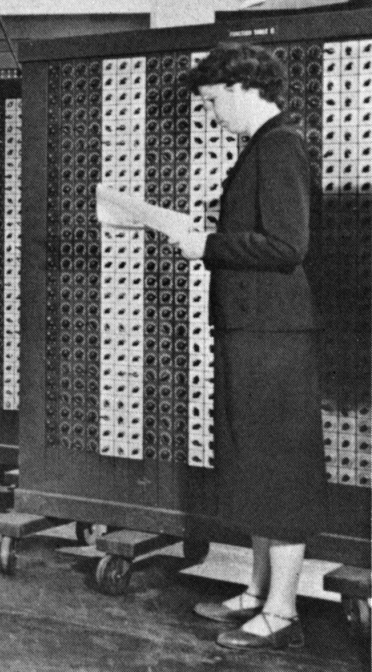
Born March 7, 1917, in Philadelphia. She studied journalism at the University of Pennsylvania because “its curriculum let her travel far afield.”1 On her first day in a mathematics course, her professor asked whether she “wouldn’t be better off at home raising children.”1
Of the six, Holberton had the most distinguished post-ENIAC career – and it is not close. She invented the breakpoint: to make a program stop at a certain point, a cable was simply removed. That removal became the “breakpoint,” a concept that remains fundamental to every programmer’s workflow today. She designed the sort-merge generator for UNIVAC I, using a deck of playing cards to develop the decision tree for the binary sort function. She redesigned the UNIVAC control console and created the C-10 instruction code that allowed control of UNIVAC by keyboarded commands rather than dials and switches. She changed the computer’s exterior color from black to gray-beige – a practical choice for office environments that became the industry standard for decades. She collaborated with Grace Hopper on the development of COBOL and FORTRAN standards. She worked on FORTRAN 77 and Fortran 90 revisions at the National Bureau of Standards.
She received the Augusta Ada Lovelace Award in 1997 – the sole original ENIAC programmer to receive an individual award that year. She died on December 8, 2001, in Rockville, Maryland, at age 84, from complications of heart disease, diabetes, and stroke. The Holberton School, founded in 2015, is named in her honor.
Of the six, Holberton left the deepest imprint on the technology itself. Every time a programmer sets a breakpoint, every time a computer sits in an office in a neutral color rather than funeral black, every time a program sorts data efficiently – the lineage traces back to a woman who was told on her first day of class that she should go home and raise children.
Marlyn Wescoff Meltzer (1922-2008)
Born in 1922 in Philadelphia. She graduated from Temple University in 1942, was hired by the Moore School to perform weather calculations on adding machines, and transitioned to ballistic trajectory calculations in 1943. In 1945, she was selected as one of the six. She resigned from the ENIAC team in 1947 to marry, before the machine relocated to Aberdeen Proving Ground. She did not continue in computing. In later years she delivered Meals on Wheels, worked at a library, and knitted over 500 chemotherapy hats for the Susan G. Komen Foundation. She died on December 7, 2008, in Yardley, Pennsylvania, at age 86.
Frances Bilas Spence (1922-2012)
Born March 2, 1922, in Philadelphia. She attended South Philadelphia High School for Girls, initially enrolled at Temple University, then transferred to Chestnut Hill College on scholarship. She graduated with a degree in mathematics and a physics minor in 1942 – it was at Chestnut Hill that she met Kay McNulty, her future ENIAC colleague. At the Moore School, she programmed calculations and operated a Differential Analyzer for ballistics equations. She married Homer W. Spence, an Army electrical engineer from Aberdeen Proving Ground, in 1947, and left the project to raise three sons: Joseph, Richard, and William. She lived the longest of the six, dying on July 18, 2012, at age 90.
Ruth Lichterman Teitelbaum (1924-1986)
Born February 1, 1924, in the Bronx, New York, to Jewish immigrant parents from Russia. Her father Simon was a teacher. She graduated from Hunter College with a B.S. in mathematics. After the 1946 unveiling, Ruth traveled to Aberdeen Proving Ground, where she spent two years teaching ENIAC to a new group of programmers. This was critical work: the knowledge of how to program ENIAC existed in the heads of the original six programmers and in Adele Goldstine’s manual, and Ruth was the one who ensured it transferred to the next generation. She married Adolph Teitelbaum in September 1948. She was the first of the six to die, on August 9, 1986, in Dallas, Texas. She was 62.
The Dinner They Were Not Invited To
On February 15, 1946, the demonstration was a triumph. The ballistics trajectory program, developed by Bartik and Holberton, showed that ENIAC could complete a trajectory calculation faster than the artillery shell itself could fly. The press was impressed. The Army was proud. The men celebrated.
The six women who had made the demonstration work were not invited to the celebratory dinner afterwards.
Think about that for a moment.
They had learned to program the machine by studying wiring diagrams – because Adele Goldstine had not yet finished writing the manual.
They had debugged the machine by tracing wires with their hands.
They had crawled inside the machine itself.
They had developed subroutines, nesting, and other fundamental programming techniques that no one had ever conceived before, because there was no “before.”
They had made ENIAC compute.
And when the evening came, they went home.
The U.S. Army had classified them as “subprofessionals.” The celebratory dinner was for professionals.
The Woman Who Trained Them All
Adele Katz Goldstine was born on December 21, 1920, in New York City, to Yiddish-speaking Jewish parents. Her father William had emigrated from Lithuania in 1902. She graduated from Hunter College and earned her master’s degree in mathematics from the University of Michigan at age 22, where she met Herman Goldstine, the Army liaison for ENIAC. They married in 1941.
At the Moore School, Adele worked as an instructor of mathematics for the women “computers.” When the Army selected six women to program ENIAC, it was Adele who trained them. She taught them the complex differential calculations that ENIAC was designed to automate. She was the mathematical bridge between the machine’s engineering and its programmers. Without her, none of the six would have known how to approach the problem.
Then she wrote the book. In the summer of 1946, Adele Goldstine authored the first technical description and operator’s manual for ENIAC – the definitive document for the first electronic digital computer. It was the first computer programming manual in history. For years, it remained the only formal technical manual for the machine. The six programmers had learned to program ENIAC without this manual. Adele wrote it based on what they had discovered together.
She did not stop there. In 1946, she collaborated with Jean Bartik and Dick Clippinger on converting ENIAC from a machine that required physical rewiring for each new problem into one capable of executing stored programs. John von Neumann consulted. Adele and Bartik did the programming work. After the war, she continued at Los Alamos, devising computational problems for ENIAC processing alongside von Neumann.
She was diagnosed with cancer in 1962. She died in November 1964. She was 43 years old. Her two children were small – born in 1952 and 1959.
Her ENIAC manual remained the definitive reference for years. Her role in the stored-program conversion was foundational. She had trained all six programmers, written the first computer manual, and helped design the first stored-program implementation. And yet her name appears in the footnotes of computing history – when it appears at all. She is far less well known than her husband Herman, who typed up von Neumann’s First Draft of a Report on the EDVAC – a document whose contested authorship became one of computing’s bitterest priority disputes. Adele’s contributions have no such controversy. They were simply not mentioned.
The Darkest Arc
Klara Dan was born on August 18, 1911, in Budapest, Hungary, to wealthy Jewish parents. The family was well-connected socially. At fourteen, Klara became a national champion in figure skating. She graduated from the Veres Palne Gimnazium in 1929. She married twice before she was twenty-seven – first Ferenc Engel, a gambler, then Andor Rapoch, an investment banker eighteen years her senior. Both marriages ended in divorce.
In 1938, she met John von Neumann at a casino in Monte Carlo. He explained that he had perfected a mathematical system to ensure that he would win at roulette every time, promptly lost all his money, and asked her to buy him a drink. It was a characteristic von Neumann encounter – brilliant theory, disastrous practice, and irresistible charm.
Both divorced their spouses and married on November 17, 1938 – his second marriage, her third. They emigrated together to Princeton, New Jersey, where the couple hosted legendary weekly parties that placed Klara at the center of the intellectual social scene. On the immigration papers, she listed her profession as “housewife.”
She was not a housewife for long. And she was not a grasshopper.
After Pearl Harbor, Klara secured the position of Head of Statistical Computing Group at Princeton – her first foray into computational work. She had no formal mathematical training beyond her gymnasium education. She was essentially self-taught as a programmer, learning through project work rather than through courses or manuals. Then came the ENIAC, and she became one of the first people in the world to write code for a stored-program computer.
In April 1948, a team including John and Klara von Neumann and Nick Metropolis spent 32 days straight at Aberdeen running the first computerized Monte Carlo simulations on ENIAC. Klara had diagrammed and coded the Monte Carlo algorithm herself. These were not only the first Monte Carlo calculations by computer – they were among the first code written in the modern stored-program paradigm ever to be executed. Her team discovered they had been “testing the conveniency of the H-bomb.”2 The simulations were for thermonuclear weapon feasibility studies.
In 1950, Jule Charney, Agnar Fjortoft, and John von Neumann ran the first computer-generated weather forecast on ENIAC – the founding moment of numerical weather prediction, the event that this entire blog series has been building toward. By then, Klara was the world’s leading expert on ENIAC coding. The published paper thanked “Mrs. K. von Neumann for instruction in the technique of coding for the ENIAC and for checking the final code.” Historians have debated the exact extent of her role on the day; what is certain is that no one outside Los Alamos understood ENIAC programming as deeply as she did, and the meteorologists learned to write code for the machine in a paradigm she had helped invent. She trained them, and she reviewed the code that made the first numerical forecast possible.
At Los Alamos, she wrote the first programs for MANIAC I, the machine designed by her husband and Julian Bigelow. She was, by any reasonable accounting, one of the first programmers in the world. And yet, in the Charney-Fjortoft-von Neumann paper that established numerical weather prediction – the founding document of the field I have been writing about for eighteen posts – she appears only in the acknowledgments. “Mrs. K. von Neumann.” Not even her first name.
The Grasshopper in Very Tall Grass
John von Neumann was diagnosed with metastatic cancer in 1955. The cancer spread to his brain. He was kept under military security at Walter Reed Army Medical Hospital – his knowledge of nuclear weapons too sensitive to risk in delirium. Klara witnessed his agonizing decline. He died on February 8, 1957.
She spent six years preserving her famous late husband’s story and legacy. Then she turned to something of her own. She sat down and put her own remarkable story on paper – an autobiography titled “A Grasshopper in Very Tall Grass.”
The title tells you everything about what this world did to her. A figure skating champion, a coder of the first weather forecast, a programmer of Monte Carlo simulations and hydrogen bomb calculations – and she thought of herself as a grasshopper in very tall grass. The memoir was to be divided into eight chapters and a postscript. She completed drafts for six of them, typewritten in English, with some produced multiple times as she edited them by hand in the margins. She submitted the manuscript for publication. She was told it was “not marketable.”3
A memoir by the woman who had coded the first weather forecast, programmed the first Monte Carlo simulations, and written the first programs for MANIAC I – the woman who had witnessed the birth of computing from inside the machine room and the death of its chief architect from inside the hospital – was not marketable. The publisher wanted the story of the husband. Not the wife.
In 1958, she married oceanographer and physicist Carl Eckart – her fourth marriage – and moved to La Jolla, California. The memoir remained unfinished.
On the night of November 10, 1963, Klara drove from her La Jolla home to the beach. Her body was found washed up on the shore at 6:45 in the morning. A neighbor identified her. The coroner’s report noted a blood alcohol level of 0.18%. Cause of death: asphyxia by drowning. The San Diego coroner’s office ruled it suicide. Her prior diagnosis was recorded as “anxiety depression with neuroses.”
Her dress had been weighed down with 15 pounds of wet sand.3
She was 52 years old.
The unfinished memoir now sits in the Library of Congress, part of the John Von Neumann and Klara Dan von Neumann papers collection. In 2022, the Lost Women of Science podcast devoted its entire second season to her story. Episode 5 is called “La Jolla.”
She coded the first computerized Monte Carlo simulations. She trained and reviewed the team that ran the first weather forecast. She wrote the first programs for MANIAC I. And her own story was “not marketable.”
I have written about the 1950 ENIAC weather forecast in Post 6 and Post 7 of this series. I named Charney, Fjortoft, and von Neumann. I did not name Klara. That is the erasure at work, and I am correcting it now.
The Mysterious Lady
Mary Tsingou was born on October 14, 1928, in Milwaukee, Wisconsin, to Greek immigrant parents who had relocated from Bulgaria. During the Great Depression, the family returned temporarily to Bulgaria; they came back to the United States in 1940. She earned a B.S. in mathematics and education from the University of Wisconsin in 1951, and a master’s in mathematics from the University of Michigan in 1955.
At Los Alamos, she became one of the first programmers on MANIAC, the computer that von Neumann and Bigelow had built. Along with Mary Hunt, she was among the first to start exploratory work on the machine. With John Pasta, she created the first computer graphics on MANIAC – making her a pioneer of computer graphics.
In the summer of 1953, Enrico Fermi, John Pasta, and Stanislaw Ulam designed a computational experiment to study energy distribution in a nonlinear system – a chain of oscillators. They expected the energy to distribute equally among all modes. Instead, the system exhibited quasi-periodic behavior, returning nearly to its initial state. This surprising recurrence became one of the foundational problems in nonlinear physics and chaos theory.
Mary Tsingou programmed the entire simulation on MANIAC. She developed the algorithm to simulate energy relaxation in model crystals following Fermi’s suggestion. This was not a trivial coding task – this was the first experiment conducted entirely inside a computer, a simulation that produced a result so unexpected it redefined an entire field of physics. Without her code, the experiment could not have been run.
But when the results were written up – after Fermi’s death in 1954 – only Fermi, Pasta, and Ulam were listed as authors. Tsingou was acknowledged in a footnote. The published paper thanks “Miss Mary Tsingou” for her work programming the simulations. Not “Dr.” or “Professor” – “Miss.” For over fifty years, the problem was known as the “Fermi-Pasta-Ulam” (FPU) problem. Her name was not included.
In January 2008, physicist Thierry Dauxois published an article in Physics Today titled “Fermi, Pasta, Ulam, and a Mysterious Lady.” He argued that Tsingou’s contributions had been systematically under-credited and campaigned for the problem to be renamed. The article had a significant impact. Subsequent publications increasingly refer to the Fermi-Pasta-Ulam-Tsingou (FPUT) problem – granting her proper attribution more than half a century after the original work. In 2020, National Security Science magazine published a piece titled “We Thank Miss Mary Tsingou.”
In 1958, she married Joseph Menzel. In 1972, she returned to the problem: with James L. Tuck, she repeated the FPUT results, further suggesting the system’s integrability. She became an early expert in Fortran programming and worked at Los Alamos until her retirement in 1991.
As of 2026, Mary Tsingou is 97 years old and living in Los Alamos with her husband. The woman in the footnote is still alive.
From Weather to the Moon
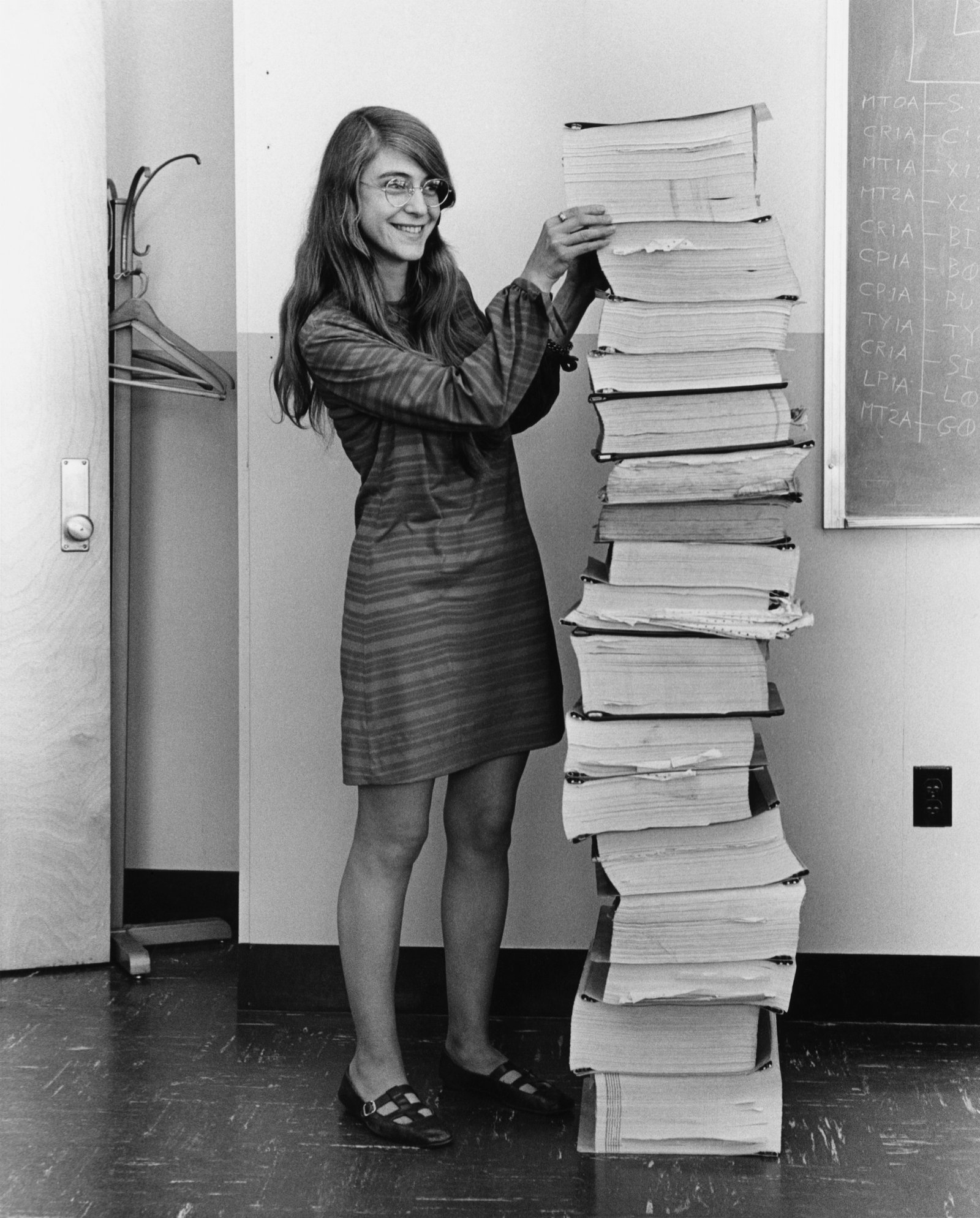
Margaret Hamilton was born on August 17, 1936, in Paoli, Indiana. She graduated from Earlham College in 1958 with a B.A. in mathematics and a minor in philosophy, intending to pursue graduate studies in abstract mathematics at Brandeis. Instead, she took a programming job to support her husband’s legal studies.
In mid-1959, Hamilton began working for meteorologist Edward Norton Lorenz in MIT’s meteorology department. She developed software for predicting weather, programming on the LGP-30 and PDP-1 computers. It was this work – her programming – that contributed to one of the most important discoveries in the history of science.
In 1961, Lorenz was using the Royal McBee LGP-30 to simulate weather patterns by modeling 12 variables. With Hamilton’s programming assistance, he made the observation that would define chaos theory: running the same simulation with slightly different initial conditions – a number rounded from six digits to three – produced completely different weather predictions. This was the discovery of sensitive dependence on initial conditions, later popularized as the butterfly effect. Hamilton’s work contributed to Lorenz’s publications on chaos theory, as acknowledged by Lorenz himself. She and her successor Ellen Fetter were responsible for programming the computer that would uncover strange attractors and other hallmarks of chaos theory.
In the summer of 1961, Hamilton moved to another project and hired and trained Ellen Fetter as her replacement. Fetter continued the programming work that would contribute to Lorenz’s future publications. Then Hamilton went on to program the AN/FSQ-7 computer at MIT Lincoln Lab for the SAGE air defense system, and then to lead the team that wrote the Apollo flight software at MIT’s Instrumentation Laboratory. The famous 1969 photograph shows her standing beside a stack of printouts taller than she is – the Apollo Guidance Computer source code, the listings of the lunar module and command module on-board flight software that she and her team developed. That photograph would become one of the most iconic images in the history of computing.
Hamilton began using the term “software engineering” during the Apollo project to distinguish software from hardware and to argue that developing software required the same rigor and discipline as any other branch of engineering. When she started programming at MIT in 1959, the term did not exist. She is credited with both coining and popularizing it. The entire discipline of software engineering – a field that now employs millions of people worldwide – takes its name from a word she invented because nobody took her work seriously enough to have a word for it.
On November 22, 2016, she received the Presidential Medal of Freedom from President Barack Obama. She was 80 years old.
Her career arc is a bridge between two pillars of this story: weather prediction and space. From Lorenz’s chaos on the LGP-30 to Armstrong’s descent on the Apollo Guidance Computer. The same woman. The same precision. The same invisibility, for decades, until the world caught up.
I wrote about Lorenz and the butterfly effect in Post 8. I mentioned that Lorenz’s simulations ran on a Royal McBee LGP-30. I did not mention who programmed that LGP-30. It was Margaret Hamilton. She was 22 when she started.
Maybe We Should Have Called It Arianna
Arianna Rosenbluth was born on September 15, 1927, in Houston, Texas. She completed her bachelor’s degree at Rice Institute in 1946, her master’s at Radcliffe College in 1947, and her PhD in physics from Harvard in 1949 – at age 22. She was the fifth woman to earn a PhD in physics from Harvard. Her thesis, “Some Aspects of Paramagnetic Relaxation,” was supervised by Nobel laureate John Hasbrouck Van Vleck. She was also a competitive fencer: she won both the Texas women’s championship in foil and the Houston men’s championship. She qualified for Olympic competition but could not compete – the 1944 Games were cancelled due to the war, and she could not afford the travel to London for the 1948 Games.
In 1951, she married physicist Marshall Rosenbluth. At Los Alamos, she learned to program MANIAC I when she verified calculations for the first full-scale test of a hydrogen bomb in 1952.
The seminal 1953 paper “Equation of State Calculations by Fast Computing Machines” lists five authors: Nicholas Metropolis, Arianna W. Rosenbluth, Marshall N. Rosenbluth, Augusta H. Teller, and Edward Teller. The paper describes what is now called the Metropolis algorithm – the foundation of Markov chain Monte Carlo methods, used across physics, statistics, biology, finance, machine learning, and climate science.
Arianna Rosenbluth wrote the entire code. She coded it in assembly language, one level of abstraction above machine language. She later recounted that Augusta Teller had started the computer work, but that Arianna herself took it over and wrote the code from scratch. In an oral history recorded shortly before his death, Marshall Rosenbluth credited Edward Teller with posing the original problem, himself with solving it, and Arianna with programming the computer. At a 2003 conference at Los Alamos marking the 50th anniversary of the publication, Marshall Rosenbluth stated that Metropolis “played no role in the development other than providing computer time.”4
The algorithm is universally called the “Metropolis algorithm” or the “Metropolis-Hastings algorithm.” It is named for the first author – the man who, by multiple accounts, contributed only computer time. Arianna Rosenbluth was the first person to ever implement the Markov chain Monte Carlo method. The algorithm she wrote has been cited tens of thousands of times and forms the backbone of modern computational statistics.
After the birth of her first child, Rosenbluth left research to focus on raising her family. She and Marshall had four children. They divorced in 1978. Her daughter Jean later said: “She was not the happiest person while we were growing up,”4 suggesting that “part of it was that she missed her work, because it meant a lot to her.”4
Arianna shared little about the algorithm before her death. She died on December 28, 2020, in the greater Los Angeles area, of complications from COVID-19. She was 93.
As the statistician Andrew Gelman wrote on his blog: “Maybe we should’ve called it Arianna.”5
Maybe we should have. The Metropolis algorithm is one of the ten most important algorithms of the twentieth century. It runs inside every Bayesian inference engine, every protein folding simulation, every climate model ensemble. The woman who wrote the code is a footnote at best, unknown to most practitioners. The man who provided the computer time is immortalized in the name.
The Women Whose Names Are Not Recorded
In 1956, the original memory of BESK – Sweden’s first electronic computer, briefly the fastest in the world – was found to be insufficient. Engineer Carl-Ivar Bergman was given just a few weeks to build and install a ferrite core memory. The deadline was impossibly tight.
To complete the work before the deadline, they hired housewives with knitting experience to thread the ferrite cores and assemble the memory.6
The tiny ferrite cores had to be threaded with fine wire by hand, using magnifying glasses. The work required extraordinary manual dexterity and precision – skills that women with knitting and textile experience already possessed.
Their names are not recorded.
This is not an accident. This is the pattern. Their labor was essential, but their identities were not considered worth preserving. The BESK memory worked. The computer ran. The weather forecasts were computed. And the women who had built the memory with their hands disappeared from the record.
The same practice extended to the other side of the Atlantic. The core rope memory for the Apollo Guidance Computer was manufactured by women at Raytheon in Waltham, Massachusetts. Many were hired from the local textile industry for their sewing skills. Others came from the Waltham Watch Company. The engineers called the manufacturing process the “LOL” method – “Little Old Ladies.”7 Margaret Hamilton herself used this term. One named worker identified in the records is Mary Lou Rogers. A 1975 NASA report on the Apollo missions praised the computing systems but mentioned none of the women who built them. Among the weavers at Raytheon were also Navajo women, whose contributions have been similarly erased.
The term “LOL memory” has been criticized for erasing both the skill required and the diversity of the women who did the work. But the term stuck. The names did not.
In Stockholm and in Waltham, the pattern was the same. The skill was women’s skill – textile work, knitting, sewing. The precision was extraordinary. The products were essential. And the workers were anonymous. In the official histories, the memory just appeared, as if it had assembled itself.
The Pattern
This is not one woman. It is not one incident. It is a pattern, and it is systematic.
The women did the foundational work. The men received the credit. And when the story was told, the women became “Refrigerator Ladies” standing in front of a machine, or “Miss Mary Tsingou” in a footnote, or unnamed hands threading wires, or a “housewife” on immigration papers who happened to code the first weather forecast.
The ENIAC six were unnamed in photo captions in 1946. Mary Tsingou was acknowledged in a footnote in 1955, not as an author. Arianna Rosenbluth was listed as an author, but the algorithm was named for Metropolis. Klara von Neumann was thanked as “Mrs. K. von Neumann” in the Charney-Fjortoft-von Neumann paper. The BESK memory threaders have no names at all. The Raytheon core weavers were called “Little Old Ladies.”
The delay between contribution and recognition tells the story:
- The ENIAC six: programmed ENIAC in 1946, first formally recognized in 1997. Fifty-one years.
- Mary Tsingou: programmed the FPUT experiment in 1953, name added to the problem in 2008. Fifty-five years.
- Arianna Rosenbluth: wrote the Metropolis code in 1953, still largely unrecognized. Over seventy years.
- Klara von Neumann: coded the 1948 ENIAC Monte Carlo simulations and trained the meteorologists who ran the 1950 weather forecast, first widely recognized in 2017. Sixty-seven years.
- Margaret Hamilton: led the Apollo software team in the 1960s, Presidential Medal of Freedom in 2016. Forty-seven years.
Many of the women left computing to raise children – Meltzer in 1947, Spence in 1947, Rosenbluth after 1953, Tsingou temporarily. Their departures were used to further diminish their contributions. The logic was circular: they were not credited because they were “just” programmers; they left because they were not credited; and their leaving was taken as evidence that the work had not mattered. Betty Holberton’s professor had asked her on the first day of class whether she would not be “better off at home raising children.” Many of the six were told the same thing, in different words, for the rest of their careers.
Meanwhile, the men who received the credit stayed in the field, published papers, won awards, and told the story of computing without mentioning the women who had done the programming. The six were not forgotten. They were never remembered in the first place.
The Recovery
In 1997 – fifty-one years after the ENIAC unveiling – all six programmers were inducted into the Women in Technology International Hall of Fame. It was the first formal recognition any of them had received for programming the world’s first general-purpose electronic computer. Ruth Teitelbaum had been dead for eleven years. She was inducted posthumously.
In 2008, Jean Bartik and Betty Holberton received Computer History Museum Fellowships and IEEE Computer Pioneer Awards. In 2014, Kleiman’s documentary The Computers: The Remarkable Story of the ENIAC Programmers premiered at the Seattle International Film Festival. In 2016, it won Best Documentary Short from the United Nations Association Film Festival. In 2022, Kleiman published Proving Ground: The Untold Story of the Six Women Who Programmed the World’s First Modern Computer – the full-length book that restores the six women to their place in computing history.
The recovery came. But it came late. And it came only because one undergraduate in the 1980s refused to accept the phrase “Refrigerator Ladies.”
The women were also not invited to the ENIAC’s 50th anniversary celebration in 1996. When Kleiman learned of this, she redoubled her efforts – recording their oral histories, seeking recognition, and eventually producing the documentary that told their story. Fifty years after they were excluded from the dinner, they were excluded from the anniversary. The erasure was not a one-time oversight. It was a habit.
Close
They programmed the first computer.
They trained the team that ran the first weather forecast.
They wrote the first Monte Carlo simulation.
They programmed the experiment that founded nonlinear physics.
They implemented the algorithm that underlies modern computational statistics.
They created the first computer graphics.
They threaded the memory that made it all work.
They programmed the simulations that revealed chaos theory.
They wrote the software that landed humans on the Moon.
And for fifty years, nobody asked their names.
I have been telling you the story of computing, weather prediction, and the machines that changed how we understand the world. This is Post 19 in the series. In every previous post, the names I gave you were men’s names: Richardson, Smagorinsky, Charney, Lorenz, von Neumann, Beurling. Those men did extraordinary things. Their achievements are real. But the story I told was incomplete – because the story that was told to me was incomplete. The women were there. They were always there. They were in the photographs. They were just not named in the captions.
Now they are named.
Kay McNulty Mauchly Antonelli. Betty Jean Jennings Bartik. Betty Snyder Holberton. Marlyn Wescoff Meltzer. Frances Bilas Spence. Ruth Lichterman Teitelbaum. Adele Katz Goldstine. Klara Dan von Neumann. Mary Tsingou. Margaret Hamilton. Arianna Rosenbluth. Ellen Fetter. Mary Lou Rogers. The unnamed women of BESK. The unnamed women of Raytheon.
Some of them lived long enough to be recognized. Hamilton received the Presidential Medal of Freedom at 80. Bartik and Holberton received the IEEE Computer Pioneer Award in 2008. Tsingou is alive at 97, and the problem finally bears her name. Others were not so fortunate. Klara von Neumann drowned at 52, her memoir rejected as unmarketable. Adele Goldstine died at 43, her manual still the standard reference for a machine she had helped create. Ruth Teitelbaum died at 62, eleven years before the first formal recognition. Arianna Rosenbluth died of COVID-19 at 93, and the algorithm is still called Metropolis.
They were not Refrigerator Ladies. They were the programmers.
Footnotes
References
Books:
- Kleiman, K. (2022). Proving Ground: The Untold Story of the Six Women Who Programmed the World’s First Modern Computer. Grand Central Publishing.
- Bartik, J.J. (2013). Pioneer Programmer: Jean Jennings Bartik and the Computer that Changed the World. Truman State University Press. (Posthumous.)
- Light, J.S. (1999). “When Computers Were Women.” Technology and Culture, 40(3), 455-483.
Articles and Online Sources:
- Dauxois, T. (2008). “Fermi, Pasta, Ulam, and a Mysterious Lady.” Physics Today, 61(1), 55-57. arXiv
- Gelman, A. (2021). “Maybe we should’ve called it Arianna.” Statistical Modeling, Causal Inference, and Social Policy. Blog
- APS (2022). “Arianna Rosenbluth and the Metropolis Monte Carlo Algorithm.” APS News. APS
- IMS (2021). “Obituary: Arianna Rosenbluth 1927-2020.” Institute of Mathematical Statistics. IMS
- Radcliffe Institute at Harvard. “Flash of Genius.” Radcliffe
- Witman, S. (2017; updated 2021). “Meet the Computer Scientist You Should Thank for Your Smartphone’s Weather App.” Smithsonian Magazine. Smithsonian
- Hafner, K. (2022). Lost Women of Science podcast, Season 2: “A Grasshopper in Very Tall Grass.” Lost Women of Science
- Haigh, T. “Klara von Neumann, a ‘Lost Woman of Science’.” Tom and Maria
- Hamilton, M. “Margaret Hamilton (software engineer).” Wikipedia. Wikipedia
- Quanta Magazine (2019). “The Hidden Heroines of Chaos.” Quanta
- MIT News (2016). “Apollo code developer Margaret Hamilton receives Presidential Medal of Freedom.” MIT
- Tsingou, M. biography. MacTutor History of Mathematics. MacTutor
- National Security Science (2020). “We Thank Miss Mary Tsingou.” Los Alamos National Laboratory.
- Science News (2019). “Core memory weavers and Navajo women made the Apollo missions possible.” Science News
- Kleiman, K. ENIAC Programmers Project. eniacprogrammers.org
- Fritz, W.B. “The Women of ENIAC.” IEEE Annals of the History of Computing. IEEE/PDF
- Library of Congress. “John Von Neumann and Klara Dan Von Neumann papers.” LOC
Image Credits:
- ENIAC women programming. U.S. Army photograph. Public domain.
- Jean Bartik at ENIAC. U.S. Army photograph. Public domain.
- Betty Holberton. U.S. Army photograph. Public domain.
Previously in this series: The Man Who Forecasted Weather with a Pencil – The Number That Connects Turbulence to War – The Line That Models Cannot Draw (Part 1) – Reading the Sky – The Ghost in the Grid – The Man Who Tamed the Equations – The First Climate Model Had 5 KB of RAM – The Butterfly That Broke the Forecast – From Cables to Chaos – The Swedes Got There First – The Magician Who Told No Secrets – The Blueprint Von Neumann Gave Away – The Machine That Learned Too Early – The Machine That Built IBM – Three Mathematicians from Poznan – The Forecast That Reached the Nobel – The Man Who Caught the Computer Disease – The Decade the Forecast Got Good
-
Kleiman, K. Proving Ground: The Untold Story of the Six Women Who Programmed the World’s First Modern Computer, Grand Central Publishing, 2022. See also Kleiman, K., ENIAC Programmers Project. eniacprogrammers.org. ↩ ↩2 ↩3 ↩4 ↩5
-
Haigh, T. “Klara von Neumann, a ‘Lost Woman of Science.’” Tom and Maria. See also Witman, S. “Meet the Computer Scientist You Should Thank for Your Smartphone’s Weather App.” Smithsonian Magazine, 2017 (updated 2021). Smithsonian. ↩
-
Hafner, K. Lost Women of Science podcast, Season 2: “A Grasshopper in Very Tall Grass,” 2022. Lost Women of Science. ↩ ↩2
-
“Obituary: Arianna Rosenbluth 1927-2020.” Institute of Mathematical Statistics, 2021. IMS. ↩ ↩2 ↩3
-
Gelman, A. “Maybe we should’ve called it Arianna.” Statistical Modeling, Causal Inference, and Social Policy, 2021. Blog. ↩
-
Lundin, P. BESK: Sweden’s First Electronic Digital Computer, KTH Royal Institute of Technology, 2006. See also Persson, A. “Early Operational Numerical Weather Prediction Outside the USA.” 2005. ↩
-
“Core memory weavers and Navajo women made the Apollo missions possible.” Science News, 2019. Science News. ↩