Yesterday I told you about BESK – the bitter schnapps computer that ran the world’s first operational weather forecasts. I told you that FRA, Sweden’s signals intelligence agency, was BESK’s most urgent customer, running classified cryptanalysis sessions every night while meteorologists and aircraft engineers used the machine by day.
But I didn’t tell you why FRA existed in the first place.
This is the story of the man who created the need for Swedish code-breaking computers – and who did it with nothing but a pencil.
A Merchant Captain’s Son
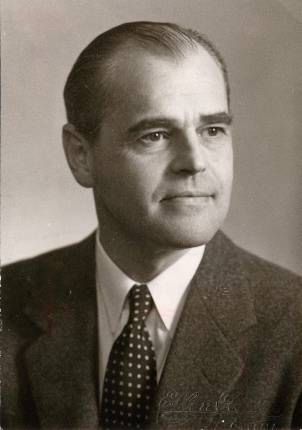
Arne Carl-August Beurling was born on 3 February 1905 in Gothenburg, Sweden. His father, Konrad Beurling, captained merchant ships. His mother, Baroness Elsa Raab, came from Swedish nobility. From his father, Arne inherited an explosive temperament, a love of hunting and sailing, and an absolute refusal to explain himself to anyone.
His great-grandfather, Pehr Henrik Beurling, had founded a prestigious clock factory in Stockholm in 1783. Precision instruments ran in the blood.
Beurling studied mathematics at Uppsala University. He proved the Denjoy conjecture – a significant open problem in complex analysis – in 1929. While hunting alligators in Panama. With his father. His doctoral thesis was then delayed by five years because the hunting expedition to South America and compulsory military service got in the way. Lars Ahlfors, his future closest friend, independently proved the same conjecture and published first. When Beurling finally submitted his thesis in 1933, it was recognized as “not a mere collection of interesting results, but one of the most influential mathematical publications in recent times.”1 The alligator detour hadn’t dulled anything.
His approach to mathematics was unlike anyone else’s. Colleagues noted that “he had a dimension to his thinking that was not logical but guided by intuition, feeling and aesthetics.”1 For Beurling, “the world of mathematics seemed to be integrated with the real world and with life itself.”1 Yngve Domar, one of his students, put it plainly: “If the label of genius is to be put on anybody, then the right thing is to put it on Beurling. He never based his results on what others did, but attacked new problems with fresh methods.”1
He was charismatic, generous with his friends, and loyal to a fault. He was also, by all accounts, impossible. He had “no sense for public relations”1 and an explosive temperament inherited from his father – a man described as “a small hot-tempered man who often used to dress in knickerbockers” and who, “when he fell out with someone, would tell them about the people he had shot.”1 The apple did not fall far from the mast.
Beurling did not publish his results until every detail was perfect, which meant that much of his work was never published during his lifetime. Paradoxically, “his readiness to share his ideas was unselfish in the extreme”1 – he would talk freely about his mathematics with anyone who cared to listen. He just wouldn’t write it down. Lennart Carleson, his most famous student, explained: “He took pride in presenting his results so that the way he discovered them was completely hidden.”1
His neighbours at Uppsala could observe his working habits. They would describe how “he walked back and forth… sometimes stopped!”1 – the stopping being the alarming part, as it suggested he was so deep in thought that even his habitual pacing had frozen.
At Harvard, where he was a visiting professor in 1948-49, he told his students: “You Harvard men seem to be afraid of integral signs.”1
A magician, in other words. In every sense.
The Machine Nobody Could Read
In April 1940, Germany invaded Norway. Suddenly, German military communications between Norway and Berlin needed to travel through cables on Swedish territory. The traffic was encrypted using the Siemens & Halske T52, known as the Geheimschreiber – the “secret writer.”
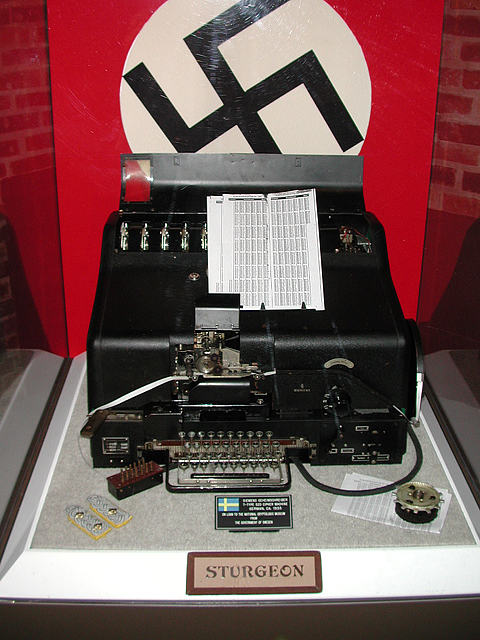
The T52 was not the Enigma. It was worse.
The Enigma was a portable, manual cipher machine – an operator typed a letter, a lamp lit up, you wrote down the encrypted letter. Three or four rotors, a plugboard. Complex, but fundamentally a souped-up substitution cipher.
The T52 was an online teleprinter cipher. It encrypted messages automatically during transmission at roughly 66 words per minute. It used ten cipher wheels (not three), each with a different coprime number of pins (from 47 to 73), creating a total keyspace of approximately 893 quadrillion – close to 10^18 – combinations. The encryption operated in two stages: first an XOR substitution, then a conditional transposition of bit pairs controlled by a plugboard. This two-stage process meant that even knowing the plaintext didn’t directly reveal the key. Later variants – T52c in July 1942, T52d in 1943, T52e in late 1944 – added irregular wheel stepping that pushed the keyspace to roughly 10^27. Beurling never tackled those; Bletchley Park first cracked T52d only in June 1944 (“Halibut”), and never broke T52e at all.
The British codenamed it “Sturgeon.” Bletchley Park would struggle with it for years.
The Germans considered it unbreakable.
Two Weeks, One Pencil
In the summer of 1940, Sweden’s Defence Cryptography Agency recruited Beurling. He was a professor of mathematics at Uppsala. He was 35 years old.
They gave him intercepted teleprinter tapes – nothing but streams of cipher text. No captured machine. No documentation. No “cribs” (known plaintext). Just encrypted noise on paper tape.
This was not Beurling’s first encounter with ciphers. During compulsory military service in 1930-31, Captain Erik Anderberg had shown him the Hagelin B-21 – a cipher machine newly purchased by the Swedish military, built by the Swedish inventor Boris Hagelin. Anderberg let Beurling take the machine home over a weekend. Beurling found a weakness, asked for a ciphertext containing “a not-too-short probable word,” received a message starting with overbefälhavaren (“supreme commander”), and returned it fully deciphered. The astonished Anderberg remembered the name. A decade later, it was Anderberg’s recommendation that brought Beurling to the code-breaking service.
Before tackling the Geheimschreiber, Beurling also broke Soviet codes prior to the Winter War (November 1939), enabling Sweden to provide Finland with intelligence. He also cracked encrypted Czech telegrams despite not knowing a word of Czech. Ciphers were simply how his mind relaxed.
The first intercepted T52 traffic arrived on 25 May 1940. Beurling sat down with the tapes and a pencil. By 27 May, he had verified his first results.
Two weeks later, he had reverse-engineered the entire machine – deduced the internal wiring, the wheel structure, the encryption process – and could read the German traffic.
Alone. With pen and paper. In two weeks.
David Kahn, the dean of cryptographic historians, called it “quite possibly the finest feat of cryptanalysis”2 performed by the Swedes. Friedrich Bauer called it “one of the most magnificent achievements of cryptanalysis.”3 Bengt Beckman, later head of FRA’s cryptanalytical section, wrote that it was “every bit as impressive as the breaking of the Enigma code.”4
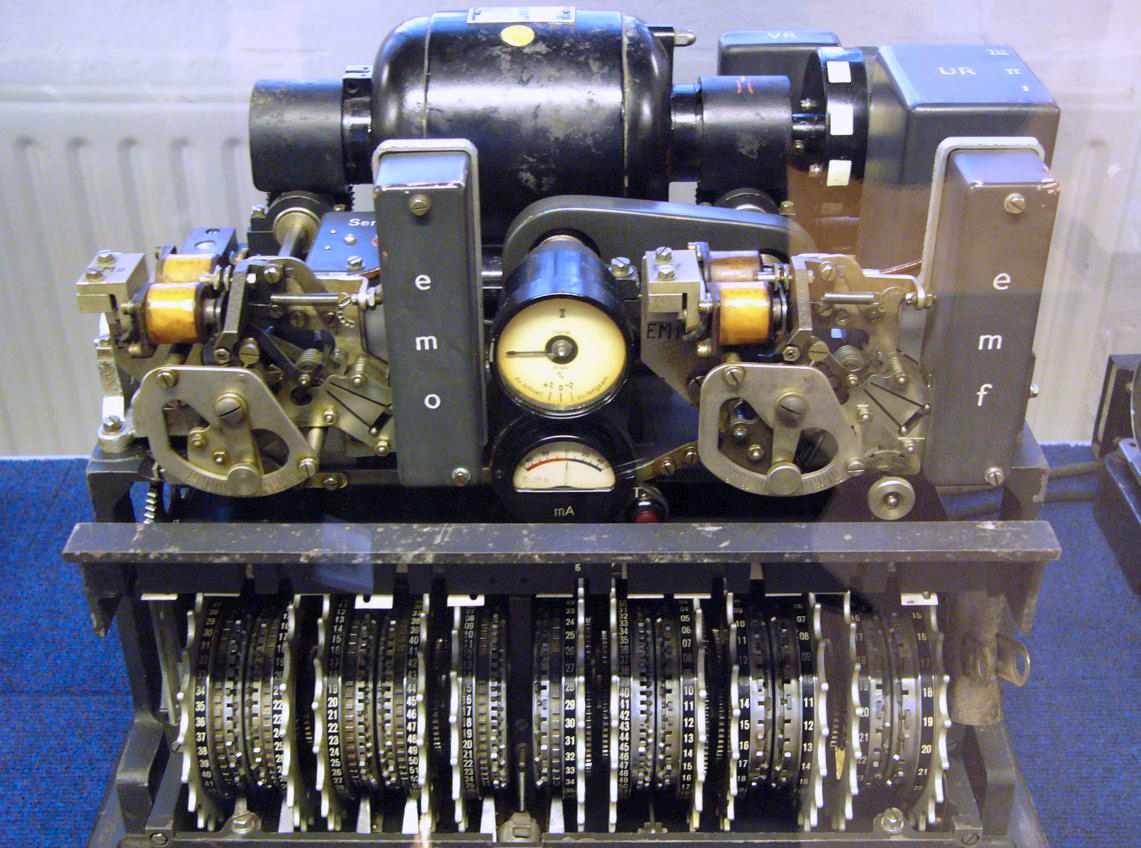
And here’s the comparison that matters: at Bletchley Park, cracking the related Lorenz SZ40/42 cipher (codenamed “Tunny”) required a team of brilliant mathematicians working for months, plus the construction of Colossus – the world’s first programmable electronic computer. Bill Tutte performed the theoretical break; Tommy Flowers built the machine to make it operational. It was a monumental team effort across years.
Beurling did something comparable. Alone. In a fortnight. With a pencil.
“A Magician Does Not Reveal His Secrets”
In later years, when colleagues and historians asked Beurling how he had accomplished the feat, he gave his legendary reply:
“A magician does not reveal his secrets.”4
He never explained his method. Not in writing, not in conversation, not on his deathbed. His approach apparently combined linguistic analysis (identifying high-frequency German words in the underlying plaintext) with systematic mathematical hypothesis testing, guided by what colleagues described as “an almost preternatural intuition.”4
He took the secret to his grave.
350 000 Messages
350 000 Messages and a Warning Ignored
Beurling’s breakthrough was not a one-time curiosity. It opened a floodgate.
Using his reverse-engineered design, the Swedish company L.M. Ericsson – working through a subsidiary called the Swedish Cash Register Company, for secrecy – manufactured analogue decoding machines. These were essentially rebuilt T52s, designed by engineer Vigo Lindstein based on Beurling’s reconstruction. They were installed at Karlaplan 4 in central Stockholm. Young women sat at teleprinters and typed intercepted ciphertext into the machines, which output German plaintext.
At peak capacity (late 1942), nearly 175 people – almost half of FRA’s workforce – were dedicated to T52 traffic. Daily output reached 678 decrypted messages in a single day (October 1943). Over three years, Sweden intercepted approximately 500 000 German messages and successfully read 350 000 of them.
The intelligence was extraordinary. In the spring of 1941, Sweden became the first nation besides Germany to possess intelligence about the planned invasion of the Soviet Union – Operation Barbarossa. The warning was passed to Britain, which passed it to Stalin. Stalin dismissed it. Partly because the source could not be revealed without compromising Swedish signals intelligence. Partly because Stalin dismissed everything.
FRA – the Försvarets radioanstalt, formally established on 1 July 1942 – built an entire operational infrastructure around Beurling’s breakthrough. And when the T52 was upgraded to more secure versions (the T52c, T52ca, T52d), Swedish cryptanalysts – building on Beurling’s foundation – cracked several of these too. In April 1943, FRA even broke the Lorenz SZ40 – the same family of cipher that Bletchley Park needed Colossus to crack.
The secret eventually leaked through two channels – a Soviet agent named Allan Nyblad, and a Finnish colonel named Stewen who told the Germans. FRA intercepted a German message that read, with chilling clarity: “These messages are decrypted in Sweden.”4 By mid-1943, the Germans had upgraded the machine beyond Swedish reach and the window closed.
But Beurling himself was not there to see the end of it. In spring 1942, his explosive temperament caught up with him. Conflicts with FRA management led to his dismissal from the code-breaking effort. The magician was shown the door.
The Poles Who Did It First
Beurling was not the first mathematician to break an “unbreakable” cipher with a pencil. Eight years before his triumph, three Polish mathematicians at the Biuro Szyfrów (Cipher Bureau) in Warsaw had done something even more extraordinary.
In December 1932, Marian Rejewski – a 27-year-old from Bydgoszcz – cracked the German military Enigma. He applied permutation group theory to cryptanalysis, the first time anyone had used pure mathematics for code-breaking. Together with Jerzy Różycki and Henryk Zygalski, he read German Enigma traffic through most of the 1930s. They built the bomba kryptologiczna – the first electromechanical cryptanalytic machine in history – and in July 1939, five weeks before Germany invaded their country, they handed everything to the British and French at a secret meeting in the Pyry forest near Warsaw. Turing’s Bombe was directly inspired by the Polish bomba.
The Biuro Szyfrów made one revolutionary decision that enabled all of this: they recruited mathematicians from Poznań University rather than linguists. Every code-breaking bureau in the world hired language experts. The Poles hired mathematicians. That single choice changed the course of the war.
The parallels with Beurling are haunting. Small countries. Pure mathematics. Pencils before machines. And both stories were buried for decades – overshadowed by Bletchley Park, which got all the credit.
The Polish codebreakers – Rejewski, Różycki, Zygalski – and the price they paid for being right too early and too quietly: that story is personal for me.
From Ciphers to Computers
After his dismissal from FRA, Beurling continued his mathematical career at Uppsala. In 1948-49 he was a visiting professor at Harvard. Then, in 1954, the Institute for Advanced Study at Princeton offered him a permanent professorship.
He accepted. He moved to New Jersey. And eventually, he moved into Albert Einstein’s former office.
Think about that for a moment. The man who cracked the Geheimschreiber with a pencil, sitting in the office where Einstein had worked out general relativity. Two minds that saw the world differently from everyone else, separated by a generation, connected by a room.
At Princeton, Beurling continued his mathematical work – the deep, structural kind that few people in the world could follow. With Paul Malliavin during 1960-61, he proved the Beurling-Malliavin theorem, solving a problem in harmonic analysis that had resisted decades of attack. Malliavin described their working method: “We devoted half of the academic year to this problem; very often I stayed at Beurling’s house for a full night of cooperative work.”5 Karin Beurling, Arne’s second wife – herself an accomplished Uppsala PhD who worked in a biochemistry lab at Princeton – prepared meals during these marathon sessions. The result has been called “one of the most celebrated results of 20th-century harmonic analysis.”5
Beurling never returned to cryptography. He never needed to. His mathematical legacy – the Beurling-Lax theorem on invariant subspaces, Beurling generalized primes, the Beurling-Ahlfors theorem on quasiconformal mappings, the Dirichlet spaces theory with Deny – was more than enough for one lifetime. Malliavin offered a paradox about Beurling’s approach: though he always started with “hard concrete problems” and sought “elementary and transparent” proofs, he repeatedly uncovered “basic general principles of universal applicability.”5 The man who refused to generalize kept discovering the general.
The Friendship
Beurling’s closest friend was Lars Ahlfors, the Finnish Fields Medal winner – one of the first two ever awarded, in 1936.
Their friendship spanned half a century, from a 1934 meeting at the Scandinavian Congress of Mathematicians to Ahlfors’ eulogy at Beurling’s memorial. The deepest moment came during wartime. When Ahlfors fled Finland in 1944, Finnish exit regulations allowed him to take only ten Swedish kronor – not enough for train fare from Stockholm to Kungsbacka on the west coast, where his family waited. In desperation, Ahlfors pawned his Fields Medal. In his own words: “I smuggled out my Fields Medal, and I pawned it in the pawn shop and got enough money. I had no other way.”6 He added: “I’m sure that it’s the only Fields Medal that has been in a pawn shop.”6
Beurling immediately arranged a position for Ahlfors at Uppsala, providing housing, office space, and teaching duties. With the Uppsala salary, Ahlfors recovered the medal.
Then tragedy struck. While in Sweden, Ahlfors’ young son Christoffer died from an electric shock while playing at home. Ahlfors was on a lecture visit to Uppsala and heard the news first from Beurling. He later wrote: “Never in my life have I witnessed anybody handle such a difficult assignment with greater tact and compassion. It seemed to me that Arne’s extraordinary sensitivity had raised our friendship to a level that I had not experienced before.”1
Forty years later, when Beurling died in 1986, Ahlfors opened his eulogy with the words: “Arne Beurling was the best friend I ever had.”1 And: “There was a streak of genius in everything he did.”1
Beurling’s most famous student, Lennart Carleson, won the Abel Prize in 2006 – mathematics’ equivalent of the Nobel. Carleson said: “It was my great fortune to have been introduced to mathematics by Arne Beurling.”1
The Thread to BESK
And here is where the story connects back to yesterday’s post.
Beurling’s wartime code-breaking created FRA. FRA needed computing power for continued cryptanalysis after the war. FRA became the most urgent institutional customer driving the creation of BARK and then BESK. Stig Comet – who was simultaneously BESK project leader and FRA bureau chief – personally ran the nightly code-breaking sessions on BESK under the strictest secrecy.
And BESK, running during the daytime, produced the world’s first operational numerical weather forecasts.
The chain runs: Beurling’s pencil → FRA → BESK → the weather.
A mathematician who cracked ciphers with intuition and aesthetics created the institutional demand for the computer that predicted the weather. He never touched BESK himself – by 1954 he was at Princeton, in Einstein’s office. But without his two weeks in 1940, Sweden might not have built the machine at all.
The Magician’s Grave
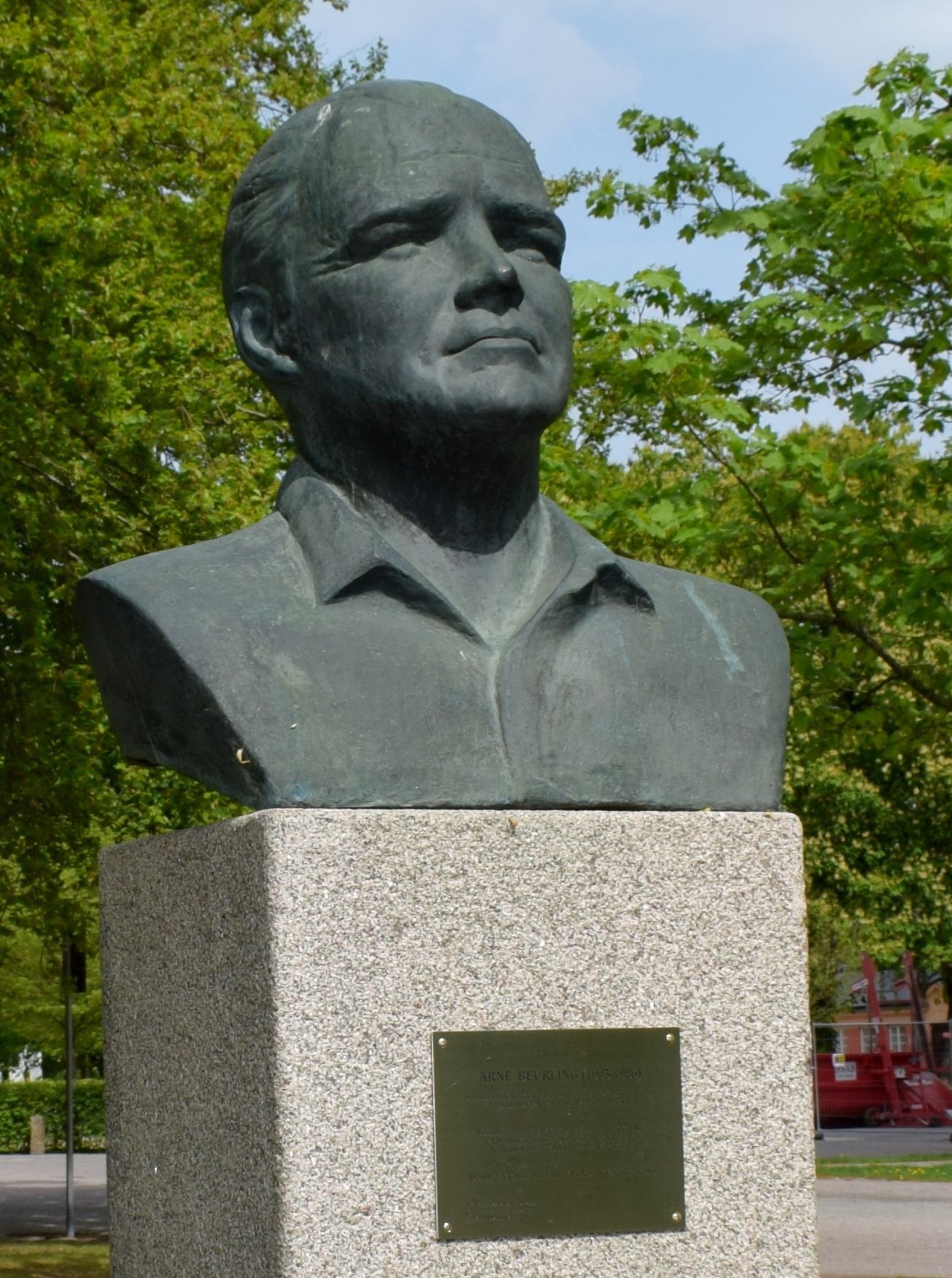
Beurling died in Princeton in 1986. He was buried at Norra begravningsplatsen in Solna, Sweden – home. His unpublished mathematical works were collected and published posthumously by Carleson and others in 1989.
There is a memorial to him in Uppsala. There is a short opera about him (Krypto CEG, 2005). Bengt Beckman, the former head of FRA’s cryptanalytical section, told the full story in his 2002 book Codebreakers: Arne Beurling and the Swedish Crypto Program During World War II.
But mostly, there is silence. The magician does not reveal his secrets. And the world has mostly not asked.
Some magicians are forgotten. Some are remembered too late. And some – like Beurling – changed the world with a pencil and were thanked with silence.
Footnotes
References
Beurling:
- Beckman, B. (2002). Codebreakers: Arne Beurling and the Swedish Crypto Program During World War II. AMS. Bookstore
- Ahlfors, L. & Carleson, L. (1988). Arne Beurling in memoriam. Acta Mathematica, 161. PDF
- Malliavin, P. (1997). “Arne Beurling – a mathematician’s sorcerer.” Tribute reprinted in Beurling’s Collected Works, Birkhauser.
- Lehto, O. (1998). Mathematics Without Borders: A History of the International Mathematical Union. Springer.
- Uppsala University. Arne Beurling
- Institute for Advanced Study. Arne K. Beurling
- IVA. Arne Beurling memorial publication (2022). PDF
Geheimschreiber:
- Kahn, D. (1996). The Codebreakers (revised ed.). Scribner.
- Bauer, F. L. (2003). Review of Codebreakers. Notices of the AMS. PDF
- Weierud, F. Rebirth of a Sturgeon. Rutherford Journal.
- Crypto Museum. Siemens T52e Technical Description
- Wikipedia. Siemens and Halske T52
Polish Codebreakers:
- Rejewski, M. (1981). How Polish Mathematicians Deciphered the Enigma. IEEE Annals of the History of Computing, 3(3), 213-234.
- Kozaczuk, W. (1984). Enigma: How the German Machine Cipher Was Broken, and How It Was Read by the Allies in World War Two. University Publications of America.
- Singh, S. (1999). The Code Book. Fourth Estate. (Chapter on Polish contribution.)
- Hodges, A. (1983). Alan Turing: The Enigma. Simon & Schuster. (Turing’s acknowledgment of Polish work.)
- JSTOR Daily. The Polish Codebreakers Who Cracked the Enigma Machine
- Enigma Cipher Centre, Poznań. centrum-szyfrów.pl
Image Credits:
- Beurling portrait (1940s): TT News Agency. Public domain in Sweden. Wikimedia Commons
- Geheimschreiber T-52D: National Cryptologic Museum, on loan from Sweden. Public domain. Wikimedia Commons
- Lorenz SZ42: Matt Crypto, Bletchley Park. Public domain. Wikimedia Commons
- Beurling memorial, Uppsala: Joshua06. CC BY-SA 4.0. Wikimedia Commons
Current status:
- The Geheimschreiber: Cracked in two weeks. With a pencil. By one man.
- The Enigma: Cracked by three Polish mathematicians in 1932. That story is coming.
- Bletchley Park: Built Colossus and the Bombe. Got all the credit. As usual.
- The magician: Died in Einstein’s office. Still not explaining how he did it.
- My cluster: Still can’t crack anything. But it runs weather models. And that’s Beurling’s fault too.
Yours Truly
-
Ahlfors, L. & Carleson, L. (1988). “Arne Beurling in memoriam.” Acta Mathematica, 161. PDF. ↩ ↩2 ↩3 ↩4 ↩5 ↩6 ↩7 ↩8 ↩9 ↩10 ↩11 ↩12 ↩13 ↩14
-
Kahn, D. (1996). The Codebreakers (revised ed.). Scribner, pp. 484-485. ↩
-
Bauer, F. L. (2003). Review of Codebreakers: Arne Beurling and the Swedish Crypto Program During World War II. Notices of the AMS, 50(8), 929-933. PDF. ↩
-
Beckman, B. (2002). Codebreakers: Arne Beurling and the Swedish Crypto Program During World War II. American Mathematical Society. ↩ ↩2 ↩3 ↩4
-
Malliavin, P. (1997). “Arne Beurling – a mathematician’s sorcerer.” Memorial tribute. Reprinted in Beurling’s Collected Works. See also Ahlfors & Carleson (1988), Acta Mathematica, 161. ↩ ↩2 ↩3
-
Lehto, O. (1998). Mathematics Without Borders: A History of the International Mathematical Union. Springer. Ahlfors’ own telling of the pawnshop anecdote is also recorded in the interview “Interview with Lars V. Ahlfors,” in Mathematical People, ed. Albers & Alexanderson, Birkhauser, 1985. ↩ ↩2