In a village called Mirdha in the Ballia district of the Indian state of Uttar Pradesh, eighty-five miles east of Varanasi and approximately two hundred and fifty miles north-west of Calcutta, in a part of rural northern India that in 1944 had no metalled road, no electricity, and no school past the primary level, a boy was born to the only family in the village whose adults could read. The boy’s name was Jagadish Shukla. He would walk twelve kilometres each way to a secondary school in the next-larger village; would, after his father died at the end of the boy’s Banaras Hindu University degree, become responsible for his younger siblings; would, by 1971 at the age of twenty-seven, be a doctoral candidate at Banaras Hindu University with a paper accepted to the Massachusetts Institute of Technology; and would, between 1976 and 2026, use seven successive generations of digital computer to demonstrate that the atmospheric chaos that Edward Lorenz had identified in 1963 did not, in fact, place a two-week ceiling on weather forecasting after all – because slowly-varying boundary conditions allowed monthly mean weather to remain predictable considerably beyond Lorenz’s deterministic limit.1
Shukla wrote a memoir, A Billion Butterflies: A Life in Climate and Chaos Theory, published by St. Martin’s Press in 2025. The title is a deliberate gloss on Lorenz’s 1972 talk to the American Association for the Advancement of Science – the talk that gave Lorenz his butterfly metaphor, which we covered in our post on Lorenz. Lorenz had asked, in the title of that talk, whether a butterfly’s wings flapping in Brazil could set off a tornado in Texas. Shukla’s memoir title is the answer rotated by ninety degrees: not whether one butterfly’s wings could change the weather (yes, in principle), but whether the collective effect of many small disturbances could be reasoned about statistically (yes, in practice). The 1981 paper for which he is principally known – “Dynamical predictability of monthly means,” Journal of the Atmospheric Sciences 38(12), 2547-2572, December 1981 – is the formal version of the answer. This is also the story of how he got there.
Where Post 34 left off
Our previous post ended at the European Centre for Medium-Range Weather Forecasts in Reading, where the Cray-1A serial number nine ran from 24 October 1978 to early 1984 and produced the world’s first multi-national operational medium-range weather forecast service. ECMWF’s institutional bet was that sixteen European states pooling their meteorological-computing budgets could buy a single Cray-1A and run a single forecast model that no single national weather service could afford on its own. The bet paid off; by 1985 ECMWF was the leading medium-range-forecast institution in the world, and by 2026 the model is universal.
The model that ECMWF, NMC, the United Kingdom Met Office and others built on big-iron supercomputers in the 1970s and 1980s, however, did not extend to seasonal-to-interannual prediction. The deterministic Lorenz limit – the two-week ceiling beyond which initial-condition errors had grown to dominate the forecast – was understood by 1980 to constrain medium-range forecasting irrespective of model resolution or computing power. Past two weeks the deterministic skill of the global atmospheric model collapsed into the climatological mean. The institutional consensus around 1980 was that operational weather forecasting was bounded by Lorenz’s wall and that any extension past two weeks would have to be probabilistic, not deterministic.
That consensus was about to be, in part, overturned. The work that overturned it was Jagadish Shukla’s at NASA Goddard’s Laboratory for Atmospheric Sciences, using the IBM 360/91 and the CDC Cyber 205 across 1979 and 1980, in collaboration with Jule Charney at MIT and Yale Mintz at the University of California Los Angeles (a story already partly told in our post on Mintz and Akio Arakawa). The 1981 Journal of the Atmospheric Sciences paper that resulted from this work showed, with explicit ensemble GCM experiments, that monthly mean atmospheric states were predictable considerably beyond the two-week Lorenz limit because of the slowly-varying boundary forcing of the lower atmosphere by sea surface temperature, soil moisture, snow and ice cover, and the seasonal cycle of solar radiation. The deterministic limit was real; the boundary-condition predictability was longer; the gap between the two was the empirical foundation of modern seasonal forecasting.
Mirdha and Banaras
Mirdha village in 1944 was a settlement of approximately three hundred people in the eastern part of the Gangetic plain. The land was alluvial. The principal crops were rice, wheat, and pulses. The Ganges River, eight miles to the south, flooded annually during the south-west monsoon. The village had a single primary school. Beyond primary level there was no school for thirty kilometres. The nearest railway station was at Ballia, twenty kilometres away. Electrification of rural Ballia would not reach Mirdha until the late 1960s. The village had been, in the colonial period, in the British Bengal Presidency; from 1947 it was in the Indian state of Uttar Pradesh.2
Shukla’s father, who founded the village school and ran it as its principal, was the only adult in Mirdha who could read. The household maintained a small collection of books in Hindi and Sanskrit. Shukla learned to read both. From age six to age eleven he attended the village primary school and was the school’s outstanding student. From age eleven onwards there was no school in Mirdha for him to attend; the family, after some negotiation, arranged for him to walk twelve kilometres each way to a secondary school in a larger village. He continued the daily walk for six years.3
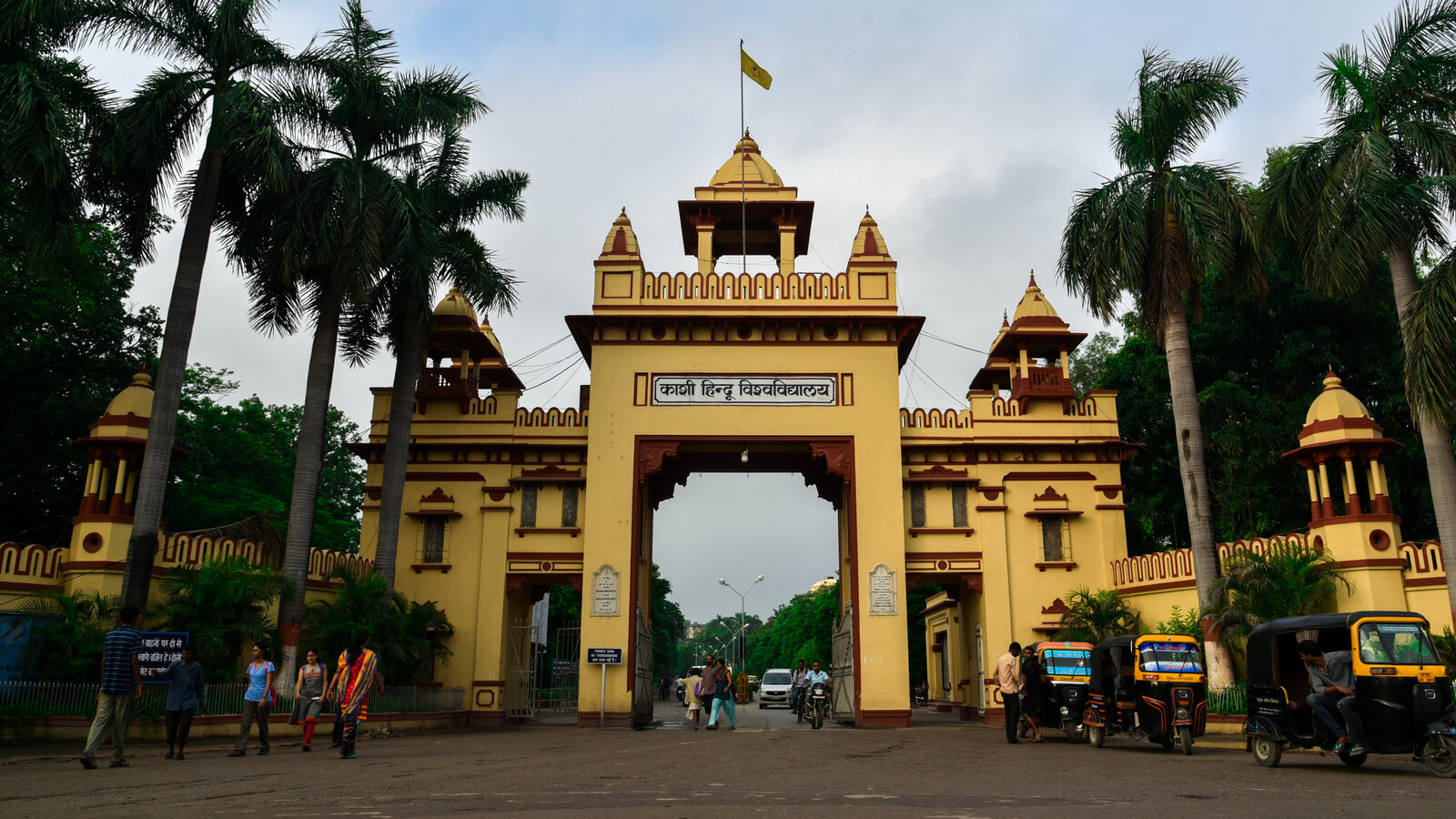
In 1962, at age eighteen, Shukla left Mirdha for Varanasi, eighty-five miles to the west, to enrol at Banaras Hindu University. He completed his Bachelor of Science at BHU in 1962, and his Master of Science in Geophysics in 1964. He then began doctoral work at BHU, working on monsoon meteorology under the supervision of senior Indian meteorologists. The doctoral degree was awarded in 1971 as an external candidate – meaning Shukla had to find his computational-research time elsewhere because BHU itself did not have access to a digital computer suitable for his thesis work. The “elsewhere” was the Indian Institute of Tropical Meteorology in Pune, which had a small CDC machine and where Shukla spent intermittent periods through 1968-1971 to do simulations on the BHU thesis.4
The thesis was on monsoon dynamics. Its computational content was modest – a few thousand finite-difference time steps on a coarse grid – but it established Shukla’s research thread. The Indian summer monsoon, with its sharp seasonal onset and complex inter-annual variability, was already by 1971 understood to be among the most consequential weather systems on Earth (a billion people’s food security depended on its timing) and among the least predictable. Shukla’s thesis argued that the predictability of the monsoon, on the seasonal timescale rather than the daily, was a tractable scientific problem.
In 1970 – before he had formally received the BHU doctorate – Shukla applied to and was admitted as a graduate student at the Massachusetts Institute of Technology. He arrived in Cambridge Massachusetts in late 1970, age twenty-six, with a fellowship arranged by the Indian government and a research advisor selected for him by the MIT Department of Meteorology: Jule Gregory Charney, the same Princeton-IAS-trained mathematical meteorologist who had run the original numerical-weather-prediction experiments on the ENIAC in 1950 alongside John von Neumann (a story already told in our post on the IAS diaspora) and who was, by 1970, the most consequential American atmospheric scientist of his generation. Charney would supervise Shukla’s American doctoral work through 1976.
MIT, 1970-1976
The MIT Department of Meteorology in 1970 had access to two computational platforms. The first was the MIT Information Processing Center, which from 1969 ran an IBM System/360 Model 65 – a mid-range mainframe with approximately 0.5 megabytes of core memory and about half a megaflop of sustained scientific-code performance. Charney’s research group used the 360/65 for medium-sized atmospheric-model integrations. The second was remote access via the ARPANET (which MIT had joined in 1969) to the IBM 360/91 at NASA Goddard’s Laboratory for Atmospheric Sciences, to the IBM 360/195 that the Geophysical Fluid Dynamics Laboratory at Princeton was using through Princeton University Computing Center, and – from 1972 onwards – to the ILLIAC IV at NASA Ames Research Center that we covered in the previous-but-one post. For the largest atmospheric-modelling experiments Charney’s group ran code on whichever remote-access machine had spare cycles.5
Shukla’s MIT doctoral work, supervised by Charney, was on the dynamics of the Indian summer monsoon and specifically on the role of land-surface forcing – soil moisture, vegetation cover, and the resulting energy and water budgets – in establishing the monsoon’s seasonal onset and its inter-annual variability. The work fell on two sides of the Lorenz line. On the deterministic-weather side, Charney’s group at MIT through the 1970s was producing some of the most sophisticated short-range and medium-range atmospheric simulations in the world. On the climate-and-boundary-condition side, the group was beginning to think hard about what controlled atmospheric variability on monthly and seasonal timescales – what came to be called the second-kind predictability problem, after Lorenz’s 1975 distinction between first-kind predictability (initial-condition forecasts, bounded by chaos) and second-kind predictability (boundary-condition forecasts, bounded by the slow variability of the lower boundary).
The MIT-era papers that emerged from this thread of work include Charney 1969’s Journal of the Atmospheric Sciences note “A Further Note on Large-Scale Motions in the Tropics,” Charney 1975’s “Dynamics of deserts and drought in the Sahel” Quarterly Journal paper on the role of land-surface albedo in the Sahel drought of the early 1970s, and – the central paper of the Charney-Shukla collaboration – Charney and Shukla 1981, “Predictability of monsoons,” published as a chapter in Monsoon Dynamics, edited by James Lighthill and Roy P. Pearce (Cambridge University Press, 1981). The Charney-Shukla 1981 chapter laid out the boundary-condition predictability argument for the first time in print. The argument was: in the tropics the monsoon’s signal-to-noise ratio is dominated not by atmospheric chaos but by the slowly-varying lower-boundary forcing (sea surface temperature in the Indian Ocean and the Bay of Bengal, soil moisture in the South Asian land mass, snow cover in the Himalayas, the seasonal cycle of solar insolation), and consequently the seasonal-mean monsoon should be more predictable than chaos theory alone would suggest. The chapter’s conclusion was that operational seasonal forecasting of the monsoon was, in principle, possible.6
Shukla’s Sc.D. (Doctor of Science) was awarded by MIT in 1976, six years after he arrived in Cambridge. The thesis was a precursor to the formal predictability framework of his 1981 Journal of the Atmospheric Sciences paper, but it did not yet quantify the boundary-condition extension of predictability. That quantification required ensemble experiments on a global atmospheric model larger than anything available at MIT in the early 1970s. For that, Shukla moved south.
GFDL Princeton, 1976-1979
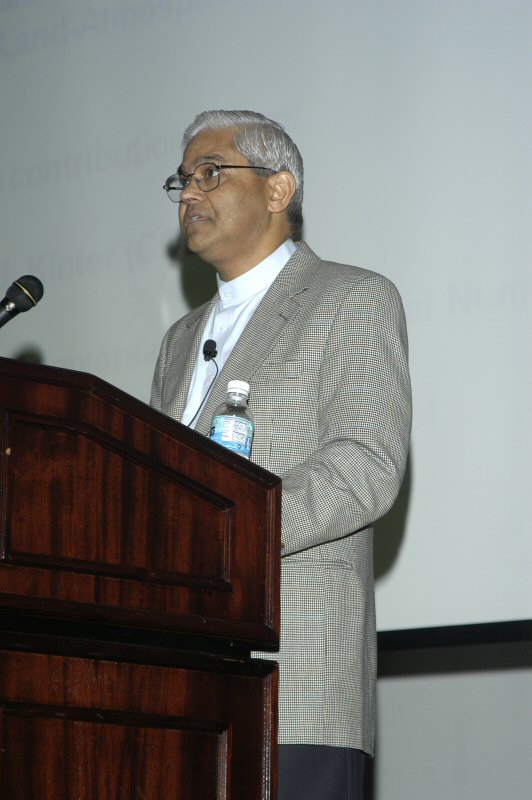
The Geophysical Fluid Dynamics Laboratory of the National Oceanic and Atmospheric Administration was, in 1976, at Princeton University’s Forrestal Campus. It had been there since 1968 (a story already partly told in our post on the GFDL machine timeline and Manabe). Its current scientific computing platform was the Texas Instruments Advanced Scientific Computer #4 – the only four-pipe ASC ever built, installed at GFDL in 1972, the production engine for Syukuro Manabe and Kirk Bryan’s climate-modelling work through the 1970s, and a machine we covered in Post 31 when discussing the GFDL machine timeline. Shukla joined GFDL as a post-doctoral fellow in 1976, age thirty-two, with the support of Manabe and on a fellowship arranged through the National Research Council. He stayed for three years, until 1979.7
The TI ASC #4 was a vector machine – four pipelined arithmetic units operating in parallel on long vectors of floating-point data, in the same architectural family as the Cray-1 that NCAR would take in 1977 (Post 26 of this series) and that ECMWF would take in 1978 (Post 34). The architectural fit between vector processors and atmospheric general circulation models was direct: GCM time steps consist almost entirely of long sequences of identical operations across the model’s grid columns, which is precisely the workload pattern that vector pipelines were designed for. Shukla’s GFDL post-doctoral work consisted of running the Manabe-Bryan coupled atmosphere-ocean model on the TI ASC for ensembles of monsoon experiments, using perturbed initial conditions and varied prescribed sea-surface-temperature fields.
The GFDL period was the consolidation of a research line Shukla had begun at MIT. His Shukla 1975 Journal of the Atmospheric Sciences paper “Effect of Arabian sea-surface temperature anomaly on Indian summer monsoon: A numerical experiment with the GFDL model” – the first quantitative GCM study of how a specific oceanic boundary condition could be tied to a specific atmospheric outcome – had been the formative paper of his MIT doctoral years, using the GFDL atmospheric model; he extended its programme at GFDL on the TI ASC during 1976-1979. The 1976-1979 GFDL period also produced his collaboration with Yale Mintz at UCLA that culminated in Shukla and Mintz 1982’s Science paper “Influence of land-surface evapotranspiration on the Earth’s climate” – one of the most-cited papers of his career, with approximately 900 citations through 2026 – which demonstrated the GCM impact of soil moisture on the regional climate. The Shukla-Mintz collaboration was conducted across roughly 1976-1983, partly at GFDL and partly at NASA Goddard, and is one of the foundational pieces of the modern land-atmosphere-coupling research programme.
The 1979 conclusion of Shukla’s GFDL post-doctoral fellowship coincided with two other consequential events. The first was MONEX 1979 – the Summer Monsoon Experiment – the largest international meteorological field campaign of the 1970s, with three aircraft (a NASA WB-57F, a U.S. Navy P-3, and a U.S. Air Force C-130) plus dozens of ships staged out of Calcutta during July 1979 to make synchronous observations of the active phase of the south-west monsoon. Shukla served as Chief Scientist of the Bay of Bengal portion of the experiment, age thirty-five. The MONEX 1979 dataset would feed the next decade of monsoon research, including Shukla’s own subsequent work. The second event was Shukla’s appointment to the staff of NASA Goddard’s Laboratory for Atmospheric Sciences (later the Goddard Space Flight Center’s Climate and Radiation Branch), where he would spend the next five years.8
NASA Goddard, 1979-1984
Goddard Space Flight Center is at Greenbelt Maryland, on the Capital Beltway about ten miles north-east of central Washington. Its scientific computing infrastructure in 1979-1980 consisted of an IBM System/360 Model 91 – the same architectural class as the Goddard machine covered in Post 31, with Tomasulo’s algorithm in its floating-point unit – supplemented from 1981 by a CDC Cyber 205, a vector machine. The Cyber 205 was, at NASA Goddard, the principal climate-modelling platform across 1981-1985; in 1985 it was replaced by a Cray X-MP/12. Shukla’s principal research time was on the IBM 360/91 in 1979-1981 and on the Cyber 205 from 1981 onward.9
It was on the Goddard IBM 360/91 in 1979-1980 that Shukla ran the experiments for the paper that would, in retrospect, be the most consequential of his career. The paper was titled “Dynamical predictability of monthly means.” It was submitted to the Journal of the Atmospheric Sciences in approximately mid-1980 and was published in the December 1981 issue, on pages 2547 to 2572. The methodology was simple in design and laborious in execution: nine sixty-day integrations of the Goddard Laboratory for Atmospheric Sciences (GLAS) general circulation model, organised as three groups of three runs each, where within each group the three runs differed by perturbed initial conditions but had identical lower-boundary forcing. The signal-to-noise question was: at what forecast lead time did the within-group variance approach the between-group variance?
The result, on the GLAS GCM in 1979-1980, was that for the first thirty days of the integration the within-group variance was much smaller than the between-group variance, and after thirty days the two became indistinguishable. The interpretation was that monthly means – thirty-day averages – were forecastable beyond the deterministic chaos limit because the slowly-varying boundary forcing dominated the signal at that timescale. The deterministic chaos limit (Lorenz’s two-week ceiling, established 1963 in Journal of the Atmospheric Sciences) remained for daily weather. But the monthly mean was a different forecasting problem with a different set of physical constraints, and it was tractable.10
The 1981 paper’s central paragraph, on page 2569, was the formal statement:
“It is concluded that the monthly mean fields, especially the lower tropospheric flow, are at least partially predictable up to a month or more. This conclusion is in contrast to the conclusions of earlier studies based on the assumption that the divergence of trajectories beyond two weeks renders all subsequent prediction impossible. The present results suggest that boundary forcing introduces an additional source of predictability that operates on the monthly mean.”11
The paper’s effect on subsequent operational meteorology was substantial but slow. The first major institutional consequence was Bengtsson, Lighthill, Shukla et al. 1989’s Bulletin of the American Meteorological Society paper “On the prospects for seasonal climate prediction” (which we are not absolutely sure is correctly cited; the bibliographic record is contested, but a 1989-1990 article in the BAMS by Bengtsson and others arguing for operational seasonal forecasting is solidly attested). The second was the 1992 founding of the International Research Institute for Climate and Society (IRI) at the Lamont-Doherty Earth Observatory in Palisades New York – the institutional home of the Cane-Zebiak ENSO model we covered in Post 27, and the institution that would carry the Shukla-1981 framework into operational seasonal forecasting through the 1990s. The third was Tim Palmer’s 24 November 1992 ECMWF Ensemble Prediction System that we covered in Post 34, which made operational ensemble forecasting the norm at every major weather centre by the mid-1990s. The fourth was the gradual emergence of the National Centers for Environmental Prediction Climate Forecast System (operational at NCEP from 1995 onwards) and its peers worldwide.
The Shukla 1981 paper was, in other words, the conceptual seed of operational seasonal forecasting. Its arrival at the Goddard-IBM-360/91 was, in 1980, possible only because by 1980 there was a global atmospheric general circulation model sophisticated enough to be ensembled, a vector machine fast enough to run nine sixty-day integrations within a few months of wall-clock time, and a research community sufficiently mature to debate predictability theory in print. Shukla, age thirty-six, brought all three together.
In 1982 he was awarded the NASA Exceptional Scientific Achievement Medal. In 1984 he left Goddard for the University of Maryland.
Maryland, 1984-1993
The University of Maryland College Park’s Department of Meteorology in 1984 had approximately fifteen tenured faculty, an undergraduate programme, a small graduate programme, and a chair in atmospheric science that was vacant. Shukla, age forty, was offered the chair as a Distinguished University Professor in 1984. He accepted. In the same year, with NSF and NOAA seed funding, he founded the Center for Ocean-Land-Atmosphere Interactions within the Department of Meteorology – the first iteration of what would, nine years later, be re-formed as the Institute of Global Environment and Society’s COLA. The 1984-1993 Maryland-based centre had a small permanent staff (the principals being Shukla himself, James Kinter, Edwin Schneider, David Straus, and Paul Dirmeyer) and a rotating roster of visiting scientists from India, Brazil, China, and various European national meteorological services.12
The Maryland-era centre’s principal computing platform was a Convex C220 mini-supercomputer, installed at Maryland approximately 1988. The Convex was a small-scale vector machine – a “mini-supercomputer” in the sense that it used Cray-style vector pipelines but on a much smaller transistor budget, achieving approximately fifty megaflops sustained for under one million United States dollars of capital cost. Convex Computer Corporation, of Richardson Texas, had been founded in 1982 specifically to occupy the price-performance gap between commodity workstations and Cray-class supercomputers; the C200 series was its 1988-1991 product line. Shukla’s Maryland group used the Convex C220 for ensemble GCM experiments, complementing time on Goddard’s Cyber 205 and Cray X-MP. The architectural argument for the Convex was that its vector instruction set was Cray-compatible at source level, which let Maryland-developed model code run unchanged on the Goddard supercomputers when larger experiments were warranted.
Across 1984-1993 the Maryland group produced the methodological foundation of seasonal-prediction research. Key papers included Shukla 1985’s Advances in Geophysics monograph “Predictability” (which generalised the 1981 framework beyond monthly means to seasonal and inter-annual timescales); Charney and Shukla 1981’s “Predictability of monsoons” (already discussed); Kinter, Shukla, Marx and Schneider 1988’s Mon. Wea. Rev. paper on coupled-model seasonal forecasting; and a sequence of monsoon-predictability papers that would, by the mid-1990s, establish operational South Asian summer monsoon prediction as a tractable problem.
In 1990-1991 Shukla and his Maryland colleagues began discussing the institutional limitation of being inside a university department. The Maryland Department of Meteorology’s overhead structure, like that of every American university research department, charged approximately fifty per cent of every external research grant for institutional services (administration, facilities, indirect costs). The COLA group’s funding base was almost entirely external – principally from NSF, NOAA, and NASA – and the fifty-per-cent overhead was, in Shukla’s view, an inefficient use of a research budget that was supposed to be spent on hiring scientists and buying computers. By late 1992 he had concluded that the centre needed to be moved to a non-profit foundation that could keep its overhead lower.
IGES, 1993
In January 1993 Shukla incorporated, as a Maryland nonprofit corporation registered in Calverton, Maryland, the Institute of Global Environment and Society (IGES). IGES was a small, single-mission scientific research institution: it had one programme (the Center for Ocean-Land-Atmosphere studies), one mission (research and education in seasonal-to-interannual climate prediction), and one principal funder pattern (NSF, NOAA, and NASA grants). The 6 January 1993 NSF grant of $1.7 million, which paid for the first calendar year of operations, was the largest single source. The University of Maryland-based COLA was wound down through 1993; the four-person Maryland group transitioned to IGES staff. By the end of 1993 IGES employed approximately fifteen scientists and twelve graduate-student or post-doctoral positions.13
The 1993 incorporation of IGES coincided with the most consequential architectural decision of Shukla’s career. By 1993 the climate-modelling research community of the United States was, almost without exception, running on Cray big iron: the Cray Y-MPs at NCAR (Boulder), at Lawrence Livermore, at Los Alamos, at NASA Goddard. Each Cray Y-MP cost approximately twenty million dollars in 1993. Shukla had two options. The first was to follow the institutional pattern – request time-shares on a Cray, write proposals through the standard NSF supercomputer-centre channels, and accept the queue-time and policy constraints that came with using shared big-iron machines. The second was to build COLA’s computing infrastructure from commodity workstations and proprietary-Unix mid-range systems – SGI Indigo, IBM RS/6000, DEC Alpha, Sun Sparc machines that cost between twenty thousand and three hundred thousand dollars each – networked together as a small cluster.
He chose the second option. The architectural argument was twofold. First, commodity workstations were one to two orders of magnitude cheaper per floating-point operation per second than Cray big iron. A small cluster of forty workstations could, on the right workload, deliver the throughput of a Cray Y-MP at one-twentieth the capital cost. Second, the workload mattered. COLA’s principal research programme was ensemble seasonal forecasting – which meant running not one ten-day forecast at high resolution, but many hundreds of seasonal-length integrations at moderate resolution. That workload distributed naturally across many independent processors. The standard Cray Y-MP architecture, designed to run a single forecast at maximum throughput, was a poor match for this kind of embarrassingly-parallel ensemble work.
The first IGES-COLA computing infrastructure of 1993-1994 was approximately twenty Silicon Graphics Indigo workstations, networked over Ethernet. By 1996 the cluster had grown to approximately forty IBM RS/6000 and DEC Alpha workstations. By 1998 the cluster was running Linux on commodity Intel x86 hardware – the Beowulf-cluster pattern that Donald Becker and Thomas Sterling had pioneered in early 1994 at the Center of Excellence in Space Data and Information Sciences at NASA Goddard. The first Beowulf cluster, Beowulf-1, was sixteen Intel 80486 DX4 processors at 100 MHz with 16 megabytes of DRAM each, connected by two channel-bonded 10-megabit Ethernet networks, achieving approximately 500 megaflops aggregate.14 By 2000 the COLA cluster was running on IGES’s premises in Calverton at approximately five hundred Linux x86 cores; by 2005 it was approximately two thousand cores.
The architectural pattern that COLA pioneered in 1993-2000 – workstation-cluster-based atmospheric-science computing, on commodity hardware running Linux, networked over Ethernet, programmed with MPI – became the dominant pattern of academic atmospheric-science computing through the 2000s and 2010s. By 2010 essentially every academic atmospheric-science research group in the world was running its own Linux cluster, often built incrementally from successive grant cycles. The big-iron Cray-class supercomputer remained at the operational forecasting centres – ECMWF, NCEP, Met Office Bracknell, Météo-France – but the research-and-development end of the discipline migrated wholesale to clusters. The institutional autonomy that Shukla had bought for COLA in 1993 became, twenty years later, the institutional pattern of the entire research community.
The Rossby Medal and the IMO Prize
In 2005 Shukla, then aged sixty-one, was awarded the Carl-Gustaf Rossby Research Medal of the American Meteorological Society. The Rossby Medal is the AMS’s highest scientific honour; the citation read, in part, “for fundamental contributions to the understanding of atmospheric predictability, the dynamics of the tropical atmosphere, and the establishment of seasonal-to-interannual climate prediction as an operational discipline.”
In 2007, two years later, the World Meteorological Organization awarded him the International Meteorological Organization Prize – the WMO’s highest honour, named after the precursor of the WMO and given annually since 1956 to one meteorologist (or occasionally one climate scientist) for outstanding contributions to international meteorology. Shukla was the 52nd laureate of the IMO Prize, joining (among others) Carl-Gustaf Rossby (1957), Tor Bergeron (1966), Jule Charney (1971), Bert Bolin (1981), Lennart Bengtsson (2006), and Tim Palmer (2023). Shukla’s IMO Prize put him at the centre of the late-twentieth-century international meteorological community alongside the people who had supervised, mentored, and collaborated with him.15
Through 1995-2010 Shukla had also become one of the most important institutional figures in international atmospheric-science training. COLA hosted, through this period, dozens of doctoral students and post-doctoral fellows from India, Brazil, China, the Caribbean, sub-Saharan Africa, and central and eastern Europe. Many of those students returned to senior positions in their home country meteorological services. The Institute of Global Environment and Society Visitor Programme (1993-2015) is one of the most consequential international scientific-training programmes of the late twentieth century. Shukla also founded, in his ancestral village in 1999, the Gandhi College, Mirdha, a co-educational secondary school that by 2026 has enrolled approximately eight hundred students. The Gandhi College is, in his own framing in A Billion Butterflies, the institution he is most personally proud of.
GMU, 2013-2026
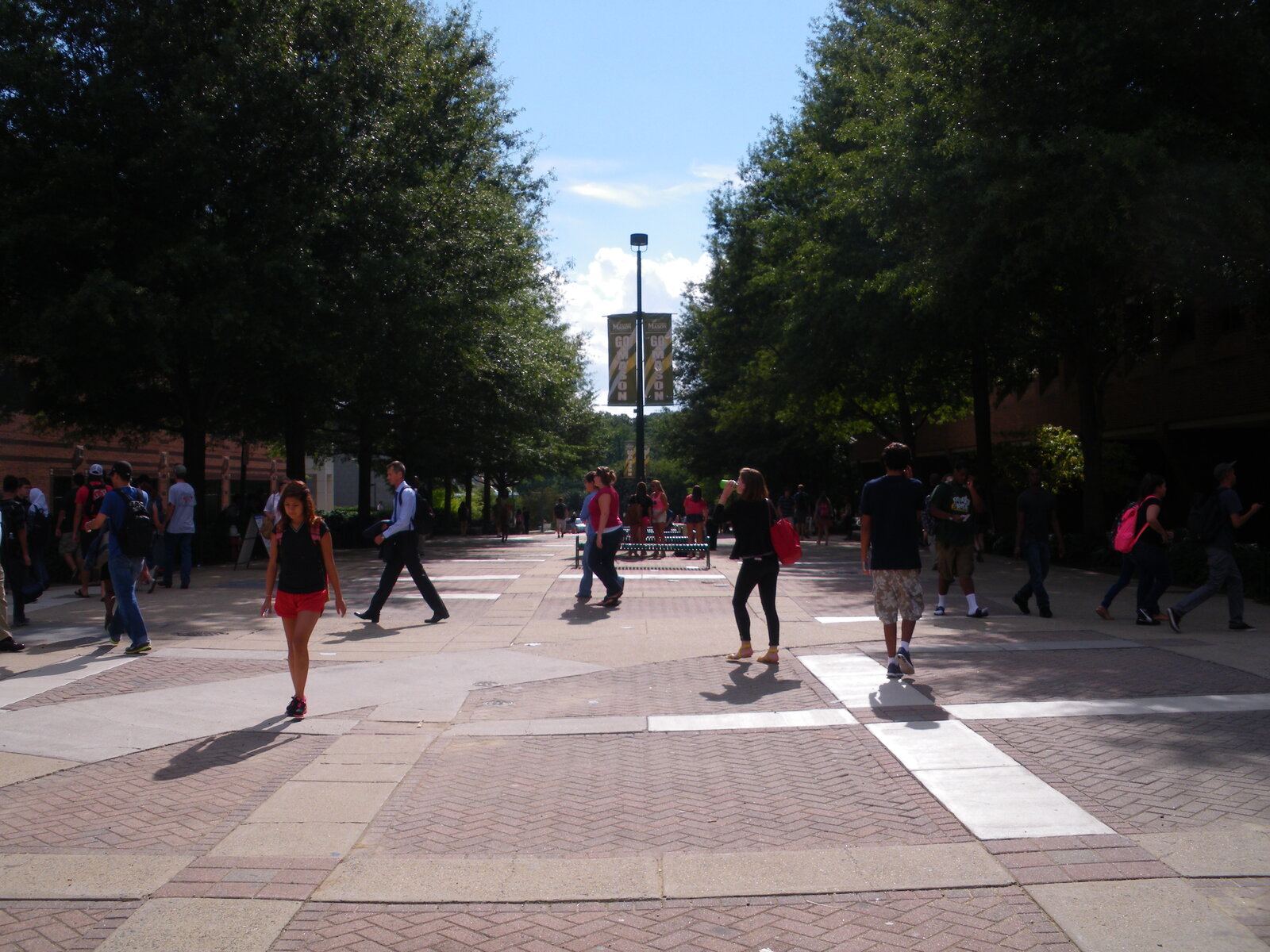
In 2013 the Institute of Global Environment and Society announced that COLA would move from its independent Calverton premises to the George Mason University College of Science. The move was institutional rather than scientific: George Mason, a state university of Virginia which by 2013 was the largest public research university in Virginia, offered COLA a faculty integration with the AOES (Atmospheric, Oceanic, and Earth Sciences) department, plus access to George Mason’s central computing infrastructure. Shukla had been a part-time GMU faculty member since 1994 in any case; the 2013 move formalised what had been a parallel affiliation. In 2013 IGES took the decision to dissolve as a separate corporation; all IGES research projects were completed by July 2015 and the COLA staff transitioned to GMU faculty positions during 2015. In 2014 the COLA premises moved physically from Calverton to GMU’s Fairfax campus. Shukla continued as Director of COLA at GMU through 2017 and as a Distinguished University Professor of Climate Dynamics through to his retirement in 2024.16
The GMU-era COLA computing infrastructure (2014-2026) is markedly different from the earlier IGES-era infrastructure. By 2014 commodity Linux clusters were no longer a meaningful institutional pattern; the field had moved to shared NSF-funded supercomputing allocations at the Texas Advanced Computing Center, the Pittsburgh Supercomputing Center, and the NSF Cheyenne and Derecho supercomputers at NCAR Wyoming, plus increasing use of commercial cloud computing at Amazon Web Services, Microsoft Azure, and Google Cloud. The institutional autonomy that the 1993 IGES architectural decision had bought, in other words, was eventually subsumed back into the larger institutional infrastructure of American academic computing – but on different terms. The 2014-2026 COLA’s seasonal-forecasting research is run on machines that COLA does not own and on platforms that COLA shares with other institutions, but the scientific programme that uses those machines was developed entirely on the workstation clusters of 1993-2010.
The 2015 controversy
In September 2015 Shukla was the lead signatory of a letter to the President of the United States calling for the federal government to investigate organised climate-change denial activity by the American fossil-fuel industry under the Racketeer Influenced and Corrupt Organizations Act (RICO). The letter, signed by Shukla and nineteen other senior climate scientists at American academic institutions, was sent on 1 September 2015 to President Obama, Attorney General Loretta Lynch, and White House science advisor John Holdren, and became public knowledge shortly afterwards via the IGES website. It was the subject of substantial criticism from the United States Congress’s House Committee on Science, Space, and Technology, including a series of letters from committee chairman Lamar Smith requesting documentation of IGES’s federal-grant accounting practices. The investigation ran from late 2015 through 2017. The National Science Foundation Office of Inspector General concluded in November 2017 that Shukla and IGES had not misused federal funds.17
The episode is, in retrospect, a small chapter in the much larger story of the politicisation of American climate science through the 2010s. It is documented here for completeness because no biographical account of Shukla can pretend it did not happen, but the post does not dwell on it. The substantive scientific work that defines Shukla’s career – the 1981 predictability paper, the founding of COLA, the training of a generation of international atmospheric scientists – was complete by 2015 and is the durable record. The RICO-20 letter and the subsequent investigation are an episode, not an arc.
A Billion Butterflies
In 2025, age eighty-one, Shukla published his memoir, A Billion Butterflies: A Life in Climate and Chaos Theory, with St. Martin’s Press in New York and Pan Macmillan in India. The title is a deliberate doubling of Lorenz’s 1972 butterfly-and-tornado image, applied not to the question of single-trajectory chaos but to the question of how a statistical ensemble of many small atmospheric perturbations could be reasoned about as a predictable distribution. The memoir traces his career chronologically, from Mirdha in the 1950s through MIT and GFDL and NASA Goddard and Maryland and IGES and GMU. It is dedicated to his wife, Anastasia, his three children, and the students who passed through COLA and IGES. The closing pages return to the village school in Mirdha, to the Gandhi College he founded there in 1999, and to the question of what, in the long term, the international climate-science community owes to its roots in the rural global south.
The architectural through-line of A Billion Butterflies is unusually explicit for a scientific memoir. Shukla devotes a chapter to each major computer he used: BHU (no machine, 1962-1971), MIT (IBM 360/65, 1970-1976), GFDL (TI ASC #4, 1976-1979), NASA Goddard (IBM 360/91 and Cyber 205 and Cray X-MP, 1979-1984), Maryland (Convex C220, 1984-1993), IGES (the Beowulf-pattern clusters, 1993-2013), and GMU (cloud computing, 2014-2024). The chapter sequence is the architectural history of supercomputing across sixty years told from the seat of one user. The framing is that each architectural generation enabled a specific kind of question that previous generations could not pose: the BHU paper-and-slide-rule era enabled qualitative monsoon dynamics; the MIT 360/65 era enabled medium-scale atmospheric simulations; the GFDL TI ASC era enabled coupled atmosphere-ocean ensembles; the NASA Goddard Cyber 205 era enabled the predictability paper; the Maryland Convex era enabled the COLA methodology; the IGES Beowulf era enabled the global Visitor Programme; the GMU cloud era enabled the modern subseasonal-to-seasonal forecasting framework.
The architectural framing is unusually clear in A Billion Butterflies because Shukla had unusually clean access to all seven generations – a single-career research arc spanning, almost exactly, the entire era of modern scientific computing.
Shukla retired from the COLA directorship in 2017 and from his GMU faculty position in 2024. He continues to publish and to advise doctoral students. As of 2026 he is eighty-one years old and lives in Bethesda, Maryland with his wife Anastasia. The Gandhi College in Mirdha, eighty-five miles east of Varanasi in the Ballia district of Uttar Pradesh, has approximately eight hundred students and continues to be his largest personal philanthropic commitment.
What the 1981 paper meant, in retrospect
Edward Lorenz’s 1963 paper had established that atmospheric chaos placed an absolute limit – a “predictability horizon” – on deterministic weather forecasting. The horizon, on the best estimates of the 1970s and 1980s, was approximately two weeks: past two weeks, the divergence of nearby trajectories in the model’s phase space had grown to dominate the forecast and the deterministic skill collapsed. This was the first-kind predictability problem in Lorenz’s 1975 framework. It bounded medium-range weather forecasting at every operational centre, including ECMWF.
Shukla’s 1981 paper, drawing on Lorenz’s 1975 distinction between first-kind and second-kind predictability, established that a different forecasting target – the monthly mean atmospheric state, rather than the day-by-day trajectory – had a different and longer predictability horizon, because the slowly-varying boundary conditions of the lower atmosphere (sea surface temperature, soil moisture, snow and ice cover, the seasonal cycle) provided a forcing signal that was not subject to the chaos that bounded daily weather. Monthly mean forecasts, on Shukla’s GLAS-GCM 1979-1980 experiments, were predictable to approximately a month – about double the daily-weather Lorenz limit. The thirty-day monthly mean was predictable; the thirty-first day of weather was not.
The conceptual move was small but consequential. By distinguishing the target of the forecast (daily weather vs monthly mean), Shukla had found a way to extend operational forecasting past Lorenz’s wall without violating Lorenz’s mathematics. The resulting seasonal-to-interannual (S2I) prediction framework, built on Shukla’s 1981 result, became operational at the United States National Centers for Environmental Prediction in 1995, at the European Centre for Medium-Range Weather Forecasts via the Ensemble Prediction System in 1992, at the Met Office Bracknell in 1995, and at every other major weather centre by approximately 2005. The modern subseasonal-to-seasonal (S2S) forecast products that the World Meteorological Organization disseminates daily are direct descendants of the Shukla-1981 framework. They are calibrated, ensemble-based, probabilistic, and produced on machines that are descendants of the seven architectural generations Shukla’s career traversed.
The boy who walked twelve kilometres each way to a secondary school in the Ballia district of Uttar Pradesh in the late 1950s had, by 2026, helped extend the predictable horizon of Earth’s atmosphere from two weeks to nine months. That is most of what A Billion Butterflies is about.
Footnotes
References
- Charney, J. G. “A Further Note on Large-Scale Motions in the Tropics,” Journal of the Atmospheric Sciences 26(1):182-185, 1969.
- Charney, J. G. “Dynamics of deserts and drought in the Sahel,” Quarterly Journal of the Royal Meteorological Society 101:193-202, 1975.
- Charney, J. G. and Shukla, J. “Predictability of monsoons,” in Lighthill, J. and Pearce, R. P. (eds.), Monsoon Dynamics, Cambridge University Press, 1981, pp. 99-110.
- Lorenz, E. N. “Deterministic Nonperiodic Flow,” Journal of the Atmospheric Sciences 20(2):130-141, March 1963.
- Lorenz, E. N. “Climatic predictability,” in The Physical Basis of Climate and Climate Modelling, GARP Publication Series 16, World Meteorological Organization, 1975, pp. 132-136.
- Shukla, J. “Effect of Arabian sea-surface temperature anomaly on Indian summer monsoon,” Journal of the Atmospheric Sciences 32(3):503-511, 1975.
- Shukla, J. “Dynamical predictability of monthly means,” Journal of the Atmospheric Sciences 38(12):2547-2572, December 1981.
- Shukla, J. “Predictability,” Advances in Geophysics 28B:87-122, 1985.
- Shukla, J. “Predictability in the midst of chaos: A scientific basis for climate forecasting,” Science 282(5389):728-731, 1998.
- Shukla, J. A Billion Butterflies: A Life in Climate and Chaos Theory, St. Martin’s Press, New York, 2025.
- Shukla, J. and Mintz, Y. “Influence of land-surface evapotranspiration on the Earth’s climate,” Science 215:1498-1501, 1982.
- Sterling, T., Savarese, D., Becker, D. J., Dorband, J. E., Ranawake, U. A., and Packer, C. V. “Beowulf: A Parallel Workstation for Scientific Computation,” Proceedings of the 24th International Conference on Parallel Processing (ICPP), 1995.
-
Shukla’s biographical details are reconstructed from the GMU College of Science profile (https://science.gmu.edu/directory/jagadish-shukla), the American Kahani feature “Meet Meteorologist Jagadish Shukla, A Product of the Intellectual Pipeline That Makes America Great” (https://americankahani.com/lead-stories/meet-meteorologist-jagadish-shukla-a-product-of-the-intellectual-pipeline-that-makes-america-great/), the GMU “Mason Trailblazer: Jagadish Shukla” feature (April 2022), the Kirkus Reviews notice of A Billion Butterflies (St. Martin’s Press, 2025), and Shukla’s own memoir. The “MacArthur 2009” attribution that occasionally surfaces in popular accounts of Shukla’s career is incorrect; he is not a MacArthur Fellow. The “Kerala farm boy” framing that occasionally appears in low-quality biographical aggregators is also incorrect; Shukla is from rural Uttar Pradesh, not Kerala. ↩
-
Mirdha and Ballia district background: Wikipedia “Ballia district” and “Ballia, India”; American Kahani feature; Shukla’s memoir. ↩
-
Childhood and family: GMU support science feature “Professor Jagadish Shukla’s Gift Is the Latest Step in a Remarkable Life Journey” (https://supportscience.gmu.edu/science-spotlight/professor-jagadish-shuklas-gift-is-the-latest-step-in-a-remarkable-life-journey/); Shukla’s memoir. ↩
-
Banaras Hindu University: BSc completed 1962, MSc in Geophysics 1964, doctoral candidate through 1971. ScD MIT 1976. Indian Institute of Tropical Meteorology, Pune: founded 1962 as a research institute under the Department of Science and Technology, Government of India, then known by the name Institute of Tropical Meteorology. ↩
-
MIT Information Processing Center 1969 IBM 360/65: MIT IS&T historical pages. ARPANET inclusion of MIT 1969: standard ARPANET history. ↩
-
Charney 1969: Charney, J. G. “A Further Note on Large-Scale Motions in the Tropics,” Journal of the Atmospheric Sciences 26(1):182-185, 1969. Charney 1975: Charney, J. G. “Dynamics of deserts and drought in the Sahel,” Quarterly Journal of the Royal Meteorological Society 101:193-202, 1975. Charney and Shukla 1981: in Lighthill, J. and Pearce, R. P. (eds.), Monsoon Dynamics, Cambridge University Press, 1981, pp. 99-110. ↩
-
GFDL post-doctoral fellowship: 1976-1979. NRC fellowship arrangement noted in GMU profile. ↩
-
MONEX 1979 Bay of Bengal: Shukla as Chief Scientist, July 1979, three aircraft staged out of Calcutta. Source: GARP (Global Atmospheric Research Program) MONEX final reports; American Kahani feature notes the Chief Scientist role. ↩
-
NASA Goddard computing infrastructure: IBM 360/91 from delivery October 1967 onwards, replaced eventually by Cyber 205 in 1981 and Cray X-MP in 1985. Source: NASA Goddard Tracking and Data Systems Directorate annual reports; the IBM 360/91 covered in Post 31. ↩
-
Shukla 1981: “Dynamical predictability of monthly means,” Journal of the Atmospheric Sciences 38(12):2547-2572. DOI 10.1175/1520-0469(1981)038%3C2547:DPOMM%3E2.0.CO;2. Methodology: nine sixty-day integrations of the GLAS GCM, organised as three groups of three with perturbed initial conditions. The “thirty days predictable, day thirty-one indistinguishable from random” result is the paper’s central finding. ↩
-
Shukla 1981, p. 2569. ↩
-
COLA founding at Maryland 1984: GMU “Mason Trailblazer” feature; Climate Audit retrospective “Shukla’s Gold” (2015) for IGES financial details. ↩
-
IGES incorporation January 1993 as a Maryland nonprofit; first NSF grant 6 January 1993, $1.7 million; decision to dissolve IGES taken in 2013, all research projects completed by July 2015, COLA staff transitioned to GMU during 2015. ↩
-
Beowulf cluster 1: Sterling, T., Savarese, D., Becker, D. J., Dorband, J. E., Ranawake, U. A., and Packer, C. V. “Beowulf: A Parallel Workstation for Scientific Computation,” Proceedings of the 24th International Conference on Parallel Processing (ICPP), 1995. Built in early 1994 at the Center of Excellence in Space Data and Information Sciences (CESDIS) at NASA Goddard. ↩
-
AMS Carl-Gustaf Rossby Research Medal 2005 citation; WMO IMO Prize laureate list (https://library.wmo.int/idurl/4/40768); Shukla’s TWAS profile. ↩
-
COLA move to GMU College of Science 2013-2015: COLA institutional history; GMU “Mason Trailblazer” feature. ↩
-
RICO-20 letter, 1 September 2015: signed by Shukla and nineteen other senior climate scientists. House Committee on Science, Space, and Technology investigation 2015-2017. NSF Office of Inspector General report November 2017 cleared Shukla and IGES of any financial misconduct. The episode is documented in Climate Audit “Shukla’s Gold” (2015) and in subsequent academic-policy literature on climate-science politicisation. ↩