On 24 October 1978 a Cray Research Inc. Cray-1A vector supercomputer, serial number nine of the company’s first commercial product line, arrived by lorry at the gates of an unfinished building on the campus of the United Kingdom’s Meteorological Office complex at Shinfield Park, Reading, four miles south of the centre of the small Berkshire town of Reading. It was the first Cray-1 ever delivered to a customer in Europe. It was the first supercomputer of any kind ever delivered to a research institution that did not exist as a sovereign government, and was instead the joint property of sixteen European states. It had cost the institution that bought it approximately eight million United States dollars in 1978 currency, paid by sixteen separate national treasuries on a gross-domestic-product-weighted formula laid down in an international Convention signed five years earlier in Brussels.1
The institution was the European Centre for Medium-Range Weather Forecasts – in 1978, four years and ten months old as a legal entity, three years old in operational existence, with approximately a hundred and thirty staff, no operational forecast yet running, and a contract for a building it would not move into until early 1979. Its founding Director, the Danish meteorologist Aksel Wiin-Nielsen, had been in post for almost five years. He would leave at the end of 1979.
The machine that arrived on 24 October 1978 would, eight months later, on 1 August 1979, run the European Centre’s first operational global weather forecast. It would carry that forecasting workload, supplemented by overnight research runs, until the spring of 1983, when a successor model and a successor Cray would replace it. By the time the Cray-1A serial number nine was decommissioned in early 1984, it had run approximately five thousand operational ten-day weather forecasts for sixteen European national meteorological services. This is the story of how it got there.
Where Post 33 left off
Our previous post ended at NASA Ames Research Center, where the ILLIAC IV – sixty-four lockstep processing elements in a Single Instruction Multiple Data architecture, designed by Daniel Slotnick at the University of Illinois between 1965 and 1972 – ran from November 1975 to September 1981 doing classified DARPA seismic analysis, NASA Ames computational fluid dynamics, and exactly two attempted general circulation model ports both of which failed. The Goddard Institute for Space Studies model, descendant of the UCLA Mintz-Arakawa lineage, ran to completion on the ILLIAC IV in 1975 and produced negative atmospheric pressures during simulation. R. Michael Hord’s twelve-word verdict on page 123 of his 1982 book is the post’s title: “the Illiac version of the code ran to completion but it didn’t make weather.”
ILLIAC IV was the architectural path that did not commercially work in the 1970s. It was the SIMD philosophy of many small lockstep processors broadcasting one instruction across many parallel data items – a philosophy that would return forty years later as the modern graphics processing unit and, by 2026, as the dominant computational substrate of climate science. But in 1978, when the European Centre’s procurement decision was being made, the ILLIAC IV was three years operational at Ames and visibly struggling. Of the four major architectural philosophies on offer in the mid-1970s – Cray’s vector pipelines, IBM’s Tomasulo-style scalar dynamic scheduling, CDC’s deeply pipelined scalar (the CDC 7600 covered in Post 32), and Slotnick’s SIMD array – only one had a clean commercial track record by 1976: Cray’s. The Cray-1, designed at Cray Research’s Chippewa Falls laboratory between 1972 and 1975, delivered to Los Alamos as serial number one on 4 March 1976 and to NCAR as serial number three in July 1977 (the story of the Cray-1 covered in our earlier post), was the safe vendor choice in 1976-1978.
ECMWF was an institution in 1976 with no operational mission, no permanent computer, and a five-year-old international Convention that demanded one. The Cray-1A serial number nine that arrived at Shinfield Park on 24 October 1978 was the answer.
The Süßenberger group
The institutional ancestry of the European Centre for Medium-Range Weather Forecasts runs not through the World Meteorological Organization (which was founded in 1950 and which set scientific standards for member-state weather services but did not run operational forecasting), but through the European Economic Community (which would later become the European Union, but which in 1967 was a five-year-old common-market arrangement among six founding states: Belgium, France, the Federal Republic of Germany, Italy, Luxembourg, and the Netherlands).
In November 1967 the European Economic Community established an Expert Group on Meteorology, chaired by Erich Süßenberger, then president of the German national weather service Deutscher Wetterdienst. The Süßenberger Group was charged with examining whether the meteorological computing requirements of the EEC member states could be more effectively met by a single shared facility than by the parallel efforts of each national weather service running its own much smaller computing operation. The group reported in April 1969. Its principal recommendation: yes, a shared European meteorological supercomputing centre was technically and economically advantageous; no, it should not be limited to EEC member states; and yes, it should be designed for medium-range (three-to-ten-day) weather forecasting, the time horizon at which national weather services with their smaller computers could not yet produce useful forecasts.2
The Süßenberger Group’s report had no legal force, but it was endorsed at the political level by the EEC and circulated to the wider European meteorological community through the existing COST (European Cooperation in Science and Technology) framework. COST Action 70, formally established in January 1970 and running through December 1973, took up the Süßenberger Group’s recommendations and turned them into a draft international Convention. COST Action 70 was chaired through 1971-1973 by Lars-Erik Olsson, the Swedish state meteorologist; its scientific subcommittee was chaired by Jules Charney, the American atmospheric scientist (a Princeton-IAS alumnus and one of the founders of the IAS Diaspora, already covered earlier in this series). The Action’s working drafts of the Convention circulated through 1972 and 1973 and were the basis for the formal diplomatic conference that would produce the signed Convention.
The Convention
On 11 October 1973 – in the same week that Egypt and Syria’s coordinated attack on Israel had triggered the Yom Kippur War, and one week before the Organization of Arab Petroleum Exporting Countries declared the oil embargo that would more or less define the global economic context for the rest of the decade – diplomatic representatives of fifteen European states met in Brussels and signed the Convention establishing the European Centre for Medium-Range Weather Forecasts.3
The signatories at Brussels on 11 October 1973 were: Belgium, Denmark, Federal Republic of Germany, Spain, Finland, France, Greece, Ireland, Italy, Netherlands, Portugal, Switzerland, Sweden, Turkey, and the United Kingdom. Austria, Luxembourg, and Norway acceded before the Convention entered force on 1 November 1975, bringing the total to eighteen founding member states.4 Iceland never acceded. Yugoslavia had observed but did not sign.
The Convention as signed contained twenty-seven articles. Article 1 established the Centre’s legal personality. Article 2 specified its objectives:
“(a) to develop dynamic models of the atmosphere with a view to preparing medium-range weather forecasts by means of numerical methods; (b) to prepare, on a regular basis, the data necessary for the preparation of medium-range weather forecasts; (c) to carry out scientific and technical research directed towards improving these forecasts; (d) to collect and store appropriate meteorological data; (e) to make the products referred to in paragraphs (b) and (c) above available to the meteorological services of Member States; (f) to make available to the meteorological services of Member States, for their research, a sufficient proportion of its computing capacity, the proportion being determined by the Council; (g) to assist in implementing the programmes of the World Meteorological Organization; (h) to assist in advanced training for scientific staff of the Member States in the field of numerical weather forecasting.”5
Article 7 established the Council of Member States as the governing body. Article 13 established the financial-contribution formula: each member state would contribute to the Centre’s budget in proportion to its average gross national income over the preceding three years, recalibrated every five years. Article 17 established that the Centre’s official languages would be English, French, and German – a compromise that gave Germany a working-language seat at the table without granting Italian or Spanish the same status, which would prove a small institutional source of friction through the 1970s.
The siting decision had been settled before the Convention was signed. Bidders to host the Centre had included Brussels (the EEC capital, with the convenience that the Convention was being signed there), Geneva (where the WMO had its headquarters), Hamburg (the German bid), Rome (the Italian bid), Copenhagen (the Danish bid), and Reading (the British bid). The decision was taken by ministerial vote in May 1973, six months before the Brussels signing. Reading won. The full vote count is not in the publicly accessible record; secondary sources record only that Denmark was the runner-up. The British bid was strengthened by the existing presence of the United Kingdom Meteorological Office at the adjacent Bracknell site (eight miles east of Reading), and by the British government’s offer of free land at Shinfield Park for the Centre’s eventual permanent building.
The Convention was deposited at the United Kingdom Foreign and Commonwealth Office and required ratification by a quorum of member states before it could enter into force. The Convention entered into force on 1 November 1975, by which date thirteen of the eighteen signatories had ratified, two years and three weeks after the Brussels signing. The remaining ratifications followed over the next four years; Spain’s was the last, in 1979, delayed by post-Franco constitutional reorganisation.6
Aksel Wiin-Nielsen
The Director the Council of Member States selected for the new Centre took up his post on 1 January 1974, almost two years before the Convention entered into force, and was therefore Director of an institution that did not yet legally exist.
Aksel Christopher Wiin-Nielsen – usually known as Aksel C. Wiin-Nielsen – had been born in Frederiksberg, Denmark, on 17 December 1924.7 He took his master of science degree at the University of Copenhagen in 1948 under Ragnar Fjørtoft, the Norwegian meteorologist who had been one of the principal architects of the first numerical weather forecasts on ENIAC in 1950 alongside Charney and von Neumann. From Copenhagen he moved in 1952 to Stockholm, where he worked under Carl-Gustaf Rossby at the International Meteorological Institute, the institution Rossby had founded in 1947 as a counterweight to Bergen and an early home of the Bergen-school dynamic-meteorology tradition. Rossby died in 1957; Wiin-Nielsen moved to the Joint Numerical Weather Prediction Unit at Suitland, Maryland, in 1959, where he spent two years working with George Cressman’s small operational forecasting group on the IBM 704 and IBM 7090 mainframes that ran the United States’s first daily computer-generated weather forecasts. In 1961 he joined NCAR – the National Center for Atmospheric Research at Boulder, where the CDC 7600 of our previous-but-one post would later run for twelve years – as a senior scientist; he stayed there from 1961 to 1963 under founding director Walter Orr Roberts. From 1963 to 1973 he was at the University of Michigan as professor of atmospheric and oceanic sciences. By 1973, when the European Centre’s Council of Member States was selecting its first Director, Wiin-Nielsen was a Danish national who had spent fourteen years at three of the most important American atmospheric-science computing institutions and had, in the process, learned both the scientific argument for medium-range forecasting and the institutional patterns of a multi-vendor research-supercomputing facility. He was an obvious choice.8
He arrived at Bracknell on 1 January 1974 to find no Centre. The Convention had been signed three months earlier but had not yet entered force; the building at Shinfield Park did not yet exist; the staff numbered four people, three of whom were temporary secondments from the United Kingdom Meteorological Office. He spent the first eighteen months of his Directorship in temporary office space at the Met Office’s Bracknell complex, hiring staff, leasing equipment, and waiting for the Convention to clear its twelfth ratification. The first substantial scientific hire was Lennart Bengtsson, the Swedish meteorologist who had been at SMHI (the Swedish Meteorological and Hydrological Institute) since 1961 and who joined ECMWF in 1975 as Head of Research. The first operations hire was Jean Labrousse, the French meteorologist seconded from Météo-France. The first computer arrived August 1975: a leased CDC 6600 – by 1975 a ten-year-old design and the architectural ancestor of the CDC 7600 covered in Post 32 – installed at John Scott House in Bracknell, on the United Kingdom Met Office site. The 6600 was the development environment, not the production machine. ECMWF used it to write and debug the forecast model code while waiting for the production supercomputer the Centre would eventually buy.
By March 1975 the Centre had hired Anthony Hollingsworth from Met Éireann; in May 1975 it had hired David Burridge from the United Kingdom Met Office; through 1975 and 1976 it had added Andrew Lorenc (data assimilation), Mike Tiedtke (convection schemes), Cliff Temperton (spectral methods), Jean-François Geleyn (radiation), Bennert Machenhauer (numerics from Copenhagen), and Adrian Simmons (joining 1978). The visiting-scientist programme brought David Williamson from NCAR, William Bourke from the Australian Bureau of Meteorology Research Centre, and a steady stream of visitors from member-state meteorological services. By 1977 the Centre’s research department contained approximately thirty-five scientists, the operations department approximately sixty-five, and the administration department approximately thirty: a total of around a hundred and thirty staff, the size at which it would stabilise through the late 1970s and early 1980s.
The 1976 procurement
In 1976 the Centre opened the procurement that would lead to the Cray-1A. Three vendors submitted bids: Cray Research, Inc., with the Cray-1; Control Data Corporation, with the CDC Cyber 76 and a forward look at the Cyber 205 vector machine then in development; and International Business Machines, with the IBM 360/195 (the same machine that the National Meteorological Center at Suitland Maryland had purchased three of in 1974-1975 for the United States’s operational weather forecasting). Burroughs did not bid, the ILLIAC IV being a NASA Ames asset rather than a Burroughs commercial product line.
The procurement decision went in favour of Cray. The Cray-1 had two architectural advantages over its competitors. First, its vector registers – eight registers of sixty-four sixty-four-bit elements each – gave it a clean programming model for grid-point and spectral atmospheric models, which were structured exactly as long sequences of identical operations across grid columns. Second, its single fast main memory of one megabyte (sixteen banks of sixty-five thousand five hundred and thirty-six words each, fifty-nanosecond access time) avoided the software-managed two-level memory hierarchy that the CDC 7600 had inflicted on its programmers (and that we covered in detail in the previous Cray post). The Cray-1 was, by 1976, the cleanest scientific-supercomputer programming model on the market. The CDC Cyber 205 was still on paper. The IBM 360/195 was a five-year-old design with the imprecise-interrupt and SCM/LCM-equivalent legacy issues of its predecessor 360/91 family (covered in Post 31). Cray won.
The contract was signed in late 1976 for delivery in late 1978, with a contract value of approximately eight million United States dollars (in 1978 dollars; about thirty-five million in 2026 dollars). Cray Research’s manufacturing in Chippewa Falls Wisconsin was at full stretch through 1977 and 1978; the European Centre’s order took its place in a delivery queue that included Los Alamos (serial #1, March 1976), NCAR (serial #3, July 1977), the United Kingdom Atomic Weapons Establishment (an unspecified serial), the United States National Center for Atmospheric Research again (#9 was originally booked for them but later resold), and through to the customers of 1979 and 1980. The European Centre’s serial number was eventually assigned as nine.9
In the meantime, ECMWF needed something to run development code on. Beginning October 1977 the Centre arranged with the Rutherford Appleton Laboratory at Chilton, Oxfordshire, to use Cray-1 serial number one – the original Los Alamos machine, which had finished its six-month evaluation at Los Alamos National Laboratory in September 1976 and had been returned to Cray Research, which had then shipped it on temporary loan to Rutherford Appleton for early-1978 evaluation. Through October 1977 to October 1978 ECMWF used Cray-1 SN1 remotely from Bracknell – approximately fifty miles away – to validate the operational forecast code that would, when SN9 arrived, take over the operational mission. SN1’s loan ended October 1978; SN9 arrived at Shinfield Park on 24 October 1978; the production code was therefore ready for the new machine on the day of delivery. This was an operational handover with effectively no downtime, an unusually clean institutional handoff for a supercomputer transition.
The building, and Prince Charles
The European Centre’s permanent building at Shinfield Park was completed in spring 1979. The original brief had specified a single-storey low-rise structure on the wooded site that the British government had donated; the executed building was a three-storey concrete-and-glass structure designed by the British architectural firm Casson Conder and Partners. The computer hall, occupying about two thousand square metres of the ground floor, was built to specifications that Cray Research had supplied: forty tons of air-conditioning, dedicated chilled-water plumbing for the freon-cooling condensers, cabling under raised floors, and a viewing window from the corridor through which visitors could see the Cray-1A’s distinctive C-shaped cylinder with the upholstered seating bench wrapping around its base. (The Cray-1’s iconic seat was deliberately part of its commercial pitch: the cabinet was shaped so that its waste-heat condensers occupied the bench beneath the cylinder, and the bench itself, finished in dark vinyl, was a place for engineers to sit during long debugging sessions. The bench at Shinfield Park, like its predecessors at Los Alamos and at NCAR, became a small landmark in the Centre’s institutional memory.)10
The building was opened on 15 June 1979 by His Royal Highness Charles, Prince of Wales, who at that point was a thirty-year-old serving naval officer not yet married to Diana Spencer. The opening ceremony was attended by senior representatives of the sixteen member states, by the Director-General of the United Kingdom Meteorological Office, by the Secretary-General of the World Meteorological Organization, and by senior figures from Cray Research including Seymour Cray’s lieutenant John Rollwagen (then aged thirty-eight, having joined Cray Research in 1975 as Vice President of Finance and approaching his appointment as President in 1977). Prince Charles cut a ribbon, gave a short speech that made standard remarks about scientific cooperation among European nations, and was given a tour of the computer hall during which he was photographed in front of the Cray-1A’s open cabinet examining a logic module. The photograph was reproduced in the Reading Mercury, the local Berkshire newspaper, on 16 June 1979.
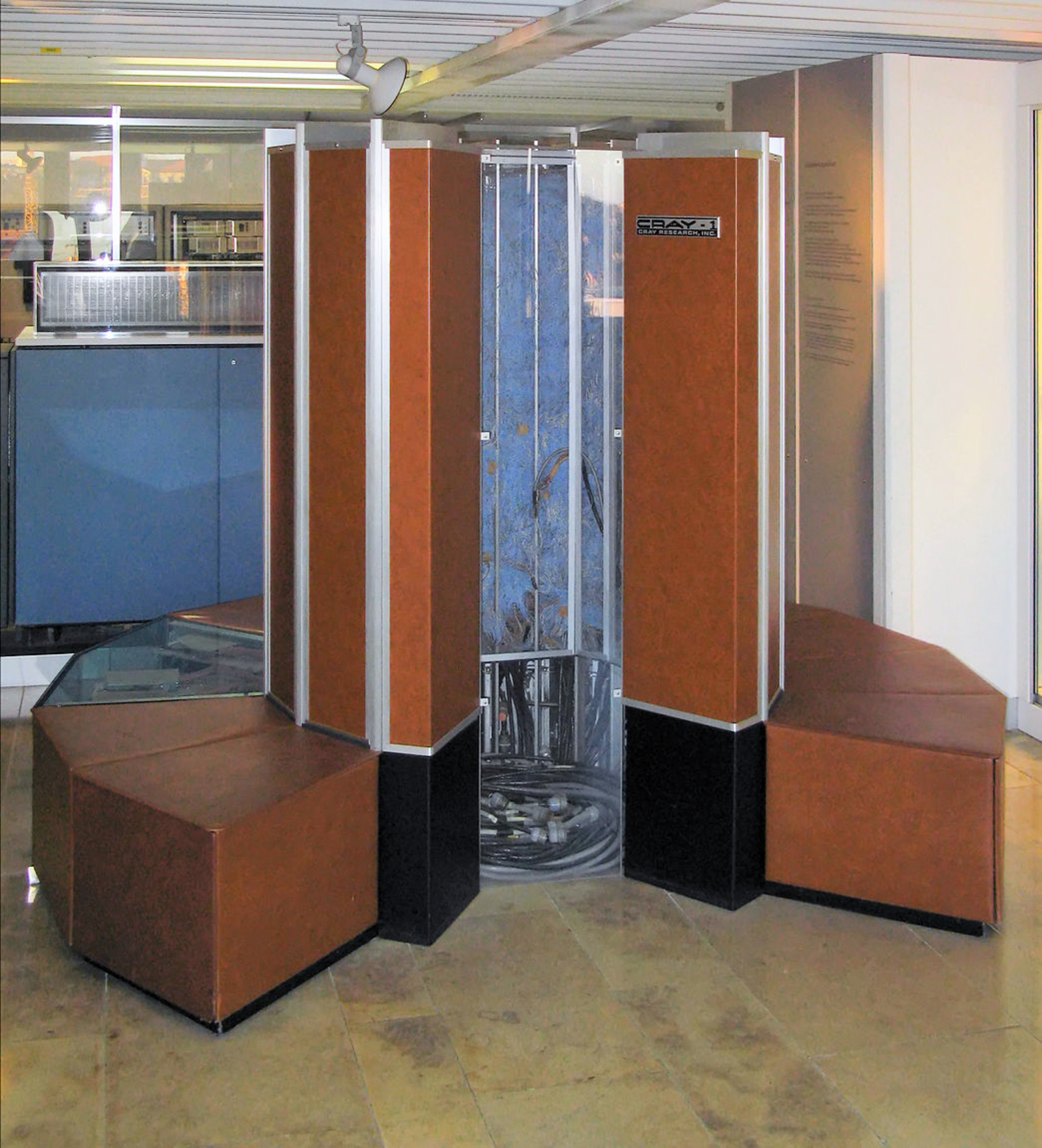
1 August 1979
Six weeks after the building opening, on 1 August 1979, the Centre’s first operational global weather forecast started running on the Cray-1A serial number nine. The model was not, as much subsequent secondary literature has stated, a T63 spectral model; it was a grid-point primitive-equation model at 1.875 degree latitude resolution (approximately 210 kilometres, about half the resolution that the NMC IBM 360/195s of Post 31 ran in the same year), with fifteen sigma vertical levels, an Eulerian leapfrog time stepping scheme with a time step of approximately fifteen minutes, and an optimal interpolation analysis of the World Meteorological Organization Global Telecommunications System data feed. A complete ten-day forecast required approximately five hours of Cray-1A central-processing-unit time, which meant that the operational system could comfortably run one ten-day forecast per day with substantial overhead for error recovery and data assimilation. The forecast was disseminated to the sixteen member-state national weather services twice daily, beginning at 00 UTC and 12 UTC, with delivery typically within an hour of forecast completion.11
The five-hour Cray-1A figure is worth dwelling on. It is, in retrospect, the operational rhythm that defined ECMWF for its first four years. Five hours of CPU time, on a Cray-1A running at sixty-six megahertz with an eighty-megaflops sustained scientific-code rate, produced ten days of weather forecast. A modern desktop CPU would produce that same forecast in a few seconds. A modern GPU cluster at NCAR or at the United Kingdom Met Office, running the same model code, would produce it in a handful of milliseconds. The five-hour-Cray-time rhythm bought ECMWF its institutional identity: long enough that operations and research could share the same machine if research ran overnight, short enough that one daily ten-day forecast could be delivered to subscriber member states with eighteen hours to spare. The architectural decision to procure a Cray-1A in 1976 had been a bet that this rhythm would work; the bet paid off.
Wiin-Nielsen leaves; the architectural pivot
On 31 December 1979, four months after the first operational forecast, Aksel Wiin-Nielsen’s six-year term as Director ended. He left Reading and returned to Geneva, where he became Secretary-General of the World Meteorological Organization – a position he held from 1980 to 1983. From 1984 to 1987 he was Director of the Danish Meteorological Institute. He returned to academic posts at the University of Copenhagen for the remainder of his career and died, in Copenhagen, on 26 April 2010, aged eighty-five.12
The Centre had no permanent successor on his departure. The Council of Member States had not yet completed its selection process; Jean Labrousse, the French Head of Operations who had been at the Centre since 1975, served as interim Director from 1 January 1980 to 31 December 1981, two years during which he kept the Centre running on operational autopilot while the Council deliberated. The Council’s eventual choice was Lennart Bengtsson, the Centre’s Head of Research, who took over as Director from 1 January 1982.
Bengtsson, born 5 July 1935 in Trollhättan, Sweden, had taken his doctorate in meteorology at the University of Stockholm in 1964 under the post-Rossby Stockholm school. He had been at SMHI from 1961 to 1974 and had built his international reputation as the principal architect of SMHI’s medium-range global model in the late 1960s. He had joined ECMWF in 1975 as Head of Research at Wiin-Nielsen’s invitation and had built the Centre’s research programme through the latter half of the decade. As Director, Bengtsson would lead the Centre for nine years, until the end of 1990, presiding over the most consequential architectural transition in its operational history.
That transition was the April 1983 switchover from the grid-point N48 model to a T63 spectral model. The argument for spectral methods had been in the air at ECMWF since the Centre’s founding; William Bourke, at the Australian Bureau of Meteorology Research Centre in Melbourne, had operationalised the world’s first global spectral numerical weather prediction model in 1976-1977 – six years before ECMWF’s switchover. Bourke had been a frequent visiting scientist at ECMWF through 1976-1980 but had never taken a permanent post; the spectral methods migrated to ECMWF through his published papers (Bourke 1972 in Monthly Weather Review, Bourke 1974 in Monthly Weather Review) and through the work of Cliff Temperton at ECMWF, who had built the spectral transform infrastructure. The April 1983 switchover went operational on the same Cray-1A serial number nine; in 1984 the Centre upgraded to a Cray X-MP/22 that ran the spectral model at higher throughput; in December 1985 it upgraded again to a Cray X-MP/48.13
The T63 spectral model was approximately twice as accurate per unit of computer time as the N48 grid-point model it replaced, on standard verification metrics for medium-range forecasts. By 1985 ECMWF was producing the most accurate medium-range global weather forecasts in the world, ahead of the United States National Meteorological Center, ahead of the United Kingdom Met Office, ahead of Météo-France and the Deutscher Wetterdienst. The Centre’s institutional bet – pool sixteen national budgets, build a single shared facility, hire the best people available across Europe, give them a Cray-1A and the time to do their work – had paid off in the international comparison statistics by 1985 and would continue paying off through every subsequent decade.
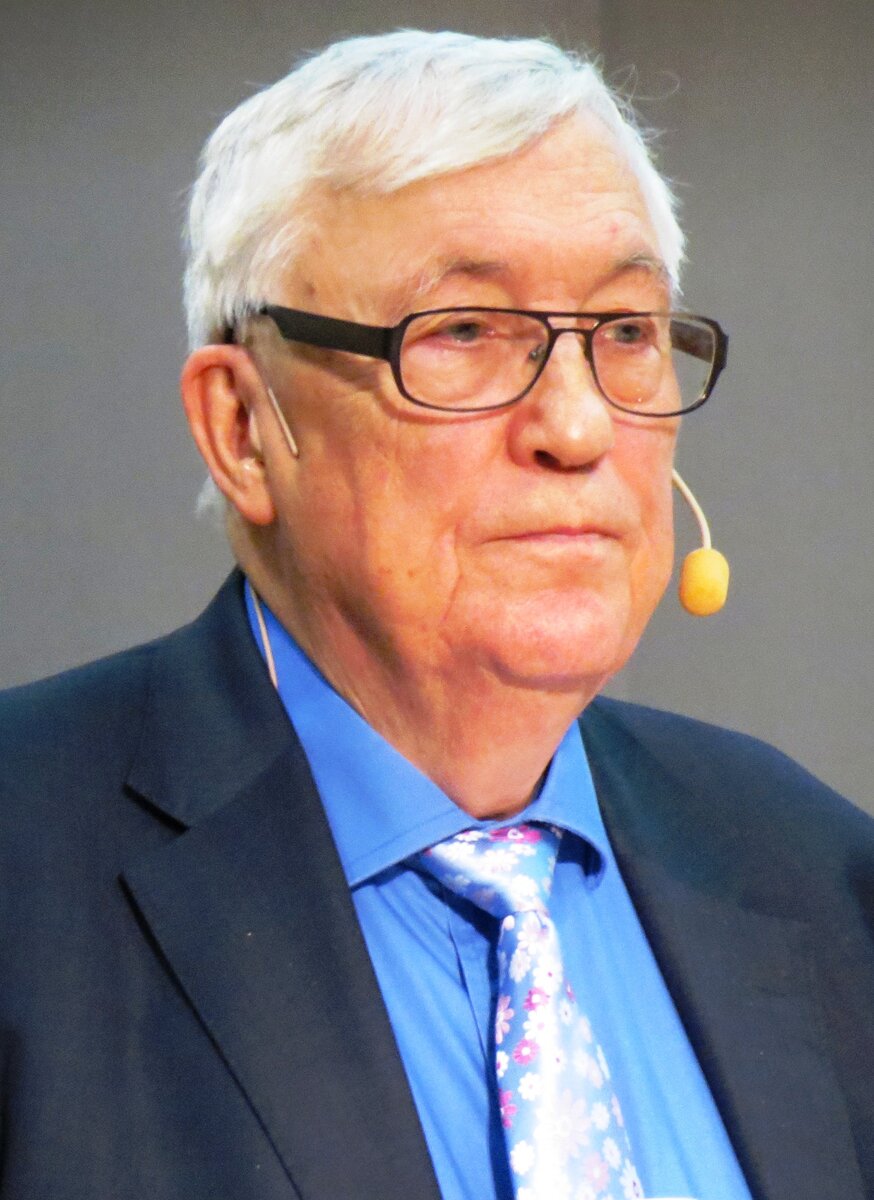
Tim Palmer and the ensemble
In 1986 the Centre hired Timothy Noel Palmer from the United Kingdom Meteorological Office. Palmer, born in Kingston upon Thames in 1952, had read mathematics and physics at the University of Bristol, taken a doctorate in general relativity at the University of Oxford in 1977 under Dennis Sciama (Stephen Hawking’s academic brother), and had famously turned down a postdoctoral offer from Hawking himself to work in atmospheric physics at the United Kingdom Met Office. At the Met Office through 1977 to 1986 Palmer had built the world’s first operational probabilistic weather-forecasting system, an early experimental ensemble that began running in November 1985 with three members per forecast cycle. He arrived at ECMWF in 1986 to lead the equivalent effort there.14
The Ensemble Prediction System (EPS) went operational at ECMWF on 24 November 1992, at T63 spectral resolution with nineteen vertical levels (T63L19) for the forecast integrations, with thirty-three ensemble members per forecast cycle – one control plus sixteen perturbed pairs. The lower T21 truncation was used only for the singular-vector perturbation calculations that generated the ensemble initial conditions. The perturbations were generated using the singular vector method that Palmer and his collaborators had developed through the late 1980s: the most rapidly-growing modes of the model’s tangent linear operator, which represent the directions in atmospheric phase space along which a small initial error grows fastest into a forecast error. The EPS was, on its launch day in 1992, the first operational ensemble system at any major weather centre. It grew to fifty-one members in December 1996 and to higher resolution and higher member count through the subsequent decades. By 2026 ECMWF runs a fifty-one-member ensemble at TCo1279 spectral resolution (approximately ten-kilometre grid spacing) with hourly updates of the analysis.
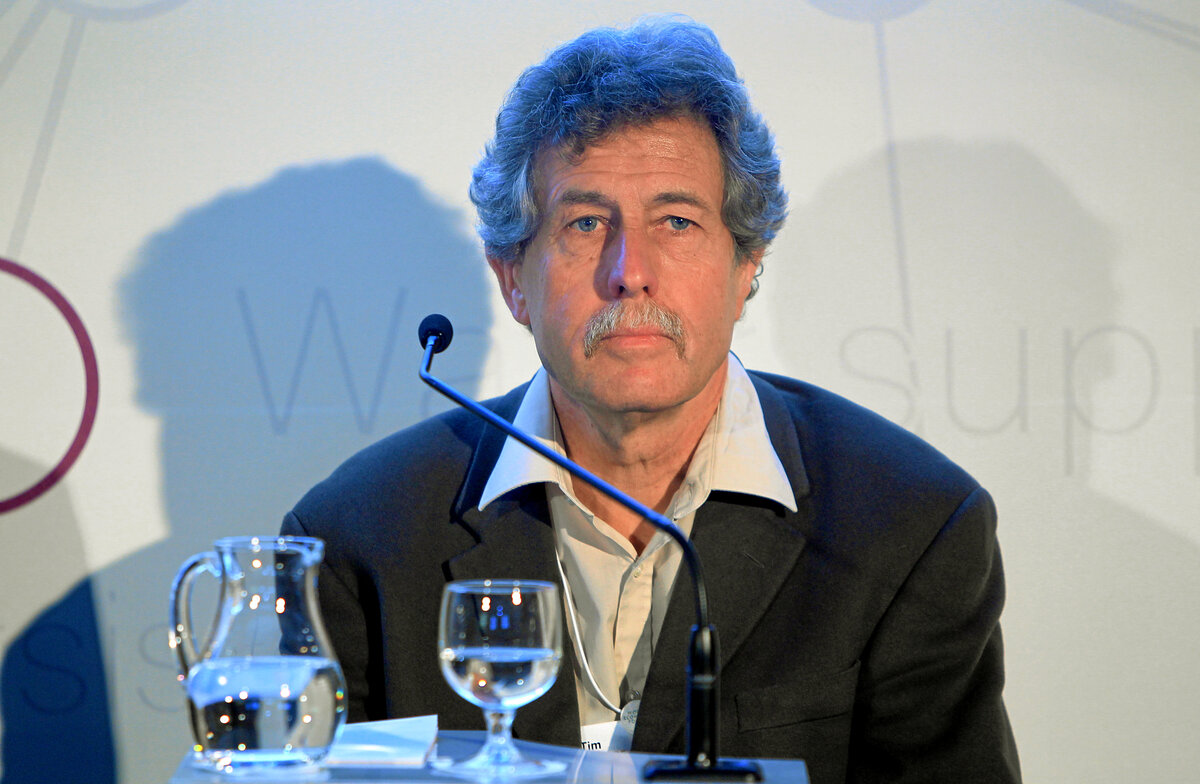
The intellectual lineage that runs from Edward Lorenz’s 1963 Journal of the Atmospheric Sciences paper on deterministic non-periodic flow (covered in our 2026-03-31 post on Lorenz), through Cecil Leith’s 1974 ensemble framework, through the singular-vector formalism of the late 1980s, to ECMWF’s 1992 operational EPS, is one of the cleanest in the history of computational atmospheric science. By 1992 it was understood that the deterministic single-forecast paradigm Charney and von Neumann had built on the ENIAC in 1950 was, after forty-two years, no longer enough; the post-Lorenz era had to be probabilistic. ECMWF’s 1992 EPS made the post-Lorenz era operational. Tim Palmer would lead the Centre’s ensemble research until 2010, when he moved to a chair at the University of Oxford. The EPS continues.
The institutional model
The European Centre for Medium-Range Weather Forecasts in 2026 employs approximately three hundred and seventy staff at its current site (since 2021 the Centre has split between Reading, an administrative campus in Bonn, and a high-performance computing facility at Bologna that opened in 2020); has thirty-five member and cooperating states (the original sixteen plus Norway 1989, Iceland 2009, and a series of central and eastern European accessions through the 1990s and 2000s); produces twice-daily ten-day medium-range forecasts and once-daily fifteen-day extended-range forecasts at TCo1279 spectral resolution; and remains the leading verification-statistics performer among major operational weather centres for medium-range forecasting in the Northern Hemisphere extratropics.15
The Centre’s institutional model – pool sixteen national meteorological-service budgets, build a single shared computing facility, deliver forecasts back to member states proportionally to their contribution, and let the research-and-operations duality drive both the operational quality and the underlying science – has become a template that other meteorological consortia have adopted. The Numerical Weather Prediction Cooperation Agreement of the Nordic and Baltic states (HIRLAM, established 1985) used the ECMWF model. The Aire Limitée Adaptation dynamique Développement INternational (ALADIN) consortium of European limited-area-model partners (established 1991) used a similar model. The Consortium for Small-scale Modeling (COSMO) (established 1998 as a German Met Office initiative) was a third version of the same idea. EUMETSAT, the European satellite meteorology agency (established 1986), is a closely related institutional sibling. The pattern of multi-national meteorological cooperation that the 1973 ECMWF Convention pioneered is, by the standards of international scientific institutions, almost mundane in 2026; in 1973 it was unprecedented.
The unprecedented part – the part that the Cray-1A serial number nine made physically real on 24 October 1978 – was the technical commitment. Sixteen sovereign states pooled approximately eight million United States dollars to buy a single supercomputer to run a single forecast model that none of them could have run on their own. The forecast model that ran on it – the N48 grid-point primitive-equation model, then from April 1983 the T63 spectral model, then from the late 1980s onward the successive larger spectral models, and from 1992 the ensemble system – delivered medium-range forecasting to the European national meteorological services that those services could not otherwise have produced. The bet paid off in technical performance, in institutional durability (the Centre is now in its fifty-third year of operational existence), and in the precedent it established for subsequent international meteorological cooperation.
What the Cray-1A serial number nine did
The Cray-1A serial number nine itself ran in the basement computer hall at Shinfield Park from 24 October 1978 until early 1984, a span of approximately five years and three months. During that time it ran approximately five thousand operational ten-day weather forecasts, each requiring approximately five hours of central-processing-unit time. It was the first Cray-1 ever delivered to a customer in Europe, the first supercomputer ever delivered to a multi-national institution, and the operational backbone of the first European medium-range forecasting service. It was decommissioned in early 1984 to make room for its successor, the Cray X-MP/22 that ECMWF would install in March 1984. After decommissioning it was not preserved; the chassis was returned to Cray Research and was later parted out for spares.
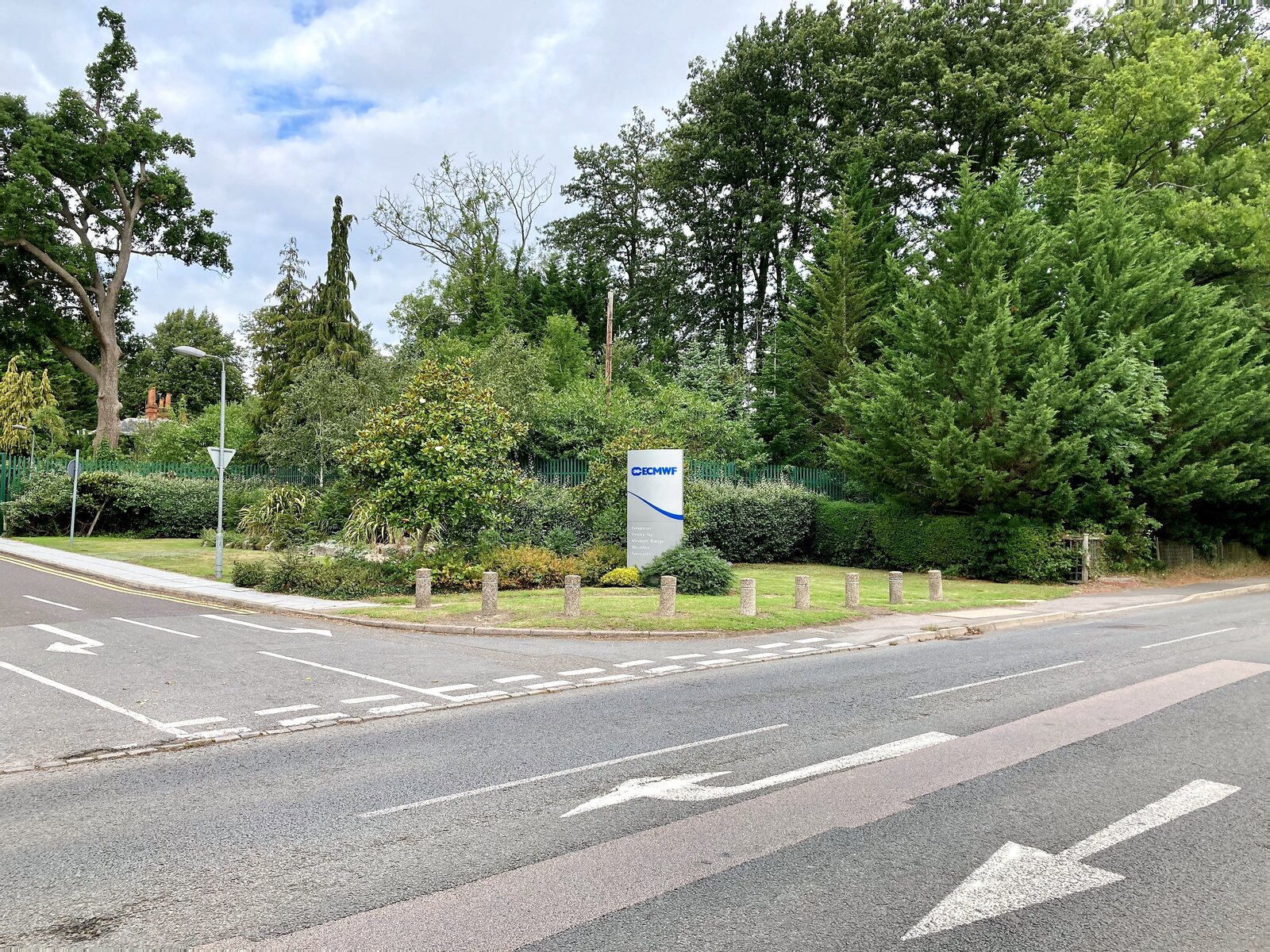
There is no surviving photograph in the public domain of the Cray-1A serial number nine in operation at Shinfield Park. The European Centre’s archive of period photographs is held under copyright by the Centre, with editorial-use permissions for ECMWF-promotional purposes only. The photograph of Prince Charles examining a logic module on 15 June 1979 is in the same archive and is not under any free licence. The institutional decision in 1978-1979 to document the Centre’s machine room and its machine but not to release any of those photographs under permissive terms means that the visual record of a foundational moment in European computational meteorology is, in 2026, off-limits to anyone who wants to write about it without paying or asking permission. The contrast with the public-domain coverage of NASA Ames in Post 33 – where every NASA-employee photograph of the ILLIAC IV is unrestricted public domain – is striking.
What survives in the public record is the Convention, the Centre’s official annual reports (which are published openly), the ECMWF Newsletter (likewise), and a body of subsequent technical and institutional history written by participants. Aksel Wiin-Nielsen died in 2010; his papers are at the Royal Library of Denmark in Copenhagen. Lennart Bengtsson, born 1935, is, as of 2026, ninety years old and lives in retirement in Reading. Tim Palmer is at Oxford. Adrian Simmons retired from the Centre as senior consultant in 2017 and continues to work part-time on reanalysis projects. Anthony Hollingsworth died unexpectedly in 2007; his obituary in the Quarterly Journal of the Royal Meteorological Society records that he had worked at ECMWF from 1 March 1975 until his death, the Centre’s longest-serving staff member. David Burridge was the third Director, 1991-2004; he is in retirement in Berkshire. Florence Rabier was the eighth Director, from 2016 to 2025; her successor as Director-General is Andrew Brown, from 2026.
The Cray-1A serial number nine ran the world’s first multi-national medium-range weather forecast service for five and a quarter years and is now scrap. The institution it served continues. So does the architectural philosophy it embodied: the Cray-1 vector pipeline, with its single fast main memory and its eight sixty-four-element vector registers, is the direct ancestor of every modern vector unit on every modern central processing unit. The graphics processing unit lineage from the previous post, descendant of Slotnick’s ILLIAC IV, today shares die-area with vector units descended from Cray’s Cray-1. The two architectural philosophies that competed in the early 1970s – ILLIAC IV’s SIMD lockstep array, and the Cray-1’s vector pipelines under one fast memory – are, in 2026, both present on every chip.
ECMWF, in its fifty-third year, runs forecasts on Atos BullSequana XH2000 nodes at the Bologna data centre. Each node contains a pair of AMD EPYC central processing units with vector units that are the direct architectural descendants of the Cray-1A serial number nine. Each node also contains GPU accelerators for the new generation of machine-learning weather models. The architectural bet of 1976 – vector beats SIMD for atmospheric work – is, in 2026, no longer a binary choice. The Centre runs both.
Footnotes
References
- Bourke, W. “An efficient, one-level, primitive-equation spectral model,” Monthly Weather Review 100(9):683-689, 1972.
- Bourke, W. “A multi-level spectral model. I. Formulation and hemispheric integrations,” Monthly Weather Review 102(10):687-701, 1974.
- Burridge, D. M. “What has ECMWF done for us?” Annual Seminar lecture, ECMWF, Reading, 2014.
- ECMWF. Convention establishing the European Centre for Medium-Range Weather Forecasts. Brussels, 11 October 1973.
- Hawkins, R. and Weger, R. “Cray-1A at ECMWF: serial number 9, manufactured by Cray Research,” ECMWF Newsletter 143, Spring 2015.
- Lorenz, E. N. “Deterministic Nonperiodic Flow,” Journal of the Atmospheric Sciences 20(2):130-141, March 1963.
- Murray, Charles J. The Supermen: The Story of Seymour Cray and the Technical Wizards Behind the Supercomputer, John Wiley & Sons, 1997.
- Palmer, T. N. and Hagedorn, R. (eds.) Predictability of Weather and Climate, Cambridge University Press, 2006.
- Russell, R. M. “The CRAY-1 Computer System,” Communications of the ACM 21(1):63-72, January 1978.
- Simmons, A. J. and Burridge, D. M. “An energy and angular-momentum conserving vertical finite-difference scheme and hybrid vertical coordinates,” Monthly Weather Review 109(4):758-766, April 1981.
- Woods, A. Medium-Range Weather Prediction: The European Approach, Springer, 2006.
-
Cray-1A serial number 9 delivery: Hawkins, R. and Weger, R. “Cray-1A at ECMWF: serial number 9, manufactured by Cray Research,” ECMWF Newsletter 143 (Spring 2015). Site: Shinfield Park, Reading. Delivery date: 24 October 1978. Reading is in the English county of Berkshire, four miles south of the centre of the town. The contract value of approximately $8 million is in 1978 United States dollars; the British pound exchange rate in late 1978 was approximately 0.51 to the dollar, giving a sterling-denominated cost of approximately £4.1 million. ↩
-
The Süßenberger Group: established by the European Economic Community Council of Ministers in November 1967, chaired by Dr Erich Süßenberger, president of the Deutscher Wetterdienst from 1966 to 1977 (died 5 December 2007). Reported April 1969. The Group’s full title was the Expert Group on the Establishment of a European Centre for Medium-Range Weather Forecasts. Its proceedings are not publicly accessible; the canonical secondary source is Woods, A. Medium-Range Weather Prediction: The European Approach, Springer, 2006, pp. 12-15. COST Action 70 ran from January 1970 to December 1973. ↩
-
The Convention establishing the European Centre for Medium-Range Weather Forecasts: signed 11 October 1973 at Brussels by representatives of fifteen European states. Original Convention text at https://www.ecmwf.int/sites/default/files/elibrary/2010/ecmwf-convention-en.pdf. The Yom Kippur War broke out on 6 October 1973 with the Egyptian crossing of the Suez Canal; the OPEC oil embargo was declared 17 October 1973. ↩
-
ECMWF 40-year anniversary article “ECMWF Convention came into force 40 years ago”: eighteen founding member states by 1 November 1975. https://www.ecmwf.int/en/about/media-centre/news/2015/ecmwf-convention-came-force-40-years-ago. Earlier drafts of this post said sixteen founding states and excluded Luxembourg and Norway; verified 2026-05-17 against ECMWF and Wikipedia. ↩
-
Convention Article 2, full text at the ECMWF Convention PDF cited in note 3. ↩
-
The Convention entered into force on 1 November 1975 with thirteen ratifications. Source: ECMWF official history page at https://www.ecmwf.int/en/about/who-we-are/history. ↩
-
Aksel Wiin-Nielsen biographical: Wikipedia “Aksel Wiin-Nielsen”; Royal Society biographical memoir; ECMWF history page. Born Frederiksberg Denmark 17 December 1924; died Copenhagen 26 April 2010. The dates are sometimes confused in secondary sources because his death date (26 April) is sometimes cited as his birth date. ↩
-
Wiin-Nielsen career arc: Copenhagen 1948 (master of science under Fjørtoft); Stockholm IMI 1952-1957 under Rossby; Joint Numerical Weather Prediction Unit Suitland 1959-1961 under Cressman; NCAR 1961-1963 under Roberts; University of Michigan 1963-1973; ECMWF Director 1 January 1974 to 31 December 1979; WMO Secretary-General 1980-1983; DMI Director 1984-1987. ↩
-
Cray-1 customer-list reconstructed from the Cray Research customer database (now held by Hewlett-Packard Enterprise) and from Murray, Charles J. The Supermen: The Story of Seymour Cray and the Technical Wizards Behind the Supercomputer, Wiley 1997. ↩
-
The Casson Conder building at Shinfield Park: opened 15 June 1979 by HRH Charles, Prince of Wales. The architect Casson Conder and Partners was the firm of Sir Hugh Casson (1910-1999), president of the Royal Academy and a senior figure in British post-war architecture. The Cray-1A’s bench is documented in Russell, R. M. “The CRAY-1 Computer System,” Communications of the ACM 21(1):63-72, January 1978. ↩
-
Operational forecast specifications: 1.875 degree latitude, 15 sigma levels, leapfrog time stepping, optimal interpolation analysis. Source: Hawkins and Weger 2015 op. cit.; Burridge, D. M. “What has ECMWF done for us?” lecture, ECMWF Annual Seminar, Reading, 2014. ↩
-
Wiin-Nielsen’s death: 26 April 2010 in Copenhagen at age 85. The death was unexpected; he had been in good health and active in the Danish meteorological community. ↩
-
William Bourke and the Australian spectral methods: Bourke, W. “An efficient, one-level, primitive-equation spectral model,” Monthly Weather Review 100(9):683-689, September 1972; Bourke, W. “A multi-level spectral model. I. Formulation and hemispheric integrations,” Monthly Weather Review 102(10):687-701, October 1974. The Australian Bureau of Meteorology operationalised its global spectral model in 1976-1977 at the Australian National Meteorological Research Centre. ↩
-
Tim Palmer biographical: Wikipedia “Tim Palmer (physicist)”; University of Oxford physics department. Born Kingston upon Thames 1952; doctorate in general relativity from the University of Oxford 1977 under Dennis Sciama; Met Office 1977-1986; ECMWF 1986-2010; Oxford 2011-present. The Hawking job offer is documented in Palmer’s published memoir. ↩
-
ECMWF in 2026: 35 member and cooperating states, three sites (Reading, Bonn, Bologna), approximately 370 staff, twice-daily TCo1279 medium-range forecasts and 51-member ensemble. Source: ECMWF official statistics page https://www.ecmwf.int/en/about/who-we-are. ↩