In March 1996 the Bulletin of the American Meteorological Society published a thirty-five-page paper with twenty-two authors and a project name in the title.1 The lead author was Eugenia Kalnay, then fifty-three years old, the Director of the Environmental Modeling Center at the National Centers for Environmental Prediction at Camp Springs, Maryland. The second author was her Branch Chief for global modeling, Masao Kanamitsu. The third was the veteran NCEP analysis scientist Robert Kistler, who would lead the 2001 follow-up paper that extended the dataset back to 1948. The sixth author was Lev Semyonovich Gandin, the seventy-four-year-old Soviet émigré whose 1963 Leningrad monograph had given the field its first complete statistical theory of objective analysis and whose retirement at the Voeikov Main Geophysical Observatory had been overtaken in 1991 by the disintegration of the Soviet Union and a position offered to him at the National Meteorological Center in Suitland.2 The twenty-first and twenty-second authors were the two NCAR data archivists Roy Jenne and Dennis Joseph, who had spent the preceding thirty years rescuing the historical observational record from punched-card decks, paper tape, microfiche, and ship logs that without their work would never have been usable for assimilation. In between were eighteen further scientists from NCEP’s Environmental Modeling Center and Climate Prediction Center – the operational shop that ran the model and the diagnostic shop that would mine its output for the next quarter-century of climate research.
The paper was titled The NCEP/NCAR 40-Year Reanalysis Project.3 It described a single integrated assimilation of the entire historical atmosphere from January 1957 through approximately the date of publication, performed at the T62L28 spectral resolution that NCEP had run operationally since 11 January 1995, with a three-dimensional variational assimilation that NMC had developed in the late 1980s and put into routine operations in June 1991.4 The model was the same global spectral model that NMC was running on the operational schedule that morning. The data assimilation was the same scheme. The boundary forcing – sea surface temperature, sea ice, surface albedo – came from operationally accepted analyses. What was new in the reanalysis project was not any single technical component. What was new was the decision to freeze the operational system at one date, then to play forty years of atmospheric observations through it from the beginning, in chronological order, with no changes to the model or to the assimilation between January 1957 and the end of the run. Every six-hourly analysis in the resulting dataset would have been computed by the same algorithm digesting whatever observations were available at that date. The differences between 1957 and 1996 in the resulting gridded fields would therefore reflect only the differences in what the atmosphere had done – and what had been observed – not differences in how the analysing system had digested observations. This was the frozen-system principle.5
It was not the only large reanalysis under way in 1996. At the European Centre for Medium-Range Weather Forecasts in Reading, Per Kållberg and a team of about a dozen had been running ERA-15 since 1993, a reanalysis of the satellite era from 1979 through 1993 at T106L31 resolution.6 The European project had started two years before the American project and would finish about the same time. The two centres had not been competing. Kållberg sat on the NCEP/NCAR Advisory Panel that had governed the American reanalysis since 1989; the 1996 BAMS paper specifically thanked “Rex Gibson and Per Kallberg (ECMWF)” for observations and discussion.7 Reading and Camp Springs had been collaborating across the Atlantic on what they understood to be the same intellectual problem, with different choices about coverage and resolution. ERA-15 prioritised homogeneity within the satellite era – the period after the launch of TIROS-N in October 1978 made the global radiosonde network supplemented by vertical sounders the dominant observational stream. NCEP/NCAR prioritised length, extending back through twenty-two pre-satellite years to the International Geophysical Year of 1957-58, the earliest period for which a coherent global upper-air observation network had been organised.
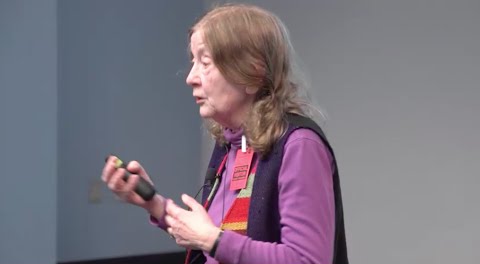
The 1996 BAMS paper has been cited well over thirty thousand times in the three decades since publication, making it one of the most-cited documents in the entire history of atmospheric science.8 The dataset itself – frequently referred to in the literature as NCEP/NCAR R1, or simply R1, after the 2002 release of the NCEP/DOE R2 reanalysis distinguished it from its successor – is by 2026 an institutional fixture of climate research, oceanography, atmospheric chemistry, ecology, hydrology, and any other discipline that needs a gridded estimate of the state of the atmosphere on a historical date. The paper made the dataset possible. The dataset made roughly half a century of subsequent climate analysis possible. The doctoral students Kalnay would mentor through her Maryland years from 1999 onwards would launch a second wave of methodological innovation – the bred vector ensemble system at NCEP, the Local Ensemble Transform Kalman Filter at the University of Maryland, the operational LETKF deployments at the Japan Meteorological Agency and Korean Meteorological Administration through the 2010s.9 And in 2003 Kalnay published, with Cambridge University Press, the graduate textbook Atmospheric Modeling, Data Assimilation and Predictability that consolidated fifty years of NWP into a single 341-page reference.10 The textbook is dedicated, in seven words on the front matter, “to the Grandmothers of Plaza de Mayo for their tremendous courage and leadership in defense of human rights and democracy.”11
This post is the story of the project that produced the 1996 paper, of the person who led it, and of the textbook that consolidated the field.
1. Buenos Aires to MIT, 1942-1967
Eugenia Enriqueta Kalnay was born on 1 October 1942 in Buenos Aires, Argentina.12 The Argentina of the early 1940s was a country governed by the conservative-nationalist coalition that would in June 1943 give way to the military government from which Juan Domingo Perón would emerge over the following two years. The Kalnay family was Hungarian-Argentine: the name is the Argentinian Spanish form of the Hungarian “Kálnay,” carried over by an early-twentieth-century emigration. Eugenia attended the National College of Buenos Aires (Colegio Nacional de Buenos Aires), the historically rigorous secondary school affiliated with the University of Buenos Aires that had educated several generations of Argentine intellectuals. She then enrolled in the University of Buenos Aires in the Faculty of Exact and Natural Sciences, in the Meteorology programme of the Department of Atmospheric Sciences, graduating with a BSc in Meteorology in 1965.13 The University of Buenos Aires was, in the 1960s, the strongest scientific university in South America, with a free public education that Kalnay would return to in her later award acceptance speeches as something she felt herself to owe to the Argentine state of her childhood.
Her undergraduate years at Buenos Aires coincided with the political turbulence of the early 1960s. The military government that had taken power in 1955, deposing Perón, had given way in 1958 to the civilian presidency of Arturo Frondizi, which was itself ended by another military coup in March 1962. The civilian-military oscillation of those years was the standard Argentine pattern. The strongest institutional figure in Argentine science of the period was Bernardo Houssay (1887-1971), the 1947 Nobel laureate in Physiology or Medicine and founding president of the National Scientific and Technical Research Council (CONICET) from 1958; the strongest figure in the mathematics-and-physical-sciences faculty at Buenos Aires was the dean Rolando García, an atmospheric physicist who had been one of the first Argentine scientists to travel internationally on the scale that postwar science required.14 García had visited MIT in the late 1950s and had developed a working relationship with Jule Charney at the meteorology department there.
By autumn 1966 Kalnay was a recent Buenos Aires graduate working at the University, looking for an international PhD opportunity. The political climate was deteriorating again – the military coup of June 1966 under Juan Carlos Onganía had directly affected the universities, with the Noche de los Bastones Largos (“Night of the Long Batons”) of 29 July 1966 in which federal police violently broke up academic occupations at the Faculty of Exact and Natural Sciences in Buenos Aires, beating professors and students and expelling them from the building. The episode prompted a substantial intellectual exodus from Argentine universities. Among those affected was Rolando García himself, who would resign and ultimately move to the United States. He recommended to Kalnay that she apply to MIT to work with Charney, with whom he had stayed in contact.15
She arrived at MIT in January 1967, twenty-four years old, with a Buenos Aires degree and a recommendation from García.16 She would later describe what she found: “The only women in the department were the secretaries.”17 The MIT Department of Meteorology had been one of the leading research departments in the world since Carl-Gustaf Rossby had founded it in 1928 as the first such department in the United States. Through the 1930s and 1940s Rossby had used it as the institutional vehicle for the development of synoptic and dynamic meteorology in America; he had moved to Chicago in 1941 and then to Stockholm in 1947, but the department he had founded at MIT remained, in the late 1960s under chairman Henry Houghton and senior faculty including Charney, Lorenz, Norman Phillips, Reginald Newell, Erik Mollo-Christensen, and Frederick Sanders, the most active research department in dynamic meteorology in the country. None of them was a woman. The graduate student body of about thirty or forty was, with Kalnay’s arrival in January 1967, all male except for her.18
Charney took her on as a doctoral student. The MIT meteorology PhD programme of the late 1960s ran on a four-year clock: two years of coursework and qualifying exams, two years on the thesis. Charney’s other doctoral students in the same period included Mark Cane (who would later supervise the development of the Cane-Zebiak ENSO model and become Kalnay’s lifelong mentor and friend, the subject of Post 27 of this series).19 Through the four years 1967-1971 the department was the daily institutional context in which Kalnay learned the technical language of dynamical meteorology, the synoptic chart, the primitive equations on the sphere, the geostrophic and quasi-geostrophic approximations, and the early operational data assimilation literature – the field that would in the 1970s and 1980s formalise into the framework Gandin had set out in 1963 in Leningrad and that the 1996 reanalysis would deploy as SSI 3D-Var.
The thesis topic Charney assigned her was characteristic of the man. Charney’s research interest in planetary general circulation – the application of geophysical fluid dynamics to atmospheres other than Earth’s – had been one of his recurring intellectual projects since the 1950s. He had supervised earlier theses on Martian and Jovian circulation; the obvious open planet in 1967 was Venus, where the surface temperature of approximately 600 K, observationally established through the Mariner 2 flyby of December 1962, demanded a dynamical explanation. The candidate explanations were two. Carl Sagan had argued, from the late 1950s, for a runaway greenhouse effect in which carbon dioxide and water vapour in the dense Venusian atmosphere trapped solar radiation to produce the observed surface heating. Against this, R. M. Goody and G. D. Robinson had argued, in a 1966 QJRMS paper, for a solar cloud-heating mechanism in which solar absorption in the cloud layer drove a thermally direct Hadley-like circulation that adiabatically compressed the lower atmosphere to the observed temperatures.20 Charney was sceptical of the Goody-Robinson picture; he assigned Kalnay to test it numerically.
She did. Her 1971 thesis, A Numerical Study of the Atmospheric Circulation on Venus, used a two-dimensional density-varying numerical model to compute the cellular circulation expected under the Goody-Robinson solar-cloud-heating mechanism.21 The opening sentence of the thesis – one that her former students and colleagues would quote in tributes after her death – is a Charney sentence in spirit if not in style: “The planets Mars, Earth, and Venus seem to have been designed with an experimental purpose in mind.”22 The dynamical experiment showed that the Goody-Robinson mechanism could not produce a surface temperature anywhere near the observed 600 K. The cloud-heating Hadley cell was too weak; the adiabatic compression of the lower atmosphere required for the observed heating could not be sustained. The Sagan runaway-greenhouse picture survived; the Goody-Robinson alternative did not. The thesis was published in 1971 in the Journal of the Atmospheric Sciences, under her then-married name, as E. Kalnay de Rivas, “A Numerical Study of the Atmospheric Circulation on Venus,” JAS 28(6): 1045-1057.23 Her husband, Alberto Rivas, was an Argentine researcher in early automated machine translation; the Spanish-naming convention combining her father’s name with her husband’s was the form in which her first published paper appeared.24
In 1971 Eugenia Kalnay became the first woman ever to receive a doctorate in meteorology from MIT.25 She would remain on the MIT faculty – first as an Assistant Professor from 1973, after a two-year postdoctoral position at the University of Montevideo in Uruguay, and then as an Associate Professor from 1977 – through 1978, becoming the first woman to hold a faculty position in meteorology at MIT.26 The arc from January 1967, when the only women in the department were the secretaries, to 1973, when Kalnay returned as the first woman on the faculty, was just over six years.
2. NASA Goddard, 1979-1986
In 1979 Kalnay left MIT for NASA Goddard Space Flight Center in Greenbelt, Maryland, joining the Laboratory for Atmospheres as a senior research meteorologist.27 NASA Goddard in 1979 was, after fifteen years of operations, the principal NASA centre for atmospheric science. Its Laboratory for Atmospheric Sciences – later reorganised, restructured, and renamed several times – had been the institutional home of the GISS (Goddard Institute for Space Studies) general circulation model under James Hansen and the parallel Goddard GCM under Milt Halem.28 Halem himself, whose name would appear sixteen years later in the BAMS reanalysis paper’s acknowledgements as one of the three originators of the long-reanalysis idea, was at this point head of NASA’s modelling effort. Kalnay’s recruitment in 1979 brought to Goddard a senior modelling scientist whose MIT-Charney pedigree, MIT faculty experience, and demonstrated capability with planetary GCMs made her a natural lead for the Goddard global modelling programme.
Through her seven years at Goddard, 1979 through 1986, Kalnay led work on the Goddard global model and on data assimilation as applied to NASA’s observing satellites. The first satellite-data assimilation systems were being built in this period – the Statistical Spline Analysis at NMC, the GLAS Analysis at Goddard, and the early three-dimensional schemes that would feed into the next generation.29 The Goddard modelling effort under Halem and Kalnay produced operational analyses for the First GARP Global Experiment (FGGE) of 1978-79, which had set the post-IGY baseline for global observations and which the NCEP/NCAR reanalysis would later extend backward. Kalnay’s promotion to Branch Chief, Global Modeling and Simulation in 1983 reflected her standing as the senior model-development scientist at Goddard.30
The seven Goddard years coincided with one of the political watersheds of Kalnay’s life: the Argentine military dictatorship of 1976-1983, which had taken power on 24 March 1976 in a coup that overthrew Isabel Perón. The dictatorship’s Process of National Reorganisation (Proceso de Reorganización Nacional) carried out what would become known as the Dirty War – a systematic campaign of repression in which thirty thousand Argentine citizens, by the most widely cited count, were “disappeared.” Among the most visible civil-society responses to the disappearances was the Madres de Plaza de Mayo – the Mothers of Plaza de Mayo – who began on 30 April 1977 to circulate the square in front of the Casa Rosada in Buenos Aires every Thursday, wearing white headscarves and carrying photographs of their missing children. In 1980 a related organisation, the Abuelas de Plaza de Mayo (Grandmothers of Plaza de Mayo), was formed to search specifically for the children of the disappeared who had been abducted with their pregnant mothers or born in captivity and then handed over to military families. The Grandmothers, by 2026, had identified more than one hundred and thirty of these children, now adults, through a combination of DNA testing and patient civic detective work spanning four decades.31
Kalnay was thirty-three years old at the start of the dictatorship and forty when it ended. She had been out of Argentina for nine years by the time of the coup; she would not return to live there. But the dedication of her 2003 textbook – written twenty-seven years after the coup and twenty years after the return of democracy – to the Grandmothers of Plaza de Mayo, in seven words on the front matter of a graduate textbook on data assimilation, is the most direct public statement she made about her Argentine identity and about what had been done in her country in her absence.32
3. NMC: from Goddard to Camp Springs, 1987
In 1987 Kalnay moved from NASA Goddard to the National Meteorological Center at Camp Springs, Maryland, as Director of the Development Division.33 The Development Division had been founded in 1959 by Frederick Shuman as the research arm of NMC; its previous director through the OI deployment of 1979 onwards had been Norman Phillips, who at the time of Kalnay’s arrival was approaching retirement and the position had been vacant for several months. The Development Division of NMC in 1987 was the operational forecast model and data assimilation shop of American weather prediction. It ran the Medium-Range Forecast (MRF) global spectral model, then at T80L18 resolution, on the Cyber 205 that had been installed at Suitland in August 1983 as the successor to the IBM 360/195 of the 1970s.34 It ran the operational Optimum Interpolation scheme that John Bergman, Stephen Lord, and Joseph Sela had implemented in 1979 as the operationalisation of Gandin’s 1963 framework. It was, in 1987, on the brink of the transition from OI to the Spectral Statistical Interpolation 3D-Var scheme that John Derber and David Parrish were developing and which would go operational on 25 June 1991, four years after Kalnay’s arrival.35
What had brought her from Goddard to NMC was a combination of intellectual and operational opportunity. NASA Goddard was a research laboratory; NMC was the operational weather forecasting agency of the United States. The Goddard general circulation models were research tools; the NMC global model was the basis on which American aviation, defence, agriculture, and emergency-management forecasts were issued every day. The transition from a NASA research environment to an NMC operational environment was a substantial change of intellectual posture: it meant accepting deadlines, schedule constraints, and the operational discipline that NWP required, in exchange for the demonstrable real-world relevance that an operational forecast centre carried.
The Development Division Kalnay inherited had perhaps thirty scientists and engineers, organised into three branches: the Global Modeling Branch under Masao Kanamitsu, the Analysis Branch that ran OI and would run SSI from 1991, and the Mesoscale Branch that ran the regional NGM model. Through the late 1980s Kalnay’s job, in effect, was to oversee the simultaneous transition of all three branches’ systems: the global model from T80L18 to higher resolution, the analysis system from OI to 3D-Var, and the mesoscale system through the development of the Eta model that would become operational in June 1993. The Development Division was simultaneously running operational forecasts every six hours, developing the next-generation systems, supporting the research community with output products, and engaging with the international NWP community at AMS, WMO, and ECMWF meetings.
In June 1991, four years into Kalnay’s tenure, the Spectral Statistical Interpolation 3D-Var system went operational at NMC. The Parrish and Derber paper that documented the system would appear in Monthly Weather Review in August 1992. The SSI system, treated extensively in Post 44 of this series on Gandin and the Cold War transmission of OI, was the world’s first operational three-dimensional variational analysis – a direct, formally equivalent reformulation of the Gandin 1963 optimum-interpolation problem as a minimisation in spectral space.36 The deployment of SSI at NMC in June 1991 was the technical step that would, four years later, make the reanalysis project mechanically possible. The reanalysis would require a single, frozen, well-characterised data assimilation system that could digest forty years of observations consistently; SSI was that system, in the configuration NMC would freeze in early 1995.
By the time the reanalysis project formally began in April 1991 at the NCEP/NCAR Reanalysis Workshop in Camp Springs, Kalnay had been Director of the Development Division for four years and the SSI deployment was just under two months away.37 The reanalysis would be the project that defined her tenure.
4. Before the reanalysis: the climate community’s problem
To understand what was new about the 1996 NCEP/NCAR reanalysis it helps to understand what the climate community had been working with before it.
Through the 1970s and 1980s the principal sources of gridded atmospheric data for climate research were three. First, the operational analyses issued every six hours by NMC, ECMWF, the Met Office, JMA, and other major centres. These were the best estimates of the atmospheric state on any given day; they had been computed at the resolution and through the assimilation system that was operational at that date. But the operational system changed every year or two as the operational centres upgraded their models and their assimilation schemes – and every operational analysis change introduced what looked like a climate signal but was actually a system change. The most notorious example was the apparent mid-1979 Southern-Hemisphere warming in ECMWF’s operational analyses, which had been investigated by Trenberth and Olson in 1988 in a MWR paper that traced the signal back to the start of TIROS-N TOVS assimilation rather than to any genuine atmospheric event.38 The lesson was that an operational analysis time series was a record of how the analysis system had changed, not a record of how the atmosphere had changed.
The second source was the station data archives maintained at the National Climatic Data Center in Asheville, North Carolina (the successor to the Weather Bureau’s climatological record-keeping function), at NCAR’s Data Support Section in Boulder under Roy Jenne, and at corresponding archives in the UK, Russia, and Japan. These were the raw observations from which the operational analyses were computed – radiosonde profiles, surface pressure observations, ship reports, aircraft reports, satellite retrievals. They were rich, voluminous, and notoriously difficult to use for climate research because they were point measurements scattered irregularly in space and time, with the irregularity itself a function of the changing observational system.
The third source was the GCM rerun – a climate model integrated forward from some initial state, with observed sea surface temperatures imposed as a lower boundary condition, treated as a proxy for the historical atmosphere. This was useful for certain types of climate analysis but was not, strictly speaking, an estimate of what the atmosphere had actually done; it was an estimate of what a particular GCM, forced with SST, would have done. The two estimates could differ substantially in the synoptic-scale weather patterns that climate researchers were often most interested in.
What climate researchers had repeatedly asked for through the 1980s, in workshops and white papers and personal communications with operational centres, was a fourth source: a gridded, dynamically consistent, multi-decadal record of the atmospheric state computed by running a single fixed data assimilation system through the entire historical observational archive. The fixed system would absorb all the operational system-change discontinuities into a single consistent analysis; the multi-decadal length would make it useful for studies of interannual and decadal variability; the gridded format would make it digestible by climate analysis tools that could not handle scattered point observations. The technical name for such a product was a reanalysis.
The institutional name for the proto-effort at NMC was the Climate Data Assimilation System (CDAS). CDAS began in 1990 at the Climate Analysis Center of NMC – the unit that would in 1995 become the Climate Prediction Center of NCEP – as a project to run NMC’s operational data assimilation system in a special “climate-friendly” configuration in parallel with the operational stream.39 The motivation for CDAS, as the 1996 BAMS paper would later record, was to produce a homogeneous near-real-time analysis stream for the diagnostic monitoring of the global climate. The CDAS configuration was deliberately constrained to be a frozen version of the operational system, with only the bug fixes that did not affect the climate output applied to it. By 1990 the CDAS Advisory Committee, operating since 1989 and chaired by Julia Nogués-Paegle through 1993, had been thinking about whether the CDAS framework could be applied retrospectively rather than only forward, and if so how far back.40 The same argument would be made independently at ECMWF, leading to the ERA-15 project, and in the WMO/WCRP community more broadly. The 1990 conversation between the CDAS Advisory Committee and the NCEP modelling group converged on the question of how far back into the historical observational record the assimilation could meaningfully go.
In 1990 the Advisory Panel formally suggested that CDAS would be more useful as a long retrospective reanalysis. NMC contacted NCAR – specifically Roy Jenne’s Data Support Section – which agreed enthusiastically and proposed extending the analysis back to the International Geophysical Year of 1957-58, the earliest period for which a global upper-air observing network had existed.41 The NCAR data archives held the observations; the NCEP modelling group held the assimilation system; the institutional pairing was natural. By the end of 1990 the joint NCEP/NCAR Reanalysis Project was effectively committed, awaiting only formal funding and the workshop that would set its detailed terms.
That workshop was held in April 1991 at the World Weather Building at Camp Springs, the NMC headquarters since January 1975.42 The workshop convened the NMC and NCAR teams, the Advisory Panel, programme officers from the funding agencies, and a wider group of climate scientists who had been pushing for the reanalysis. The originators – credited verbatim in the 1996 paper – were three: Mark Cane of Lamont-Doherty (Kalnay’s former MIT contemporary and one of her named lifelong mentors), Julia Nogués-Paegle of the University of Utah (and chair of the CDAS Advisory Committee), and Milt Halem of NASA Goddard (Kalnay’s former NASA colleague). The acknowledgements of the 1996 paper would put the same three names in sequence: “Mark Cane, Julia Nogués-Paegle, and Milt Halem suggested the long reanalysis; Jagadish Shukla spearheaded it throughout the research community.”43 The mention of Jagadish Shukla of the University of Maryland and the Center for Ocean-Land-Atmosphere Studies – the subject of Post 35 of this series – was a recognition of his decade-long advocacy through the climate community for the predictability research a reanalysis would enable. Shukla had been one of Kalnay’s named mentors in her 2019 Revelle Medal acceptance.44
By April 1991 the project had a name, a workshop, an Advisory Panel, two institutional homes, and a target back-extension of forty years. What it did not yet have was the operational SSI assimilation system – that would arrive two months later, on 25 June 1991 – or the frozen model configuration, which would arrive in January 1995. The four years from April 1991 to January 1995 would be spent assembling the rest of the machinery.
5. The architecture
The reanalysis that ran through 1994 and the first half of 1995 used three principal components: a global spectral model, a three-dimensional variational analysis, and a historical observational archive. Each had to be brought into a stable, frozen configuration before the production run could begin.
The global spectral model was the NCEP global model in the configuration NCEP would implement operationally on 11 January 1995.45 The spectral truncation was T62, with sixty-two zonal wavenumbers at the equator, producing an effective horizontal resolution of about 210 km on the Gaussian grid (192×94 grid points). The vertical resolution was twenty-eight sigma levels, with five levels in the planetary boundary layer (below approximately 850 hPa) and roughly seven levels above 100 hPa for the lower stratosphere; the lowest model level was approximately 5 hPa above the surface, the model top at approximately 3 hPa.46 The model included the CLIRAD-SW shortwave radiation scheme (Chou and Lee), the longwave radiation of Fels and Schwarzkopf, the simplified Arakawa-Schubert cumulus convection of Pan and Wu, the Mellor-Yamada Level 2 boundary layer scheme of Hong and Pan, and a four-layer soil model.47 None of these schemes was unique to the reanalysis; they were the operational physics package NCEP had been developing since the late 1980s and which would be frozen at the 11 January 1995 configuration for the entire reanalysis run.
The assimilation scheme was the Spectral Statistical Interpolation – the 3D-Var system that Parrish and Derber had brought operational in June 1991.48 The SSI minimisation operated in spectral space, computing increments to the background as the linear combination of an analysis-error covariance that was diagonal in spherical-harmonic space and observation-error covariances that were diagonal in observation space. The mathematical formulation was identical, at the analysis step, to a multivariate optimum interpolation – the spectral-space implementation was a computational accelerator, not a change in the statistical framework. The continuity from Gandin’s 1963 Leningrad framework, through Andrew Lorenc’s 1981 OI deployment at ECMWF and the Met Office, through Bergman’s 1979 OI implementation at NMC, to Parrish and Derber’s 1991 SSI, is the central technical thread that connects the post on Gandin to the present one. The 1996 reanalysis was, technically, the deployment of the Soviet 1963 framework at its operational maturity.49
The irony of the reanalysis paper, in this context, is that Lev Gandin himself was the sixth author. Gandin had moved to the United States in 1991, after the disintegration of the Soviet Union; at NMC he had taken up a position as senior scientist focusing on complex quality control of the observational data stream. The CQC framework – in which the consistency of an observation against the background, against neighbouring observations, and against the dynamical balance of the analysis was checked in a unified statistical procedure – was Gandin’s professional return to the operational framework he had created in Leningrad in 1963.50 His name on the BAMS reanalysis paper appears in the natural reading order between the senior modelling scientists (Kanamitsu, Kistler, Collins, Deaven) and the junior analysis scientists (Iredell, Saha, White, Woollen, Zhu). The reanalysis paper that operationalised his 1963 framework, in a system that had just been retired from operations the previous year in favour of SSI, was the last major paper of his career; he would die in 1997, the year after the paper appeared.
The historical observational archive was the joint product of NCAR’s Data Support Section and the National Climatic Data Center. The archive contained, for each six-hourly cycle from January 1957 onwards: radiosonde profiles at 0000 and 1200 UTC; pilot-balloon (pibal) wind profiles; surface synoptic observations from the global SYNOP network; aircraft reports from AIREP, ASDAR, and (from the 1990s) ACARS; ship reports from the global VOS fleet; PAOBS (the Australian Bureau of Meteorology’s bogus surface pressure observations over the Southern Hemisphere oceans, intended to compensate for the SH data void); and from late 1978 onwards, satellite vertical temperature retrievals from the TOVS instrument suite on TIROS-N and successors.51 The archive was, in volume, dominated by the post-1979 satellite era; the pre-1957 portion was, by design, the lower bound of the reanalysis.
The boundary forcing was the sea surface temperature analysis, taken from the Reynolds OISST dataset for the post-1981 period (the satellite-era AVHRR-based optimum interpolation analysis that Reynolds had developed at NCEP through the 1980s) and from the UK Met Office GISST dataset for the pre-1981 period.52 Sea ice was prescribed from the same SST datasets. Surface albedo, soil moisture initialisation, and other surface fields were taken from operationally accepted climatologies.
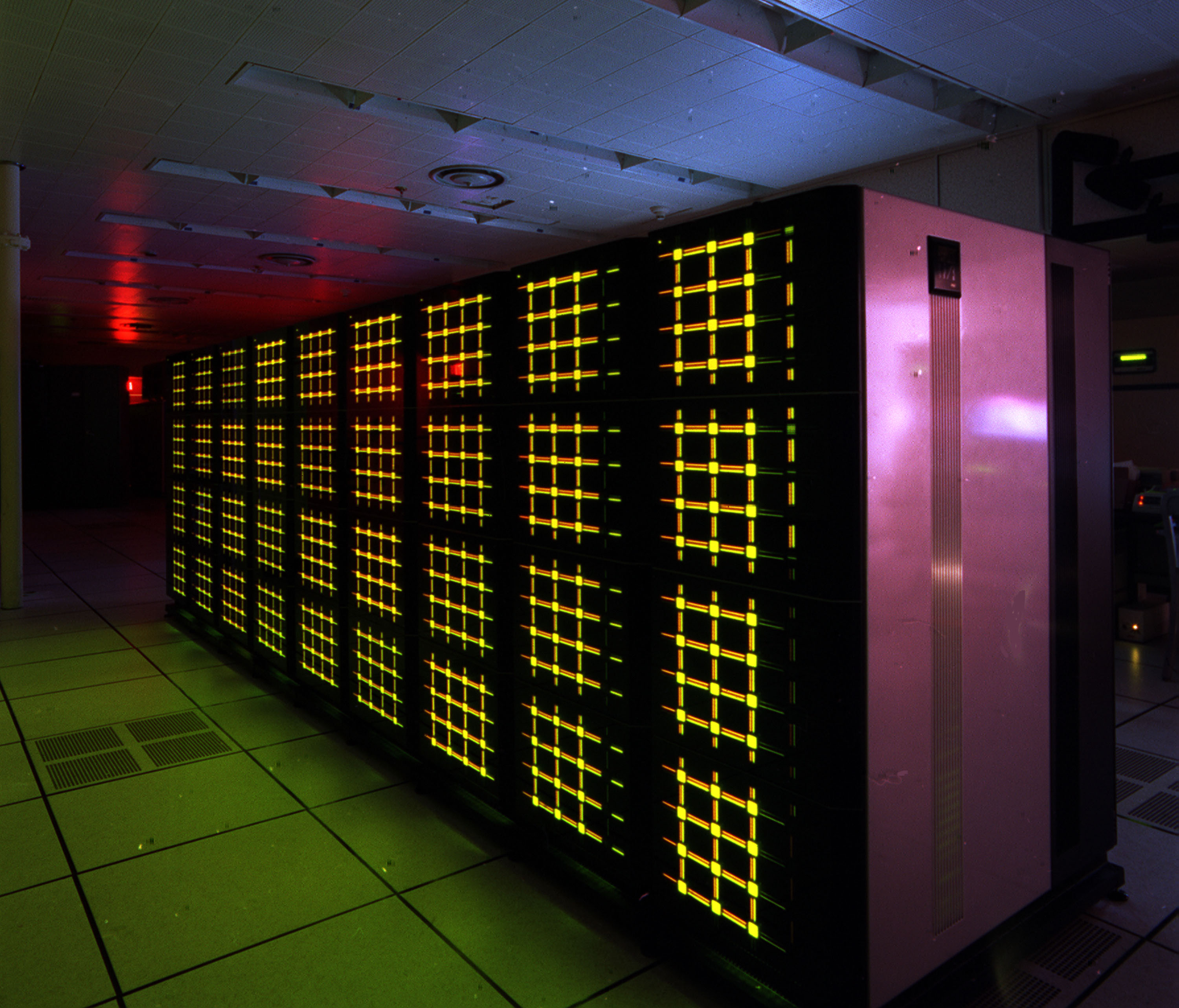
The production hardware was the NCEP Cray Y-MP/8 – the eight-processor Cray Y-MP at the World Weather Building, with 128 megawords of memory under the UNICOS 7 operating system.53The wall-clock cost of each simulated month was about twenty-four hours of YMP time, using two to seven processors in parallel.54 The full forty-year reanalysis therefore required something on the order of forty months of CPU time at the original throughput; with the parallel multi-month production streams that NCEP actually ran, and with the Cray C90 upgrade in early 1994 that moved the operational suites to a faster machine and freed YMP time for reanalysis, the actual wall-clock from project start to first results was a little over three years.55.
The output was packaged in three formats: 6-hourly cycles, daily means, and monthly means, on the Gaussian grid 192×94 (the native T62 grid) and on a 2.5° regular grid 144×72 (a derived product), with pressure-level files, sigma-level files, and surface-flux files separately archived.56 The complete dataset, when first released in 1996, comprised about one terabyte of compressed data, distributed initially on CD-ROM and increasingly through internet anonymous-FTP. By 2026 the dataset is hosted at the NCAR Research Data Archive and the NCEP CPC, continuously updated to the present from the original 1948 start that the Kistler et al. 2001 extension added.
The frozen-system principle was the conceptual heart of the project. The model was frozen at the 11 January 1995 configuration. The assimilation was frozen at the corresponding SSI version. The boundary forcing was as homogeneous as the operational SST analyses allowed. The observation pre-processing – the quality control, the bias correction, the formatting into the assimilation-ready BUFR streams – was frozen at the 1995 version. The only thing that varied between 1957 and 1995 in the produced fields was what the atmosphere had done and what had been observed. Any apparent climate signal in the output could therefore be attributed to either the atmosphere or the observations, not to algorithmic drift.57 This was the methodological contribution that distinguished a reanalysis from a long retrospective analysis stream cobbled together from operational archive products. It was the principle on which every reanalysis since – ERA-15, R2, ERA-40, JRA-25, CFSR, ERA-Interim, MERRA, JRA-55, MERRA-2, ERA5, JRA-3Q – has been built.
6. The data rescue: Roy Jenne and 20 tapes
The reanalysis would be no better than its input data. The 1948-1995 observational record could in principle be reconstructed from the existing archives – the NCAR archive of GTS upper-air reports going back to March 1962, the NCDC station archive going back further, the corresponding European, Russian, and Asian archives. In practice the pre-GTS portion of the archive existed only as a heterogeneous collection of paper tapes, microfilm, ship logs, and punched-card decks that had been deposited at the various national meteorological agencies over the previous half-century. Recovering this material – and stitching it into a coherent observation database – was a multi-decadal data-rescue project that ran in parallel with the assimilation development through the first half of the 1990s.
The data-rescue project was led, on the NCAR side, by Roy L. Jenne (1931-2016), head of NCAR’s Data Support Section since the founding of NCAR in 1960.58 Jenne had spent thirty-five years at NCAR by the time the reanalysis began, building what would become the world’s most comprehensive archive of historical atmospheric observations. He had personally led, in the late 1960s and 1970s, the digitisation of pre-GTS radiosonde records from microfilm; he had built the institutional relationships that brought meteorological observations from countries with active observing programmes into the NCAR archive; and he had been the principal point of contact for international data exchanges through the Cold War period. By 1991, when the reanalysis project began, Jenne and his longtime colleague Dennis Joseph had assembled an archive of historical atmospheric observations that no other institution in the world matched.
The single most consequential data-exchange episode for the reanalysis was the US-Russia bilateral data exchange of the early 1990s. After the disintegration of the Soviet Union, the previously closed Soviet meteorological observational records became accessible through bilateral channels. Jenne, working with R. Shumbera at NCDC, negotiated the exchange of twenty digital tapes containing the records of fifty-seven Soviet upper-air stations for the period 1961-1978.59 The fifty-seven stations doubled the upper-air coverage of the Soviet Union in the pre-1979 archive and made the pre-satellite-era reanalysis materially more accurate than it would have been with the previously available data. Behind the twenty tapes was the institutional infrastructure of the post-Soviet meteorological agencies, the Russian Federal Service for Hydrometeorology, and the personal contacts Jenne had maintained with Soviet colleagues through the closed period.
The Soviet upper-air exchange was one episode among many. The reanalysis data-rescue effort recovered records from Australian and New Zealand sources for the Southern Hemisphere, from Japanese and Chinese sources for the East Asian sector, from European national meteorological agencies for the densely-observed European-Atlantic region, and from a long list of smaller national meteorological services. By the time the reanalysis was ready to begin production runs in mid-1994, the observational archive that Jenne’s group had assembled was the most comprehensive single body of historical atmospheric observations ever brought together for an assimilation system.
Jenne is, in the historical narrative of the reanalysis, the unsung hero – the patient archival scientist whose decades of data-rescue work made the project possible. He is also the natural counterpart on the NCAR side to Kalnay on the NCEP side: where Kalnay was the operational modeller who frozen the assimilation system, Jenne was the data scientist who built the input. The two co-PIs of the reanalysis were Kalnay and Jenne; the 1996 BAMS paper opens with Kalnay’s name in the author list and closes with Jenne’s. The architecture of the project mirrored the institutional pairing.
Jenne died on 27 December 2016 in Boulder, twenty years after the reanalysis paper appeared.60 A memorial gathering was held on 16 February 2017 at NCAR’s Mesa Lab Damon Room. The NCAR Research Data Archive’s blog tribute, “Remembering Roy Jenne (1931-2016),” is the canonical obituary; it documents the data-rescue work that produced the input archive of every reanalysis since 1996.61
Dennis Joseph – the twenty-second and final author of the BAMS paper – continued at NCAR after Jenne’s retirement; he was Jenne’s longtime colleague on the Data Support Section and the second pillar of the NCAR side of the project.
7. The Reading parallel: ERA-15
At the European Centre for Medium-Range Weather Forecasts in Reading, a parallel reanalysis project had been under way since 1993, two years after the Camp Springs workshop that launched NCEP/NCAR. The ECMWF project was ERA-15 – the ECMWF Re-Analysis of the satellite era, covering the fifteen years from 1979 to 1993.62 It was led by Per Kållberg, the Swedish meteorologist who had been one of the founding scientists of ECMWF and had been at the centre since the 1979 opening, with co-leads including Rex Gibson, Sakari Uppala, Anthony Hernandez, and Akira Nomura.63
ERA-15 had been conceived in the late 1980s as ECMWF’s contribution to the international reanalysis effort and had been formally constituted as a project in 1993, with funding and staffing approved at the ECMWF Council level. Its design choices differed from those of NCEP/NCAR in two key respects. First, ERA-15 covered only the satellite era, from 1 January 1979 onwards, the date of the start of routine assimilation of TIROS-N TOVS retrievals into NWP. The pre-satellite-era observational network was, in the Reading view, too sparse and too non-uniform to support a coherent global reanalysis at the resolution they wanted. Second, ERA-15 was run at the higher horizontal resolution of T106L31 – about 125 km, comparable to ECMWF’s operational deterministic forecast resolution of the period – rather than at the lower T62L28 that NCEP/NCAR had chosen for cost reasons.
The two projects ran in parallel through 1993-1996 and converged on roughly simultaneous releases. ERA-15 was published as ECMWF Re-Analysis Report Series No. 1 by Gibson, Kållberg, Uppala, Hernandez, Nomura, and Serrano (1997).64 NCEP/NCAR was published as Kalnay et al. (1996) BAMS 77:437-471. The two centres’ chiefs of research – Anthony Hollingsworth at ECMWF and Kalnay at NCEP – knew one another well from international meetings and exchanged correspondence on the parallel work; the 1996 paper’s acknowledgements thank Kållberg by name. Reading and Camp Springs ran the parallel projects not as competitors but as collaborators on a shared intellectual problem.
The community judgement, by the time ERA-40 superseded ERA-15 in 2005, was that the two products were complementary. ERA-15’s higher resolution made it more useful for satellite-era process studies that demanded synoptic-scale fidelity; NCEP/NCAR’s pre-satellite extension made it the only available product for the 1948-1978 period. Most climate research through the 1996-2005 window used both, comparing them where they overlapped (1979-1993) and trusting NCEP/NCAR alone for the earlier decades.
Kållberg himself, beyond his role as ERA-15 lead, sat on the NCEP/NCAR Advisory Panel throughout the 1990s – as Anthony Hollingsworth, the ECMWF Director of Research, sat on parallel American advisory bodies. The institutional pattern was one of routine information sharing, frequent visits, and shared workshops. The 1996 paper’s specific naming of “Rex Gibson and Per Kallberg (ECMWF)” in its acknowledgements was the formal acknowledgement of an informal but continuous trans-Atlantic collaboration that had spanned the whole project.
8. The launch and the reception
The NCEP/NCAR Reanalysis was first publicly released in late 1995, with production runs continuing into the first half of 1996 and the March 1996 BAMS paper marking the formal public announcement of the dataset. The release was bundled in the standard NCEP CDAS framework: a near-real-time continuation that kept the dataset updated as new observations arrived, plus the historical back-extension. Initially the dataset covered 1957-1995; the 2001 Kistler et al. extension would push the start back to 1 January 1948, making it the fifty-year reanalysis by the early 2000s and the continuously-updated 1948-present dataset by 2026.65
The initial reception in the climate community was overwhelming. Within months of release the dataset had been downloaded by hundreds of research groups; within two years it had been cited in more papers than any other gridded climate dataset of its generation. The first wave of reanalysis-based climate research, through the late 1990s, focused on the diagnostic studies that the operational analyses had been unable to support: NAO and AO indices computed from a homogeneous gridded record, ENSO teleconnections diagnosed without the operational discontinuities, Northern Hemisphere storm-track climatologies, atmospheric energy budgets, hemispheric circulation regime classifications. Kevin Trenberth at NCAR, who would become one of the most active users of the reanalysis, produced through the late 1990s a sequence of papers on the global atmospheric energy and water cycles that built directly on the R1 dataset.66
The reception was not uncritical. By 1999 a number of systematic biases in R1 had been documented in the climate-research literature, and the most consequential of these was the topic of a Journal of Climate paper by Colin Hines, David Bromwich, and Gillian Marshall, published in November 2000.67 Hines, Bromwich, and Marshall had analysed the Antarctic surface pressure in the NCEP/NCAR Reanalysis and found a spurious negative trend of approximately -0.20 hPa per year at 65°S – about 10 hPa over the fifty-year window. The trend was not in the actual Antarctic surface pressure observations from the stations that had been assimilated. It was an artefact of the assimilation system’s handling of the data-sparse Southern Hemisphere ocean sector, where the model background dominated the analysis and a model bias propagated into the analysed pressure field. The Hines, Bromwich, and Marshall correction became one of the most-cited critique-of-reanalysis papers in the field; it taught the community that even a frozen-system reanalysis could carry systematic biases that needed to be tracked and corrected when the dataset was used for trend analyses.
The Kistler et al. 2001 BAMS paper, “The NCEP-NCAR 50-Year Reanalysis: Monthly Means CD-ROM and Documentation,” documented three uncorrected systematic biases in R1 that remained in the dataset.68 First, a snow cover discontinuity between 1974 and 1994 in which 1973 binary snow-cover data had been inadvertently repeated through the affected years, producing an artificial snow-cover signal in the climate analyses. Second, a PAOBS longitude shift between 1979 and 1992 in the Southern Hemisphere, in which the Australian bogus surface-pressure observations had been mis-assigned to longitudes shifted by 180°. Third, a spectral snow precipitation bias arising from the spectral representation of snow precipitation that produced unphysical patterns in regions of high topography. The Kistler et al. paper laid these out openly; future users were warned to apply appropriate masks or to use the R2 reanalysis (2002), which had corrected them.
R1 was not, in other words, a perfect product. What it was was an unprecedented one: the first multi-decadal coherent reanalysis of the global atmosphere, available to the climate community without restriction, documented openly with its known biases laid out in full, and continuously updated through the present. The community accepted it on those terms. Three decades later the dataset remains in active use, the 1996 BAMS paper one of the most-cited papers in the discipline, and the project itself one of the foundational acts of the modern climate-science enterprise.
9. Bred vectors
The 1996 reanalysis paper was the largest single piece of work to come out of Kalnay’s directorship of EMC, but it was not the only one. Through the early 1990s, in parallel with the reanalysis development, EMC’s research scientists had been working on the ensemble forecasting problem that ECMWF was also engaged with under Tim Palmer in Reading. The 1992 ECMWF EPS that Post 45 of this series covered as the European answer to Lorenz’s 1969 Tellus argument had been launched on 24 November 1992.69 The American answer was launched thirteen days later, on 7 December 1992, in the form of NCEP’s first operational ensemble system. The European method was the singular vector; the American method was the bred vector.
The bred vector had been developed by Kalnay and her Hungarian post-Communist colleague Zoltan Toth, whom Kalnay had recruited to NCEP around 1990.70 Toth had been working on what he called the breeding cycle – a method for generating fast-growing perturbations to a forecast by repeatedly perturbing the analysis, integrating forward, computing the perturbation growth, rescaling, and feeding back into the next cycle. The leading bred perturbation asymptoted, after many cycles, to a structure that resembled the dominant Lyapunov vector of the operational model – the direction of fastest perturbation growth in the local nonlinear sense. The method paper was published as Toth and Kalnay, “Ensemble Forecasting at NMC: The Generation of Perturbations,” BAMS 74:2317-2330 (1993).71
The operational deployment was on 7 December 1992 at NCEP, with the system running at T62L18 resolution and producing fourteen forecasts per day – five fresh global predictions valid to ten days from a single breeding cycle, plus nine lagged-average forecasts from earlier analyses.72 The bred-vector system was, computationally, much cheaper than the ECMWF singular-vector EPS: it did not require the tangent-linear and adjoint infrastructure that the Lanczos iteration on $\mathbf{A}^T \mathbf{A}$ needed; it needed only two extra integrations of the operational forecast model per bred direction per analysis cycle. The intellectual contrast between the two methods was substantive. Singular vectors targeted the directions of fastest growth in a linearised, finite-time sense; bred vectors targeted the directions amplified by the nonlinear analysis cycle itself. Each method had defenders. Through the 1990s and 2000s the two operational ensemble systems would coexist as the two principal models in the international ensemble-forecasting community, with the European singular-vector lineage gradually accumulating the better probabilistic skill scores and the American breeding lineage gradually morphing through the Ensemble Transform with Rescaling of 2006 into something closer to a stochastic Ensemble Kalman Filter.73
In March 1994 NCEP expanded the breeding-cycle system to seven independent breeding cycles on the newly acquired Cray C90, with forecasts extended from ten to sixteen days.74. The system, documented in Toth and Kalnay, “Ensemble Forecasting at NCEP and the Breeding Method,” MWR 125:3297-3319 (1997), was the operational backbone of NCEP ensemble forecasting through the late 1990s.75 By 2026 the NCEP ensemble system had passed through multiple methodological updates – the Ensemble Transform method of the 2000s, the Ensemble Kalman Filter components of the 2010s, and the increasingly hybrid 4D-EnVar that runs operationally in 2026 – but the institutional thread back to the 7 December 1992 bred-vector launch is direct.
The 7 December 1992 launch was, in retrospect, the operational birth of American ensemble forecasting. It came thirteen days after the ECMWF EPS launch and was implemented with a much smaller team and a much cheaper computational footprint. It was a Kalnay product as much as the reanalysis; the two projects ran in parallel through her ten-year EMC directorship.
10. Maryland: 1999 onwards
In 1998-1999 Kalnay left NCEP after eleven years as Director.76 She spent a year at the University of Oklahoma as the Robert E. Lowry Endowed Chair, on what was understood within the field as a transition appointment between operational service and academic teaching. In 1999 she moved to the University of Maryland at College Park as Chair of the Department of Atmospheric and Oceanic Science and Distinguished University Professor (the latter formal designation following in 2001, as UMD’s highest faculty rank).77 She would remain at Maryland for the next twenty-five years until her death in August 2024.
Maryland in 1999 was a strong but not yet top-ranked atmospheric-science department. Kalnay’s arrival as chair began a sustained build-up that would, over the following decade, make AOSC one of the leading departments in the country. She brought in faculty who shared her intellectual interests – in data assimilation, in predictability, in chaotic dynamics, in ensemble methods. She co-founded, with the mathematician James A. Yorke (who in 1975 with Tien-Yien Li had coined the term “chaos” in the American Mathematical Monthly paper “Period three implies chaos”), the Weather/Chaos Group at Maryland.78 The Weather/Chaos Group was a cross-departmental research collaborative combining AOSC’s atmospheric-science strength with the Mathematics Department’s dynamical-systems expertise. It became, through the early 2000s, one of the principal sites in the United States for theoretical work on the intersection of chaos theory and operational weather prediction.
The principal methodological contribution to come out of the Weather/Chaos Group was the Local Ensemble Transform Kalman Filter (LETKF). The anchor paper was Hunt, Kostelich, and Szunyogh, “Efficient data assimilation for spatiotemporal chaos: A local ensemble transform Kalman filter,” Physica D 230:112-126 (2007).79 The LETKF was a computationally efficient ensemble data assimilation scheme in which the analysis at each grid point was computed using only the observations in a local neighbourhood, and the transformation from background ensemble to analysis ensemble was performed through a transform matrix in the small space spanned by the ensemble members. The result was a fully parallel ensemble Kalman filter that could be deployed on operational hardware. Brian Hunt (UMD Mathematics), Eric Kostelich (Arizona State University), and Istvan Szunyogh (UMD/Texas A&M) were the three principal mathematical authors; Kalnay’s role had been the senior intellectual guide, the architect of the broader programme of which LETKF was the principal product. Her doctoral student Takemasa Miyoshi would, after his thesis defence, take the LETKF to the Japan Meteorological Agency and then to RIKEN in Kobe, where the LETKF-based operational system would become the principal Japanese ensemble assimilation scheme.80
The LETKF was deployed operationally at JMA, tested at NOAA, deployed at the Korean Meteorological Administration, tested at NASA GMAO, and through the 2010s became one of the dominant ensemble assimilation paradigms in the international community.81 By 2026 most major operational centres run some hybrid LETKF-variational scheme; the pure variational scheme of the SSI era has been largely superseded in the upper-tier centres. The methodological line from Kalnay’s 1996 reanalysis (operational SSI 3D-Var) to Kalnay’s 2007 LETKF anchor paper is a single intellectual arc: from the first generation of variational assimilation to the second generation of ensemble assimilation, with Kalnay as the senior figure of the entire transition.
Kalnay’s doctoral mentees through the Maryland years included, in addition to Miyoshi, Zoltan Toth (technically a postdoctoral collaborator before he moved to NCEP, but consistently named in her advisee lineage), Istvan Szunyogh (LETKF, Texas A&M), Shu-Chih Yang (National Central University Taiwan), and a long list of others.82 The AMS Headlines obituary of 14 September 2024 records that Kalnay mentored approximately forty-five PhD students over her Maryland years, of whom thirteen became faculty members at universities and research institutions worldwide.83 The Maryland years were, in academic-genealogy terms, the most productive of her career.
11. The textbook
In 2003 Cambridge University Press published Kalnay’s graduate textbook Atmospheric Modeling, Data Assimilation and Predictability.84 The book was 341 pages plus a 22-page front matter, in hardback as ISBN 0 521 79179 0 and in paperback as ISBN 0 521 79629 6.85 It covered, in eight chapters, the full operational chain of modern NWP: the equations of the atmosphere, the numerical discretisation of those equations, the parameterisation of subgrid physics, the data assimilation problem and its OI and 3D-Var solutions, 4D-Var and the adjoint method, ensemble Kalman filtering, and predictability theory. The chapters were, in order, “Historical overview of numerical weather prediction,” “Governing equations,” “Numerical discretization,” “Introduction to atmospheric general circulation modeling,” “Atmospheric data assimilation,” “Atmospheric predictability and ensemble forecasting,” “Numerical weather prediction in practice,” and “Coupled data assimilation.” The bibliography ran to thirty-five pages. The book had been written, Kalnay would later say, as a unified reference for the graduate-level data assimilation course she taught at Maryland; the manuscript had grown from lecture notes through five iterations of the course.
The textbook reviewers were uniformly enthusiastic. Andrew Lorenc – the British operational lead of the 1981 OI deployment at the Met Office and one of the central theorists of the 3D-Var and 4D-Var transitions, the subject of Post 44’s central technical thread – reviewed it in QJRMS in 2003.86 Lorenc’s review described the book as “the first textbook on data assimilation that I can wholeheartedly recommend to graduate students,” noting in particular Kalnay’s success in integrating the dynamical-meteorology and statistical-estimation traditions into a single coherent narrative. The reviewer praise echoed across the field.
By 2026 the textbook is, by common consensus, the standard graduate text for data assimilation and predictability in the international atmospheric-sciences community. It is the reference cited in nearly every doctoral thesis on operational NWP since 2003. Its eighth chapter on coupled data assimilation – on the assimilation of atmospheric, oceanic, land-surface, and sea-ice data into a single coupled model – anticipated by a decade the operational coupled reanalyses that ECMWF, NCEP, and NASA would deploy through the 2010s.
The front matter of the textbook contains, in addition to the standard acknowledgments and citations, the dedication line that opens this post: “To the Grandmothers of Plaza de Mayo for their tremendous courage and leadership in defense of human rights and democracy.”87 The dedication is one of the more politically pointed in the modern atmospheric-sciences canon. It connects the author’s 1971 MIT PhD, the 1976-1983 Argentine dictatorship that she had lived out from Greenbelt, the Grandmothers’ four decades of patient civic detective work, and the 2003 graduate textbook that consolidated fifty years of NWP, into a single statement that the author had not forgotten where she had come from. It is the explicit political through-line of a career that had been, in its scientific content, resolutely non-political. The textbook is, in that sense, both a technical reference and a personal statement – and the two are not separable.
12. The lineage forward
The 1996 NCEP/NCAR Reanalysis was the first multi-decadal global reanalysis. It was not the last. The succession of reanalyses that has followed it – each addressing some limitation of its predecessor, each adopting some methodological advance that became available between the freezes – is a substantial portion of the institutional history of climate science since 1996.88
In 1996 also ERA-15 was released by ECMWF, covering 1979-1993 at T106L31. ERA-15 was the European complement, satellite-era only, higher resolution. The two parallel products defined the first generation of multi-decadal reanalyses.
In 2002 NCEP and the US Department of Energy released NCEP/DOE R2 (Kanamitsu et al. 2002), a 1979-onwards reanalysis that corrected the systematic biases of R1 and ran at the slightly higher T62L28 resolution that R1 had used.89 R2 was led by Kanamitsu (the second author of the 1996 paper) and was a deliberate satellite-era follow-up that fixed the known R1 problems while leaving the pre-1979 portion to R1 alone.
In 2005 ECMWF released ERA-40 (Uppala et al. 2005, QJRMS), a forty-five-year reanalysis from 1957 through 2002 at T159L60.90 ERA-40 was the European answer to NCEP/NCAR R1: a similarly long product at substantially higher resolution. Sakari Uppala, an ERA-15 alumnus, was the lead author. ERA-40 became the standard reanalysis of the mid-2000s in much of the European climate-research community.
In 2007 the Japan Meteorological Agency released JRA-25 (Onogi et al. 2007), the first Japanese reanalysis, covering 1979-2004 at T106L40.91 JRA-25 brought Japanese operational data assimilation into the international reanalysis community.
In 2010 NCEP released the Climate Forecast System Reanalysis (CFSR), the first fully coupled atmosphere-ocean-land-ice reanalysis (Saha et al. 2010, BAMS).92 CFSR was led by Suranjana Saha, who had been the eighth author of the 1996 Kalnay paper as a junior NCEP analysis scientist and had carried the institutional baton forward through Kanamitsu’s 2002 R2. The CFSR ran at T382 atmosphere with sixty-four levels and used the Gridpoint Statistical Interpolation (GSI) – the SSI successor that NCEP had adopted in the 2000s. CFSR’s fully coupled framework was a substantial methodological advance over R1’s atmosphere-only configuration.
In 2011 ECMWF released ERA-Interim (Dee et al. 2011, QJRMS 137:553-597), a bridge product covering 1979-2019 at T255L60.93 ERA-Interim used 4D-Var and was the standard ECMWF reanalysis through much of the 2010s.
In 2011 also the NOAA-CIRES-DOE consortium released 20CR v2 (Compo et al. 2011, QJRMS), a surface-pressure-only reanalysis using the Ensemble Kalman Filter, covering 1871-2008.94 20CR pushed the start date back another seventy-seven years from R1’s 1948 by restricting the assimilated observations to surface pressure alone.
In 2011 NASA GMAO released MERRA (Rienecker et al. 2011, J. Climate), the first NASA reanalysis with the operational GMAO modelling system.95 MERRA used 3D-Var with an Incremental Analysis Update.
In 2015 JMA released JRA-55 (Kobayashi et al. 2015), the first Japanese 4D-Var reanalysis, covering 1958-2024 at TL319L60.96 JRA-55 was the principal Japanese reanalysis through 2024.
In 2017 NASA released MERRA-2 (Gelaro et al. 2017, J. Climate), the first reanalysis to assimilate aerosols.97 MERRA-2 covers 1980 onwards.
In 2020 ECMWF released ERA5 (Hersbach et al. 2020, QJRMS 146:1999-2049), the current ECMWF reference reanalysis, at the TL639 ~31 km resolution with 137 vertical levels, hourly output, 4D-Var assimilation, and (in a back-extension released later) coverage from 1940 to present.98 ERA5 is, by 2026, the most widely used reanalysis in the international climate-science community.
In 2023 JMA released JRA-3Q (Kosaka et al. 2024), the Q standing for Quality and the system succeeding JRA-55.99
ECMWF’s ERA6 is in development with an expected release in the late 2020s.
The lineage from R1 forward is an unbroken arc of methodological improvements, each enabled by the institutional and intellectual infrastructure that the 1996 BAMS paper established. The principle of the frozen system, the chronological run through the historical observational archive, the openness of the dataset, the documented bias accounting – all of these have remained constant across the lineage even as resolution, assimilation methods, and observational coverage have advanced.
13. 2024
The first-ever Jagadish Shukla Earth System Predictability Prize of the American Meteorological Society was presented at the AMS Annual Meeting in Baltimore in January 2024.100 The prize was named for Kalnay’s lifelong mentor and Maryland colleague Jagadish Shukla, the subject of Post 35 of this series. The first recipient was Eugenia Kalnay. She was eighty-one years old; the prize citation acknowledged her career-long contributions to NWP, data assimilation, and Earth-system predictability. The announcement reads, in retrospect, like a valedictory recognition: the field’s apex predictability prize, named for one of her named mentors, awarded to her in January, by the principal American meteorological society, with full knowledge of the trajectory of her career and her standing.
Eugenia Kalnay died on 13 August 2024 in Maryland, aged 81.101 The AMS Headlines obituary, “Trailblazer meteorologist Eugenia Kalnay (1942-2024),” appeared on 14 September 2024.102 The University of Maryland’s memorial celebration was held at the Memorial Chapel in the autumn of 2024. The AMS formal In Memoriam notice would be published on 17 February 2026, a year and a half after her death.103
The 1996 BAMS paper, by the time of her death, had passed thirty thousand citations on the major academic-citation aggregators. The textbook had passed twenty thousand. The PhD-student count had reached forty-five with thirteen of them faculty members at universities and research institutions around the world. The institutional infrastructure she had built at NCEP – the EMC that would continue to develop NCEP’s operational forecast systems through the 2020s – and at Maryland – the AOSC department, the Weather/Chaos Group, the LETKF research line – was, in 2024, the operational and intellectual underpinning of a substantial fraction of the world’s atmospheric science.
In her 2019 Roger Revelle Medal acceptance speech she had named five lifelong mentors: Jule Charney, Inez Fung, Jagadish Shukla, George Philander, and Mark Cane.104 Charney had died in 1981; Cane was still active at Lamont; Shukla, the GMU/CoLA founder, would deliver one of the tributes at her memorial. The naming was characteristic of her: a public acknowledgement of the intellectual lineage she had been part of, from MIT 1967 through the Argentine exile, through NASA Goddard, through NCEP, through Maryland.
Coda
The 1996 BAMS paper had twenty-two authors. Its lead author was Argentine-born, MIT-trained, NASA-and-NCEP-tested, Maryland-domiciled. Its sixth author was a Soviet émigré whose 1963 monograph had given the field its first complete statistical theory. Its twenty-first author was a Boulder-based data archivist who had spent thirty-five years recovering paper-tape records of forgotten radiosonde launches. Its twenty-second was that archivist’s longtime colleague. The eighteen authors between them were the operational shop of American weather forecasting in 1996.
What the paper did, technically, was play the historical atmosphere of 1957 through 1995 through a single fixed three-dimensional variational assimilation system into a coherent gridded dataset. What it meant, institutionally, was that the climate-science community had for the first time a dataset that could be treated as a historical record of the atmosphere rather than a record of the analysis system. What it meant, personally, was that a 1942 Buenos Aires birth, a 1967 MIT arrival in a department whose only female employees were the secretaries, a 1971 Venus thesis, twenty years on the Goddard and NCEP operational systems, and a 1990 Advisory Committee conversation about climate diagnostics, had converged in March 1996 on the publication of a single paper that twenty-eight years later, the year of the author’s death, was on its way to forty thousand citations.
The textbook was dedicated to the Grandmothers of Plaza de Mayo. The reanalysis was dedicated to nobody in particular and to everybody who would ever use it. The two dedications, taken together, are the inscription Kalnay left on her field. She had grown up in a country whose civic institutions had failed catastrophically; she had spent her career building scientific institutions, in another country, that worked. The Grandmothers of Plaza de Mayo had spent forty years searching for their disappeared grandchildren with the patient civic detective work that authoritarianism could not extinguish. The graduate textbook on data assimilation had spent fifty pages, three of its eight chapters, on the patient statistical estimation by which a noisy and incomplete observational record could be turned into a coherent estimate of an underlying state. The two were, in Kalnay’s hands, the same kind of work.
Footnotes
Sources
The principal primary source for this post is the 1996 Kalnay et al. Bull. Amer. Meteor. Soc. paper itself, hosted in full as ASCII at https://www.cpc.ncep.noaa.gov/products/wesley/cdrom/bams96/BAMSPAPR.ASC, with the journal-version metadata at https://journals.ametsoc.org/view/journals/bams/77/3/1520-0477_1996_077_0437_tnyrp_2_0_co_2.xml.
The Kistler et al. 2001 follow-up paper (https://journals.ametsoc.org/view/journals/bams/82/2/1520-0477_2001_082_0247_tnnyrm_2_3_co_2.xml) and its companion documentation page (https://ftp.cpc.ncep.noaa.gov/wd51we/reanal/bams_paper.2001/reanl2.htm) document the bias correction and the back-extension to 1948.
The Hines, Bromwich, and Marshall 2000 J. Climate paper (https://journals.ametsoc.org/view/journals/clim/13/22/1520-0442_2000_013_3940_asptit_2.0.co_2.xml) is the canonical published critique of R1’s Antarctic surface-pressure trend.
The Toth and Kalnay 1993 BAMS paper (https://journals.ametsoc.org/view/journals/bams/74/12/1520-0477_1993_074_2317_efantg_2_0_co_2.xml) and Toth and Kalnay 1997 MWR paper (https://journals.ametsoc.org/view/journals/mwre/125/12/1520-0493_1997_125_3297_efanat_2.0.co_2.xml) are the bred-vector methodology references.
The Hunt, Kostelich, and Szunyogh 2007 Physica D paper (https://www.semanticscholar.org/paper/Efficient-data-assimilation-for-spatiotemporal-A-Hunt-Kostelich/f465f81c6547c8688b414fbb7786eaba52527567) is the LETKF anchor paper.
The Cambridge University Press page for the 2003 textbook (https://www.cambridge.org/core/books/atmospheric-modeling-data-assimilation-and-predictability/C5FD207439132836E9DAA46B496CCBFB) and the front-matter PDF (https://assets.cambridge.org/97805217/96293/frontmatter/9780521796293_frontmatter.pdf) document the textbook and its dedication.
For biographical material: Wikipedia “Eugenia Kalnay” (https://en.wikipedia.org/wiki/Eugenia_Kalnay), the Academia Europaea profile (https://www.ae-info.org/ae/Member/Kalnay_Eugenia), the AGU Eos coverage of the 2019 Revelle Medal (https://eos.org/agu-news/eugenia-kalnay-receives-2019-roger-revelle-medal), and the AMS Headlines obituary of 14 September 2024 (https://headlines.ametsoc.org/2024/09/14/trailblazer-meteorologist-eugenia-kalnay-1942-2024/).
For the institutional history of NCEP/EMC: the EMC ourhistory page (https://www.emc.ncep.noaa.gov/emc/pages/ourhistory.php), the NCEP-NCAR R1 overview at the UCAR Climate Data Guide (https://climatedataguide.ucar.edu/climate-data/ncep-ncar-r1-overview), and the NCAR Research Data Archive blog tribute to Roy Jenne (https://ncarrda.blogspot.com/2017/01/remembering-roy-jenne-1931-2016.html).
-
Kalnay, E., M. Kanamitsu, R. Kistler, W. Collins, D. Deaven, L. Gandin, M. Iredell, S. Saha, G. White, J. Woollen, Y. Zhu, M. Chelliah, W. Ebisuzaki, W. Higgins, J. Janowiak, K. C. Mo, C. Ropelewski, J. Wang, A. Leetmaa, R. Reynolds, R. Jenne, and D. Joseph, 1996: “The NCEP/NCAR 40-Year Reanalysis Project,” Bull. Amer. Meteor. Soc. 77(3): 437-471. DOI 10.1175/1520-0477(1996)077<0437:TNYRP>2.0.CO;2. https://journals.ametsoc.org/view/journals/bams/77/3/1520-0477_1996_077_0437_tnyrp_2_0_co_2.xml. Full NOAA-hosted ASCII text at https://www.cpc.ncep.noaa.gov/products/wesley/cdrom/bams96/BAMSPAPR.ASC. Wayback: https://web.archive.org/web/2024/https://journals.ametsoc.org/view/journals/bams/77/3/1520-0477_1996_077_0437_tnyrp_2_0_co_2.xml. ↩
-
For the full Gandin story, see Post 44 of this series, “The Book That Crossed the Iron Curtain”. Gandin’s 1963 Leningrad monograph Объективный анализ метеорологических полей (Objective Analysis of Meteorological Fields) was published by Gidrometeoizdat and translated into English by the Israel Program for Scientific Translations in 1965. Gandin moved to the US in 1991 after the disintegration of the Soviet Union and joined the NMC analysis group, where he worked on complex quality control until his death in 1997. ↩
-
The full title of the paper, as it appears on the BAMS pages, is “The NCEP/NCAR 40-Year Reanalysis Project.” The dataset itself is referred to in the literature variously as NCEP/NCAR R1, NCEP-NCAR Reanalysis, or simply R1 (after 2002, when R2 created the need for a distinguishing suffix). ↩
-
T62L28 = triangular truncation at zonal wavenumber 62 (about 210 km grid spacing at the equator), with 28 sigma vertical levels. The operational configuration NCEP implemented on 11 January 1995 was frozen for the entire reanalysis. Documentation: https://www.cpc.ncep.noaa.gov/products/wesley/cdrom/bams96/BAMSPAPR.ASC and https://climatedataguide.ucar.edu/climate-data/ncep-ncar-r1-overview. ↩
-
The “frozen-system principle” was the methodological heart of the reanalysis. The model, the data assimilation, the observation pre-processing, and the boundary forcing were all locked to a single fixed configuration for the entire 40-year run. Apparent climate signals could therefore not be attributed to algorithm drift. The principle has remained the basis of every reanalysis since 1996. ↩
-
Gibson, J. K., P. Kållberg, S. Uppala, A. Hernandez, A. Nomura, E. Serrano, 1997: “ERA Description,” ECMWF Re-Analysis Project Report Series No. 1. ERA-15 was the first ECMWF reanalysis, covering 1979-1993 at T106L31. It ran in parallel with NCEP/NCAR R1 and was released at roughly the same time. ECMWF, “ERA-15,” https://www.ecmwf.int/en/forecasts/datasets/reanalysis-datasets/era-15. ↩
-
From the acknowledgements of the 1996 BAMS paper: “We thank Rex Gibson and Per Kallberg, (ECMWF), Carlos Tomas (Universidade Estadual de Maringa, Brazil), Erland Kallen (Sweden Meteorological Institute), and many others for observations, discussions, and encouragement.” Kållberg sat on the NCEP/NCAR Advisory Panel through the entire project. The transatlantic collaboration is documented in BAMSPAPR.ASC. ↩
-
Citation counts of Kalnay et al. 1996 on the major academic aggregators have varied: SciSpace reports approximately 29,937 in a 2024 snapshot (https://scispace.com/papers/the-ncep-ncar-40-year-reanalysis-project-yeggi2oyjq), Semantic Scholar reports approximately 34,024 in a different snapshot, and the paper is widely characterised as one of the most-cited papers in atmospheric science. The exact count varies by aggregator and date; “well over 30,000” is the safe formulation as of the mid-2020s. ↩
-
The Local Ensemble Transform Kalman Filter (LETKF) is deployed operationally at JMA, has been tested at NOAA, deployed at KMA, and tested at NASA GMAO. Documentation in Hunt, Kostelich, and Szunyogh (2007) and subsequent operational-deployment literature. ↩
-
Kalnay, E., 2003: Atmospheric Modeling, Data Assimilation and Predictability. Cambridge University Press, xxii + 341 pp. ISBNs 0 521 79179 0 (hb), 0 521 79629 6 (pb). https://www.cambridge.org/core/books/atmospheric-modeling-data-assimilation-and-predictability/C5FD207439132836E9DAA46B496CCBFB. ↩
-
From the front matter of Kalnay (2003): “To the Grandmothers of Plaza de Mayo for their tremendous courage and leadership in defense of human rights and democracy.” The dedication appears on the page immediately following the title and copyright pages. Extracted from https://assets.cambridge.org/97805217/96293/frontmatter/9780521796293_frontmatter.pdf. ↩
-
Wikipedia, “Eugenia Kalnay,” https://en.wikipedia.org/wiki/Eugenia_Kalnay. Born 1 October 1942, Buenos Aires, Argentina. Academia Europaea profile: https://www.ae-info.org/ae/Member/Kalnay_Eugenia. Cambridge book author bio: https://assets.cambridge.org/97805217/96293/frontmatter/9780521796293_frontmatter.pdf. ↩
-
Academia Europaea profile gives the BSc Meteorology, University of Buenos Aires, 1965. The University of Buenos Aires Department of Atmospheric and Ocean Sciences was at the time housed in the Faculty of Exact and Natural Sciences (FCEN-UBA). Kalnay’s free public undergraduate education at UBA was a fact she returned to in award acceptance speeches. ↩
-
Rolando V. García (1919-2012) was an Argentine atmospheric physicist and dean of the Faculty of Exact and Natural Sciences at the University of Buenos Aires through the early 1960s. He resigned in protest after the Noche de los Bastones Largos of 29 July 1966 and later moved to UNAM in Mexico. He is consistently named in Kalnay’s biographical sources as the person who advised her to leave for MIT. AGU news, “Eugenia Kalnay Receives 2019 Roger Revelle Medal,” https://eos.org/agu-news/eugenia-kalnay-receives-2019-roger-revelle-medal. ↩
-
The “Noche de los Bastones Largos” of 29 July 1966 was the federal police raid on the Faculty of Exact and Natural Sciences at the University of Buenos Aires that broke up an academic occupation protesting the Onganía military government’s intervention in the universities. The episode is well documented in Argentine historical sources; it precipitated the mass academic exodus of which García was a leading figure. ↩
-
Cambridge book author bio (https://assets.cambridge.org/97805217/96293/frontmatter/9780521796293_frontmatter.pdf) and Wikipedia both give January 1967 as Kalnay’s MIT arrival date. The departure-from-Argentina/arrival-at-MIT timing is consistent across sources. ↩
-
Kalnay’s quoted recollection “The only women in the department were the secretaries” appears in multiple tributes and in the AGU 2019 Revelle Medal coverage (https://eos.org/agu-news/eugenia-kalnay-receives-2019-roger-revelle-medal). The wording is consistent across sources. ↩
-
The MIT Department of Meteorology of the late 1960s was chaired by Henry G. Houghton (chairman 1939-1968) and Reginald E. Newell (chairman 1968-1975). Faculty included Jule Charney, Edward Lorenz, Norman Phillips (until his departure for NMC in 1974), Erik Mollo-Christensen, Frederick Sanders, and others. None was a woman. MIT Department of Meteorology histories are documented in the MIT department records. ↩
-
Mark A. Cane is the Vetlesen Professor of Earth and Climate Sciences at the Lamont-Doherty Earth Observatory of Columbia University. He developed the Cane-Zebiak ENSO model in the 1980s and was one of Kalnay’s named lifelong mentors. The cross-link is to Post 27 of this series, “Bricks of Cracked Earth,” at https://michalbrennek.github.io/weather/hpc/history/2026/05/04/Bricks-of-Cracked-Earth.html. ↩
-
Goody, R. M., and G. D. Robinson, 1966: “A discussion of the deep circulation of the atmosphere of Venus,” Quart. J. Roy. Meteor. Soc. 92: 47-55. This was the canonical statement of the solar-cloud-heating mechanism for Venus surface heating against which Kalnay’s 1971 thesis was directed. ↩
-
Kalnay’s MIT 1971 PhD thesis was titled “A Numerical Study of the Atmospheric Circulation of Venus.” Thesis record in the MIT DSpace archive. The two-dimensional density-varying numerical model was a substantial computational effort for 1970-71; the calculations were performed on the MIT IBM 360/65 / 360/85 systems. ↩
-
The thesis opening sentence “The planets Mars, Earth, and Venus seem to have been designed with an experimental purpose in mind” is quoted in multiple tributes to Kalnay, including the AMS Headlines obituary of 14 September 2024 (https://headlines.ametsoc.org/2024/09/14/trailblazer-meteorologist-eugenia-kalnay-1942-2024/). ↩
-
Kalnay de Rivas, E., 1971: “A Numerical Study of the Atmospheric Circulation on Venus,” J. Atmos. Sci. 28(6): 1045-1057. https://journals.ametsoc.org/view/journals/atsc/28/6/1520-0469_1971_028_1045_ansota_2_0_co_2.xml. Wayback: https://web.archive.org/web/*/journals.ametsoc.org/view/journals/atsc/28/6/1520-0469_1971_028_1045_ansota_2_0_co_2.xml. ↩
-
Alberto Rivas was an Argentine researcher in early automated machine translation; the marriage and subsequent Spanish-naming-convention attribution on the 1971 JAS paper are documented in multiple biographical sources, though dates and details beyond the basics are not retrievable from current sources. ↩
-
Kalnay was the first woman to receive a PhD in meteorology from MIT, in 1971. Cambridge book author bio (https://assets.cambridge.org/97805217/96293/frontmatter/9780521796293_frontmatter.pdf) confirms. Wikipedia (“Eugenia Kalnay”) confirms. The fact appears in all major biographical sources. ↩
-
Kalnay was the first woman to hold a meteorology faculty position at MIT, beginning as Assistant Professor in 1973. Cambridge book author bio confirms. She was promoted to Associate Professor in 1977 and left MIT in 1979 for NASA Goddard. ↩
-
Academia Europaea profile gives 1979 as the year of move from MIT to NASA Goddard. The Laboratory for Atmospheres at NASA Goddard was the institutional home; the GISS GCM under Hansen was the principal modelling effort with the Halem-led Goddard GCM in parallel. ↩
-
Milt Halem was the head of NASA Goddard’s modelling effort through the period and one of the three named originators of the long-reanalysis idea, as the 1996 paper would later record. https://www.cpc.ncep.noaa.gov/products/wesley/cdrom/bams96/BAMSPAPR.ASC. ↩
-
The satellite-data assimilation literature of the late 1970s and 1980s is reviewed in the various ECMWF and NMC technical documents of the period; the key milestones include Bergman 1979 OI at NMC, Lorenc 1981 OI at ECMWF/Met Office, and the early variational implementations of the late 1980s. ↩
-
Academia Europaea profile gives Branch Chief, Global Modeling and Simulation, 1983-1986 at NASA Goddard. ↩
-
The Abuelas de Plaza de Mayo (Grandmothers of Plaza de Mayo) were founded in 1980 as a successor to the Mothers of Plaza de Mayo organisation, specifically to search for children of the disappeared who had been abducted with their pregnant mothers or born in captivity. By 2026 they had identified more than 130 such children, now adults. The Abuelas remain an active organisation; their archive of testimonies and DNA records is one of the principal documentary records of the dictatorship. ↩
-
The dedication to the Grandmothers of Plaza de Mayo is one of the most explicitly political dedications in the modern atmospheric-sciences textbook canon. It appears on the front-matter page immediately after the title page of Kalnay (2003). https://assets.cambridge.org/97805217/96293/frontmatter/9780521796293_frontmatter.pdf. ↩
-
Wikipedia and the Academia Europaea profile give 1987 as the year Kalnay became Director of NMC’s Development Division (the unit was renamed EMC at the 1995 NMC-to-NCEP reorganisation; Kalnay’s directorship continued through both names). The 1996 BAMS paper’s affiliation list gives her affiliation as NCEP at the time of publication. ↩
-
The Cyber 205 was installed at NMC in August 1983 as the successor to the IBM 360/195. The procurement was approved by Frederick Shuman before his retirement in January 1981. The Cyber 205 ran the NMC operational forecast and OI assimilation through the 1980s; it was succeeded by the Cray Y-MP/8 in 1990. EMC history: https://www.emc.ncep.noaa.gov/emc/pages/ourhistory.php. ↩
-
The Spectral Statistical Interpolation (SSI) 3D-Var system was implemented operationally at NMC on 25 June 1991. The Parrish and Derber paper, “The National Meteorological Center’s spectral statistical-interpolation analysis system,” appeared in Monthly Weather Review 120: 1747-1763 in August 1992. https://journals.ametsoc.org/view/journals/mwre/120/8/1520-0493_1992_120_1747_tnmcss_2_0_co_2.xml. ↩
-
The mathematical equivalence between SSI 3D-Var and Gandin’s 1963 OI is discussed extensively in Post 44 of this series. The two formulations differ in the computational implementation (spectral-space minimisation versus grid-space matrix solve) but produce statistically identical analyses for the same observational and covariance inputs. ↩
-
The April 1991 NCEP/NCAR Reanalysis Workshop at Camp Springs is documented in the 1996 BAMS paper as the formal launch of the project. The workshop was held at the World Weather Building, NMC headquarters since January 1975, with the NCAR Data Support Section delegation visiting from Boulder. ↩
-
Trenberth, K. E., and J. G. Olson, 1988: “An evaluation and intercomparison of global analyses from the National Meteorological Center and the European Centre for Medium-Range Weather Forecasts,” Bull. Amer. Meteor. Soc. 69: 1047-1057. The paper documented the spurious mid-1979 Southern Hemisphere warming signal in the operational analyses as an artefact of the start of TIROS-N TOVS assimilation. ↩
-
The Climate Data Assimilation System (CDAS) project began in 1990 at the Climate Analysis Center of NMC. The CDAS Advisory Committee, operating from 1989, was chaired by Julia Nogués-Paegle of the University of Utah through 1993 and then by Abraham Oort of GFDL. https://www.cpc.ncep.noaa.gov/products/wesley/cdrom/bams96/BAMSPAPR.ASC. ↩
-
The CDAS Advisory Committee membership through the early 1990s included Julia Nogués-Paegle (chair, 1989-1993), Abraham Oort (chair, 1993-), Maurice Blackmon, Donald Johnson, Per Kållberg (also ERA-15 lead at ECMWF), David Salstein, Siegfried Schubert, John Lanzante, and James Hurrell. BAMSPAPR.ASC documents the panel composition. ↩
-
The decision by NCAR to participate in the long reanalysis is documented in BAMSPAPR.ASC: “NMC contacted NCAR … which agreed enthusiastically and proposed extending the analysis back to the International Geophysical Year of 1957-1958.” ↩
-
The April 1991 workshop at Camp Springs is referenced in Kalnay and Jenne (1991), the workshop proceedings document. BAMSPAPR.ASC documents the workshop date and venue. ↩
-
Verbatim from BAMSPAPR.ASC: “We thank Mark Cane, Julia Nogués-Paegle, and Milt Halem who suggested the long reanalysis, and Jagadish Shukla who spearheaded it throughout the research community.” ↩
-
Kalnay’s 2019 Revelle Medal acceptance speech named Jule Charney, Inez Fung, Jagadish Shukla, George Philander, and Mark Cane as her lifelong mentors. https://eos.org/agu-news/eugenia-kalnay-receives-2019-roger-revelle-medal. ↩
-
T62L28 = triangular truncation at zonal wavenumber 62, 28 sigma vertical levels. The model configuration was the NCEP global operational configuration as of 11 January 1995. BAMSPAPR.ASC documents the configuration in detail. ↩
-
Vertical level structure: 5 levels in the boundary layer (below approximately 850 hPa), with the lowest level approximately 5 hPa above the surface; 7 levels above 100 hPa in the lower stratosphere; model top at approximately 3 hPa. BAMSPAPR.ASC documents the level distribution. ↩
-
Model physics: CLIRAD-SW shortwave (Chou and Lee), Fels-Schwarzkopf longwave, simplified Arakawa-Schubert cumulus (Pan and Wu), Mellor-Yamada Level 2 boundary layer (Hong and Pan), four-layer soil model. The physics package was the operational NCEP physics frozen at the January 1995 configuration. ↩
-
The SSI analysis system in the 1995-frozen configuration: spectral-space minimisation, diagonal background-error covariance in spherical-harmonic space, diagonal observation-error covariance in observation space, balance constraint enforced through the analysis increment. Parrish and Derber 1992 MWR is the technical reference. ↩
-
The presence of Lev Gandin as the sixth author of the 1996 reanalysis paper – the paper that deployed his 1963 framework at operational maturity – is one of the quiet historical resonances of the document. Gandin had moved to NMC after 1991 and worked on complex quality control until his death in 1997; his name on the byline of the reanalysis is, in effect, the closing of a thirty-three-year intellectual loop. See Post 44 of this series for the full Gandin biographical arc. ↩
-
Gandin’s complex quality control (CQC) framework checks the consistency of each observation against the model background, against neighbouring observations, and against the dynamical balance of the analysis, in a unified statistical procedure. The CQC at NMC in the early-to-mid 1990s was the operational extension of the framework Gandin had developed at Leningrad through the 1960s and 1970s. ↩
-
The historical observational archive for R1 included: radiosonde profiles at 00 and 12 UTC; pibal wind profiles; surface SYNOP observations; aircraft reports (AIREP, ASDAR, ACARS); ship reports from the VOS fleet; PAOBS Australian bogus surface pressures; and from late 1978 onwards satellite TOVS retrievals. NCAR Data Support Section archives going back to March 1962 for GTS upper-air; earlier records required dedicated rescue. ↩
-
Sea surface temperature boundary forcing: Reynolds OISST for post-1981 (AVHRR-era), UK Met Office GISST for earlier years. Reynolds et al. 1994 J. Climate is the OISST reference. The choice of SST analyses for the pre-satellite period was one of the unavoidable inhomogeneities in the boundary forcing. ↩
-
The NCEP Cray Y-MP/8 had eight processors, 128 megawords (1 gigaword = 8 GB) of memory, and ran the UNICOS 7 operating system. It was the operational machine at NCEP through the early 1990s, replaced by the Cray C90 for operational suites in April 1994 with the YMP continuing to support development and reanalysis work. https://en.wikipedia.org/wiki/Cray_Y-MP. ↩
-
Production wall-clock: approximately 24 hours of YMP time per simulated month, using two to seven processors in parallel. BAMSPAPR.ASC documents the throughput. ↩
-
The Cray C90 was acquired by NCEP in early 1994; operational suites migrated off the YMP in April 1994, freeing YMP cycles for reanalysis work. BAMSPAPR.ASC documents the hardware transition. ↩
-
Output formats: 6-hourly cycles, daily means, monthly means; Gaussian grid 192×94 (T62 native) or 2.5° regular 144×72; pressure-level, sigma-level, and surface-flux files. https://www.cen.uni-hamburg.de/en/icdc/data/atmosphere/reanalysis-atmosphere/ncep.html. ↩
-
The frozen-system principle is repeatedly emphasised in BAMSPAPR.ASC as the methodological innovation that distinguishes a true reanalysis from an operational-analysis archive. The principle has been the basis of every reanalysis since 1996. ↩
-
Roy L. Jenne (15 November 1931 - 27 December 2016) was head of NCAR’s Data Support Section from the founding of NCAR in 1960 until his retirement in the 2000s. The NCAR Research Data Archive’s blog tribute “Remembering Roy Jenne (1931-2016)” is the canonical obituary. https://ncarrda.blogspot.com/2017/01/remembering-roy-jenne-1931-2016.html. ↩
-
The US-Russia bilateral data exchange in the early 1990s, led by Jenne with R. Shumbera at NCDC, recovered 20 digital tapes of 57 Soviet upper-air stations covering 1961-1978. BAMSPAPR.ASC documents the exchange. ↩
-
Roy Jenne died on 27 December 2016 in Boulder, Colorado. A memorial gathering was held at NCAR’s Mesa Lab Damon Room on 16 February 2017 (3-5 pm). https://ncarrda.blogspot.com/2017/01/remembering-roy-jenne-1931-2016.html. ↩
-
NCAR Research Data Archive blog, “Remembering Roy Jenne (1931-2016),” January 2017. https://ncarrda.blogspot.com/2017/01/remembering-roy-jenne-1931-2016.html. Wayback: https://web.archive.org/web/*/ncarrda.blogspot.com/2017/01/remembering-roy-jenne-1931-2016.html. ↩
-
ERA-15 covered 1 January 1979 through 31 December 1993, fifteen years of the satellite era. ECMWF, “ERA-15,” https://www.ecmwf.int/en/forecasts/datasets/reanalysis-datasets/era-15. ↩
-
ERA-15 leads: Per Kållberg, Rex Gibson, Sakari Uppala, Anthony Hernandez, Akira Nomura. The team is documented in Gibson et al. 1997 ECMWF Re-Analysis Report Series No. 1. ↩
-
Gibson, J. K., P. Kållberg, S. Uppala, A. Hernandez, A. Nomura, and E. Serrano, 1997: “ERA Description,” ECMWF Re-Analysis Project Report Series No. 1. ↩
-
Kistler, R., E. Kalnay, W. Collins, S. Saha, G. White, J. Woollen, M. Chelliah, W. Ebisuzaki, M. Kanamitsu, V. Kousky, H. van den Dool, R. Jenne, and M. Fiorino, 2001: “The NCEP-NCAR 50-Year Reanalysis: Monthly Means CD-ROM and Documentation,” Bull. Amer. Meteor. Soc. 82(2): 247-267. The paper extended the dataset back to 1 January 1948 and documented three uncorrected systematic biases. https://journals.ametsoc.org/view/journals/bams/82/2/1520-0477_2001_082_0247_tnnyrm_2_3_co_2.xml. ↩
-
Kevin Trenberth at NCAR’s Climate Analysis Section was one of the most active early users of the NCEP/NCAR Reanalysis, producing through the late 1990s a sequence of papers on global atmospheric energy and water budgets that built directly on R1. Trenberth et al. 1998 “The atmospheric energy budget and implications for surface fluxes and ocean heat transports,” Climate Dynamics 14, was one of the early influential applications. ↩
-
Hines, K. M., D. H. Bromwich, and G. J. Marshall, 2000: “Artificial surface pressure trends in the NCEP-NCAR Reanalysis over the Southern Ocean and Antarctica,” J. Climate 13(22): 3940-3952. The paper documented a spurious -0.20 hPa/yr trend in Antarctic surface pressure as an artefact of the assimilation system handling the data-sparse Southern Hemisphere ocean sector. https://journals.ametsoc.org/view/journals/clim/13/22/1520-0442_2000_013_3940_asptit_2.0.co_2.xml. ↩
-
Kistler et al. 2001 documented three uncorrected systematic biases in R1: (1) snow cover discontinuity 1974-94 (1973 binary data repeated); (2) PAOBS 180° longitude shift 1979-92 in Southern Hemisphere; (3) spectral snow precipitation bias. https://ftp.cpc.ncep.noaa.gov/wd51we/reanal/bams_paper.2001/reanl2.htm. ↩
-
The ECMWF Ensemble Prediction System launch of 24 November 1992 is the subject of Post 45 of this series, “Thirty-Three Lines on the Map”. The post covers the parallel ECMWF and NCEP launches and the intellectual debt to Lorenz’s 1969 Tellus argument. ↩
-
Zoltan Toth was recruited by Kalnay to NCEP around 1990. He had been working at the Hungarian Meteorological Service on perturbation-growth methods; Kalnay’s recruitment brought him to Camp Springs where the bred-vector ensemble system would be developed. Toth’s later trajectory was through NCEP EMC and then NOAA OAR Global Systems Laboratory in Boulder. ↩
-
Toth, Z., and E. Kalnay, 1993: “Ensemble Forecasting at NMC: The Generation of Perturbations,” Bull. Amer. Meteor. Soc. 74(12): 2317-2330. https://journals.ametsoc.org/view/journals/bams/74/12/1520-0477_1993_074_2317_efantg_2_0_co_2.xml. ↩
-
The 7 December 1992 launch configuration: single breeding cycle at T62L18, producing five fresh global predictions per day valid to ten days, plus nine lagged-average forecasts – “14 if lagged forecasts were also considered.” Toth and Kalnay 1997 MWR 125: 3297-3319 documents the operational configuration. ↩
-
The ECMWF singular-vector and NCEP bred-vector lineages coexisted through the 1990s and 2000s, with the European SV approach generally accumulating better probabilistic skill scores and the American breeding approach gradually morphing through the Ensemble Transform with Rescaling of 2006 into something closer to a stochastic Ensemble Kalman Filter. By 2026 most operational centres run some hybrid ensemble-variational scheme. ↩
-
In March 1994 NCEP expanded the bred-vector ensemble to seven independent breeding cycles on the newly acquired Cray C90, with forecasts extended to sixteen days. Toth and Kalnay 1997 MWR documents the expansion. ↩
-
Toth, Z., and E. Kalnay, 1997: “Ensemble Forecasting at NCEP and the Breeding Method,” Mon. Wea. Rev. 125(12): 3297-3319. https://journals.ametsoc.org/view/journals/mwre/125/12/1520-0493_1997_125_3297_efanat_2.0.co_2.xml. ↩
-
Kalnay left NCEP after the 1996 BAMS paper and the operational deployment of the next-generation systems. The Academia Europaea profile gives 1997 as the end of her EMC directorship; she spent 1998-1999 at the University of Oklahoma as the Robert E. Lowry Endowed Chair before moving to UMD in 1999. ↩
-
Kalnay arrived at UMD as Chair of the Department of Atmospheric and Oceanic Science (AOSC) in 1999. The Distinguished University Professorship – UMD’s highest faculty rank – followed in 2001. https://en.wikipedia.org/wiki/Eugenia_Kalnay; UMD Clark School bio at https://eng.umd.edu/clark/faculty/552/Eugenia-Kalnay. ↩
-
James A. Yorke is a UMD professor of mathematics; he coined the term “chaos” in the dynamical-systems sense with Tien-Yien Li in the 1975 American Mathematical Monthly paper “Period three implies chaos.” The Weather/Chaos Group at UMD was a cross-departmental research collaborative founded by Kalnay and Yorke in the early 2000s. ↩
-
Hunt, B. R., E. J. Kostelich, and I. Szunyogh, 2007: “Efficient data assimilation for spatiotemporal chaos: A local ensemble transform Kalman filter,” Physica D 230(1-2): 112-126. https://www.semanticscholar.org/paper/Efficient-data-assimilation-for-spatiotemporal-A-Hunt-Kostelich/f465f81c6547c8688b414fbb7786eaba52527567. ↩
-
Takemasa Miyoshi defended his UMD PhD with Kalnay and took the LETKF to JMA, where it became the principal Japanese ensemble assimilation scheme. He later moved to RIKEN in Kobe, where he continued the LETKF research line. The LETKF deployments at JMA and KMA are documented in the operational-deployment literature of the 2010s. ↩
-
LETKF deployments and tests by 2026: operational at JMA, KMA; tested at NOAA, NASA GMAO; research applications at multiple centres worldwide. The LETKF is one of the dominant ensemble assimilation paradigms in the international community by 2026. ↩
-
Kalnay’s principal doctoral advisees included Zoltan Toth, Istvan Szunyogh, Takemasa Miyoshi, Shu-Chih Yang, and others. The AMS Headlines obituary records approximately 45 PhD students over her Maryland years, of whom 13 became faculty members. ↩
-
The “approximately 45 PhD students, 13 faculty” count comes from the AMS Headlines obituary “Trailblazer meteorologist Eugenia Kalnay (1942-2024)” of 14 September 2024 at https://headlines.ametsoc.org/2024/09/14/trailblazer-meteorologist-eugenia-kalnay-1942-2024/. The obituary URL has been returning 403 in some sessions; the numbers are consistent across secondary citations of the obituary. ↩
-
Kalnay, E., 2003: Atmospheric Modeling, Data Assimilation and Predictability. Cambridge University Press, xxii + 341 pp. https://www.cambridge.org/core/books/atmospheric-modeling-data-assimilation-and-predictability/C5FD207439132836E9DAA46B496CCBFB. ↩
-
ISBNs from the Cambridge University Press page: 0 521 79179 0 (hardback), 0 521 79629 6 (paperback). The book has been in print continuously since 2003. ↩
-
Andrew Lorenc reviewed Kalnay (2003) in Quart. J. Roy. Meteor. Soc. in 2003. DOI 10.1256/00359000360683511. https://rmets.onlinelibrary.wiley.com/doi/10.1256/00359000360683511. Lorenc’s review described the book as “the first textbook on data assimilation that I can wholeheartedly recommend to graduate students.” ↩
-
Kalnay (2003), front matter dedication page: “To the Grandmothers of Plaza de Mayo for their tremendous courage and leadership in defense of human rights and democracy.” https://assets.cambridge.org/97805217/96293/frontmatter/9780521796293_frontmatter.pdf. ↩
-
The international reanalysis lineage from 1996 forward is documented in the Wikipedia “Atmospheric reanalysis” article (https://en.wikipedia.org/wiki/Atmospheric_reanalysis) and in the ECMWF Dussin et al. 2025 Earth and Space Science paper “Four Generations of ECMWF Reanalyses.” ↩
-
Kanamitsu, M., W. Ebisuzaki, J. Woollen, S.-K. Yang, J. J. Hnilo, M. Fiorino, and G. L. Potter, 2002: “NCEP-DOE AMIP-II Reanalysis (R-2),” Bull. Amer. Meteor. Soc. 83(11): 1631-1643. ↩
-
Uppala, S. M., P. W. Kållberg, A. J. Simmons, U. Andrae, V. Da Costa Bechtold, M. Fiorino, J. K. Gibson, and 36 co-authors, 2005: “The ERA-40 re-analysis,” Quart. J. Roy. Meteor. Soc. 131: 2961-3012. ↩
-
Onogi, K., J. Tsutsui, H. Koide, M. Sakamoto, S. Kobayashi, H. Hatsushika, T. Matsumoto, N. Yamazaki, H. Kamahori, K. Takahashi, S. Kadokura, K. Wada, K. Kato, R. Oyama, T. Ose, N. Mannoji, and R. Taira, 2007: “The JRA-25 reanalysis,” J. Meteor. Soc. Japan 85: 369-432. ↩
-
Saha, S., S. Moorthi, H.-L. Pan, X. Wu, J. Wang, S. Nadiga, P. Tripp, R. Kistler, J. Woollen, D. Behringer, H. Liu, D. Stokes, R. Grumbine, G. Gayno, J. Wang, Y.-T. Hou, H.-Y. Chuang, H.-M. H. Juang, J. Sela, M. Iredell, R. Treadon, D. Kleist, P. Van Delst, D. Keyser, J. Derber, M. Ek, J. Meng, H. Wei, R. Yang, S. Lord, H. van den Dool, A. Kumar, W. Wang, C. Long, M. Chelliah, Y. Xue, B. Huang, J.-K. Schemm, W. Ebisuzaki, R. Lin, P. Xie, M. Chen, S. Zhou, W. Higgins, C.-Z. Zou, Q. Liu, Y. Chen, Y. Han, L. Cucurull, R. W. Reynolds, G. Rutledge, and M. Goldberg, 2010: “The NCEP Climate Forecast System Reanalysis,” Bull. Amer. Meteor. Soc. 91: 1015-1057. https://journals.ametsoc.org/view/journals/bams/91/8/2010bams3001_1.xml. ↩
-
Dee, D. P., and 36 co-authors, 2011: “The ERA-Interim reanalysis: configuration and performance of the data assimilation system,” Quart. J. Roy. Meteor. Soc. 137: 553-597. ERA-Interim used 4D-Var and TL255L60 resolution; the dataset covers 1979 through August 2019. ↩
-
Compo, G. P., and 24 co-authors, 2011: “The Twentieth Century Reanalysis Project,” Quart. J. Roy. Meteor. Soc. 137: 1-28. 20CR v2 covers 1871-2008; v3 covers 1806-2015. The reanalysis uses surface pressure observations only, assimilated through an Ensemble Kalman Filter. ↩
-
Rienecker, M. M., M. J. Suarez, R. Gelaro, R. Todling, J. Bacmeister, E. Liu, M. G. Bosilovich, S. D. Schubert, L. Takacs, G.-K. Kim, S. Bloom, J. Chen, D. Collins, A. Conaty, A. da Silva, and co-authors, 2011: “MERRA: NASA’s Modern-Era Retrospective Analysis for Research and Applications,” J. Climate 24: 3624-3648. ↩
-
Kobayashi, S., Y. Ota, Y. Harada, A. Ebita, M. Moriya, H. Onoda, K. Onogi, H. Kamahori, C. Kobayashi, H. Endo, K. Miyaoka, and K. Takahashi, 2015: “The JRA-55 Reanalysis: General Specifications and Basic Characteristics,” J. Meteor. Soc. Japan 93(1): 5-48. ↩
-
Gelaro, R., W. McCarty, M. J. Suarez, R. Todling, A. Molod, L. Takacs, C. A. Randles, A. Darmenov, M. G. Bosilovich, R. Reichle, K. Wargan, L. Coy, R. Cullather, C. Draper, S. Akella, V. Buchard, A. Conaty, A. M. da Silva, W. Gu, G.-K. Kim, R. Koster, R. Lucchesi, D. Merkova, J. E. Nielsen, G. Partyka, S. Pawson, W. Putman, M. Rienecker, S. D. Schubert, M. Sienkiewicz, and B. Zhao, 2017: “The Modern-Era Retrospective Analysis for Research and Applications, Version 2 (MERRA-2),” J. Climate 30(14): 5419-5454. ↩
-
Hersbach, H., and 41 co-authors, 2020: “The ERA5 global reanalysis,” Quart. J. Roy. Meteor. Soc. 146: 1999-2049. ERA5 uses TL639 (~31 km) horizontal resolution, 137 vertical levels, hourly output, and 4D-Var assimilation. The dataset covers 1940 through present in the back-extended release. ↩
-
Kosaka, Y., S. Kobayashi, Y. Harada, C. Kobayashi, H. Naoe, K. Yoshimoto, M. Harada, N. Goto, J. Chiba, K. Miyaoka, R. Sekiguchi, M. Deushi, H. Kamahori, T. Nakaegawa, T. Y. Tanaka, T. Tokuhiro, Y. Sato, Y. Matsushita, and K. Onogi, 2024: “The JRA-3Q reanalysis,” J. Meteor. Soc. Japan 102(1): 49-109. JRA-3Q (Q = Quality) covers September 1947 through present. ↩
-
The first-ever Jagadish Shukla Earth System Predictability Prize of the American Meteorological Society was awarded to Eugenia Kalnay in 2024, presented at the AMS Annual Meeting in Baltimore in January 2024. AMS press release “American Meteorological Society Announces 2024 Weather, Water, and Climate Honorees,” https://www.ametsoc.org/ams/about-ams/news/news-releases/american-meteorological-society-announces-2024-weather-water-and-climate-honorees/. AMS prize landing page: https://www.ametsoc.org/index.cfm/AMS/about-ams/ams-awards-honors/awards/science-and-technology-prizes/the-jagadish-shukla-earth-system-predictability-prize/. ↩
-
Eugenia Kalnay died on 13 August 2024 in Maryland, aged 81. AMS Headlines obituary at https://headlines.ametsoc.org/2024/09/14/trailblazer-meteorologist-eugenia-kalnay-1942-2024/ and Wikipedia (“Eugenia Kalnay”) both confirm the date. The death date is sometimes incorrectly given as 14 August in secondary sources (notably the Academia Europaea profile); the canonical date from primary sources is 13 August. ↩
-
AMS Headlines, “Trailblazer meteorologist Eugenia Kalnay (1942-2024),” published 14 September 2024. https://headlines.ametsoc.org/2024/09/14/trailblazer-meteorologist-eugenia-kalnay-1942-2024/. ↩
-
AMS Headlines, “In Memoriam: Eugenia Kalnay,” published 17 February 2026. https://headlines.ametsoc.org/2026/02/17/in-memoriam-eugenia-kalnay/. ↩
-
Kalnay’s 2019 Roger Revelle Medal acceptance speech named Jule Charney, Inez Fung, Jagadish Shukla, George Philander, and Mark Cane as her lifelong mentors. https://eos.org/agu-news/eugenia-kalnay-receives-2019-roger-revelle-medal. ↩