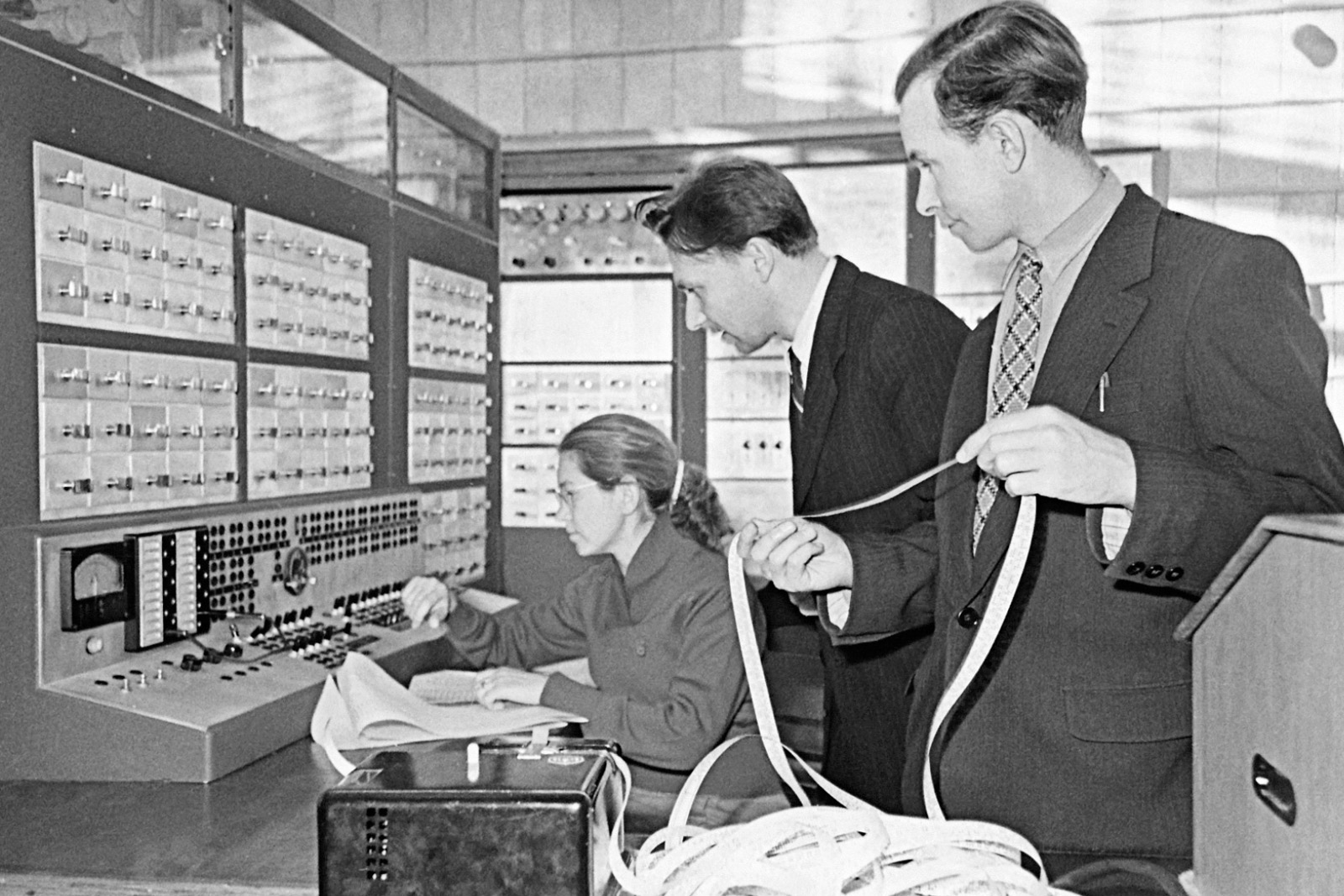
In January 1960, in a basement classroom of Spanagel Hall on the campus of the U.S. Naval Postgraduate School at Monterey, California, a quiet thirty-four-year-old electrical engineer from Wisconsin stood next to a freshly-installed digital computer the size of two large refrigerators. The computer carried a manufacturer’s serial-number plate stamped 001. The engineer had personally certified the machine in the previous days. He had wired some of its connections by hand, signed off on its acceptance test, and watched its first operational program complete a sample numerical integration of a simple ordinary differential equation. The room (Spanagel Hall, Room 101A) was small and the machine filled most of it. A small group of Navy officers and a handful of civilian researchers stood around watching as the engineer, whose name was Seymour Cray, finished his last walkthrough and prepared to leave Monterey on the late train back to Minnesota.
The machine was the Control Data Corporation 1604. It was among the first commercially successful general-purpose scientific computers built using transistors throughout rather than vacuum tubes – the IBM 7090, announced in 1958 and first installed in December 1959, was its closest transistorised contemporary – and it was the first such machine designed from the ground up by a startup. It had a 48-bit word, hardware floating point, and a magnetic-core random-access memory of 32 768 words. It ran at roughly 100 000 single-address operations per second. It cost a little under one million dollars in 1960 dollars. It was built by a startup company that did not exist three years before, by a man who had walked out of his previous employer two and a half years before. Its serial number was 001.1
Eight months later, in August 1960, the Naval Postgraduate School’s Navy numerical weather group – known at the time as NANWEP (Naval Weather Plotting and Analysis facility, renamed Fleet Numerical Weather Facility, FNWF, in 1961) and running on the same CDC 1604 in Spanagel Hall – produced what its commanding officer Captain Paul M. Wolff described in the Navy’s annual report as “the first surface weather map produced by a computer.” By December 1961, FNWF was using its 1604 to generate forecast products and to distribute them by teleprinter to more than one hundred U.S. Navy ships and shore stations across the Pacific. CDC’s 1963 sales brochure quoted, with quiet pride, “two billion computations per analysis-and-forecast cycle.” FNWF would later expand, become the Fleet Numerical Oceanography Center, and is today the U.S. Navy’s principal operational meteorology and oceanography centre at the same site in Monterey.2
The story of how a startup founded in 1957 by a Nebraska farm boy, a St. Paul jeweller’s son, and a quiet engineer from Chippewa Falls Wisconsin came to ship a machine in January 1960 that would become the Navy’s first operational weather computer is the subject of this post. The story starts in a shuttered glider factory in St. Paul, runs through a Sperry-Rand boardroom in Philadelphia, includes one of the first major engineer-led equity exits in American business history, and ends in a hometown laboratory in a small Wisconsin town that Cray had never really wanted to leave.
ERA: Out of CSAW
The story begins, as so much of the early-computer story does, with U.S. Navy codebreakers.
In January 1946, in St. Paul, Minnesota, four men signed the founding documents of a company called Engineering Research Associates. They were John Parker, a financier and former Navy officer; Howard Engstrom, a Yale mathematician who had spent the war breaking Japanese fleet codes; William Norris, a Nebraska-born electrical engineer (B.S.E.E., University of Nebraska 1932) who had also spent the war on cryptanalysis; and Ralph Meader, another wartime cryptanalyst. All four had served at the Naval Computing Machine Laboratory at Communications Supplementary Activity Washington (CSAW), the Navy’s central WWII codebreaking facility on Nebraska Avenue in northwest Washington D.C. The CSAW operation had grown from a handful of people in 1941 to several thousand by 1945, designing and building special-purpose electromechanical and electronic machines for cryptanalytic work. After the war, with the Pacific theater closing down and the Navy’s special-purpose machines no longer needed at full wartime intensity, the CSAW alumni were dispersing – some to academia, some to the brand-new Office of Naval Research, some to the National Security Agency that would be formally founded in 1952.3
The deal Engstrom and Norris had structured was unusual. ERA would not be a defence contractor in the conventional sense. It would be a private company in St. Paul Minnesota, but it would receive most of its revenue from classified contracts with the Navy and (later) NSA, doing exactly the same kind of work that had been done at CSAW during the war. Parker had put up about $220 000 in personal capital; the company’s first office was the second floor of a shuttered glider factory at 1902 Minnehaha Avenue in St. Paul, which Parker had owned during the war. The technical staff was almost entirely former CSAW employees. The company’s first major project was ATLAS, an electronic stored-program digital computer designed for NSA cryptanalytic work, completed in 1950. ATLAS’s commercial sibling, the ERA 1101, was the first U.S.-designed stored-program scientific computer to be sold on the open market.4
ERA built the 1101, then the 1102 (a smaller variant), then the ERA 1103 (a substantially more powerful 36-bit scientific machine, 1953). The 1103 was the machine on which a young engineer named Seymour Cray – twenty-eight years old, a recent University of Minnesota master’s graduate in applied mathematics, who had joined ERA in 1950 – did his first major computer work as a junior team member.
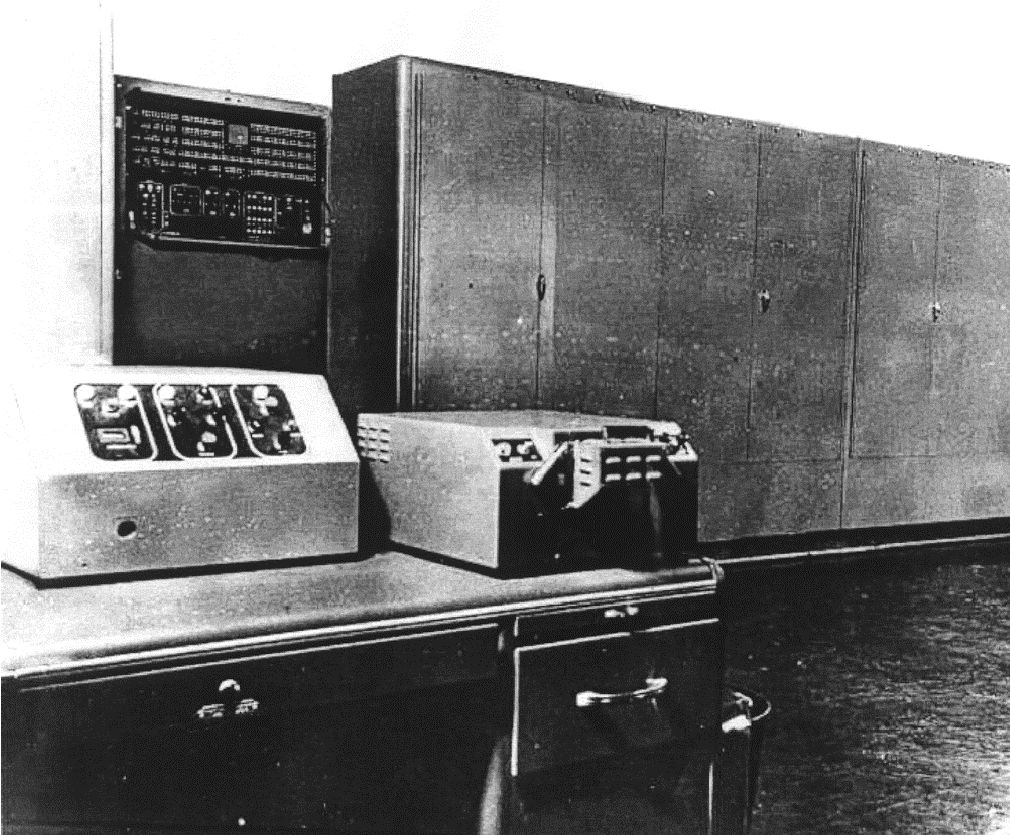
In 1952 ERA was sold. Parker’s outside investors had been pressing for years for liquidity; the company was profitable but not on the trajectory that would justify the kind of valuation a public offering would require. Remington Rand offered to buy ERA outright. Parker, after some agonising, accepted. Remington Rand merged ERA with its other recently acquired computing operation – the Eckert-Mauchly Computer Corporation in Philadelphia, makers of the UNIVAC – and in 1955, when Remington Rand was in turn merged with the Sperry Corporation to form Sperry-Rand, the combined company’s computing operation was a single division called Sperry Univac. ERA in St. Paul was now a subsidiary of a subsidiary of a conglomerate. Decisions about products were made in Philadelphia. The St. Paul team – engineers who had been doing leading-edge scientific computing under their own steam since 1946 – were now reporting to managers who had run a successful office-equipment business and viewed digital computers primarily as eventual replacements for tabulating machines.5
The product cycle slowed. The Philadelphia UNIVAC team prioritised commercial mainframes for banks and insurance companies. The St. Paul scientific team’s project ideas were repeatedly deferred, modified, or cancelled outright in favour of commercial-mainframe work. Norris – by then a senior executive at Sperry-Rand’s St. Paul operations – was demoted in 1956 in a corporate reorganisation. The next year, several of the St. Paul team’s most senior engineers privately concluded that they were not going to be allowed to ship a machine that mattered.
The walkout
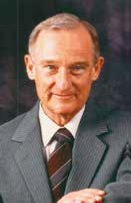
In early 1957 a small group of Sperry-Rand employees in St. Paul began meeting privately to plan the founding of a new company. The earliest meetings were not led by Norris. According to Frank C. Mullaney’s 1986 oral history at the Charles Babbage Institute – the single most detailed primary-source account of the period – the original conspirators were two of Norris’s deputies, Arnold Ryden and Byron Smith, who first pitched the idea over dinner at the Minneapolis Athletic Club to Mullaney himself. Mullaney was a thirty-four-year-old St. Paul native, the son of a jeweller, with a Minnesota BSEE earned in 1943 (he had worked nights as a 250-watt radio operator at the Minneapolis station WMIN to pay for his tuition). Mullaney had served as a Naval officer at the Key West sonar base during the war and had joined ERA in June 1947 on a tip from his brother-in-law. By 1957 he was Norris’s chief lieutenant in the St. Paul operation. Ryden and Smith pitched him the new-company idea; Mullaney declined. He felt loyalty to Norris and was unwilling to go behind his boss’s back. He told Norris about the conversation that same week. Norris listened carefully, then quietly said something to the effect of: tell them I want to come too.6
The new company was incorporated as Control Data Corporation in Minnesota on 8 July 1957. The state filing was deliberately quiet – the founders did not want Sperry-Rand’s lawyers to find out about the new entity until the engineers were ready to resign. Norris and Mullaney resigned from Sperry on 26 July 1957, two and a half weeks after CDC’s incorporation. The newspaper announcement of CDC’s founding ran on 14 August 1957. The seven canonical founders, in the form most often given in Murray’s The Supermen and in CBI’s CDC corporate-history materials, were Norris, Mullaney, Ryden, Willis Drake, Henry Forrest, Robert Kisch, and one of the Sperry-Rand junior engineers whose name was Seymour Cray. Cray had not yet resigned. He was still finishing the AN/USQ-17 Naval Tactical Data System prototype for Sperry, an obligation he had personally undertaken to complete and which he refused to walk away from. He resigned only after the AN/USQ-17 was honourably delivered, in late 1957 or early 1958, and joined CDC as their chief design engineer in early 1958.7
The founding capital of CDC was raised through one of the most unusual public offerings in American business history. CDC had no product, no customers, and no track record. A conventional venture capital firm would not have invested. A conventional public offering required SEC registration, which would have alerted Sperry-Rand and possibly invited a lawsuit. So Ryden – who had been an accountant at Sperry and understood securities law better than most – structured the offering through a small Minneapolis brokerage called Kalman and Company under the Minnesota Blue Sky exemption, which allowed sales of small blocks of shares to Minnesota residents without SEC registration. Six hundred thousand shares were offered at one dollar each. The prospectus was eight pages long. The offering opened in late August 1957. By early September the entire 600 000 shares had been subscribed; by the time CDC formally announced operations the company had 1.2 million dollars committed, double the prospectus target, and the public-offering door had been quietly closed before any out-of-state regulator could act.8
CDC was now in business with two months’ worth of cash in the bank, no product, and Sperry-Rand watching with some surprise.
Cray and Little Character
The decision to build a 48-bit transistor scientific computer was Cray’s. Norris was the company’s CEO, but Norris was not an architect. Mullaney was a strong engineer but not a chip designer. The thinking that produced the CDC 1604 happened largely inside Cray’s head and in conversation with one or two engineers he trusted – principally James E. Thornton, who would later be Cray’s principal engineering collaborator on the CDC 6600 and later still wrote the canonical book on that machine.
Cray was thirty-two when he joined CDC. He had been born on 28 September 1925 in Chippewa Falls, a small lumber town in northwestern Wisconsin where his father was a civil engineer. He had been a high-school amateur radio operator. He had been drafted into the U.S. Army in 1943, served as a radio operator and infantry communications technician in Europe during the Battle of the Bulge (popular accounts that put him in the Pacific are wrong; the Markoff New York Times obituary corrects this), and then been deployed to the Philippines after V-E Day to support Filipino guerrillas in the final months of the Pacific war. After demobilisation he had earned a B.S.E.E. at the University of Minnesota in 1949 and an M.S. in applied mathematics at Minnesota in 1951 (popular accounts that say Wisconsin are also wrong). He had joined Engineering Research Associates the year after his master’s, worked on the 1103, and had become known within ERA as the engineer who would silently take a problem home and return three days later with a solution that worked.9
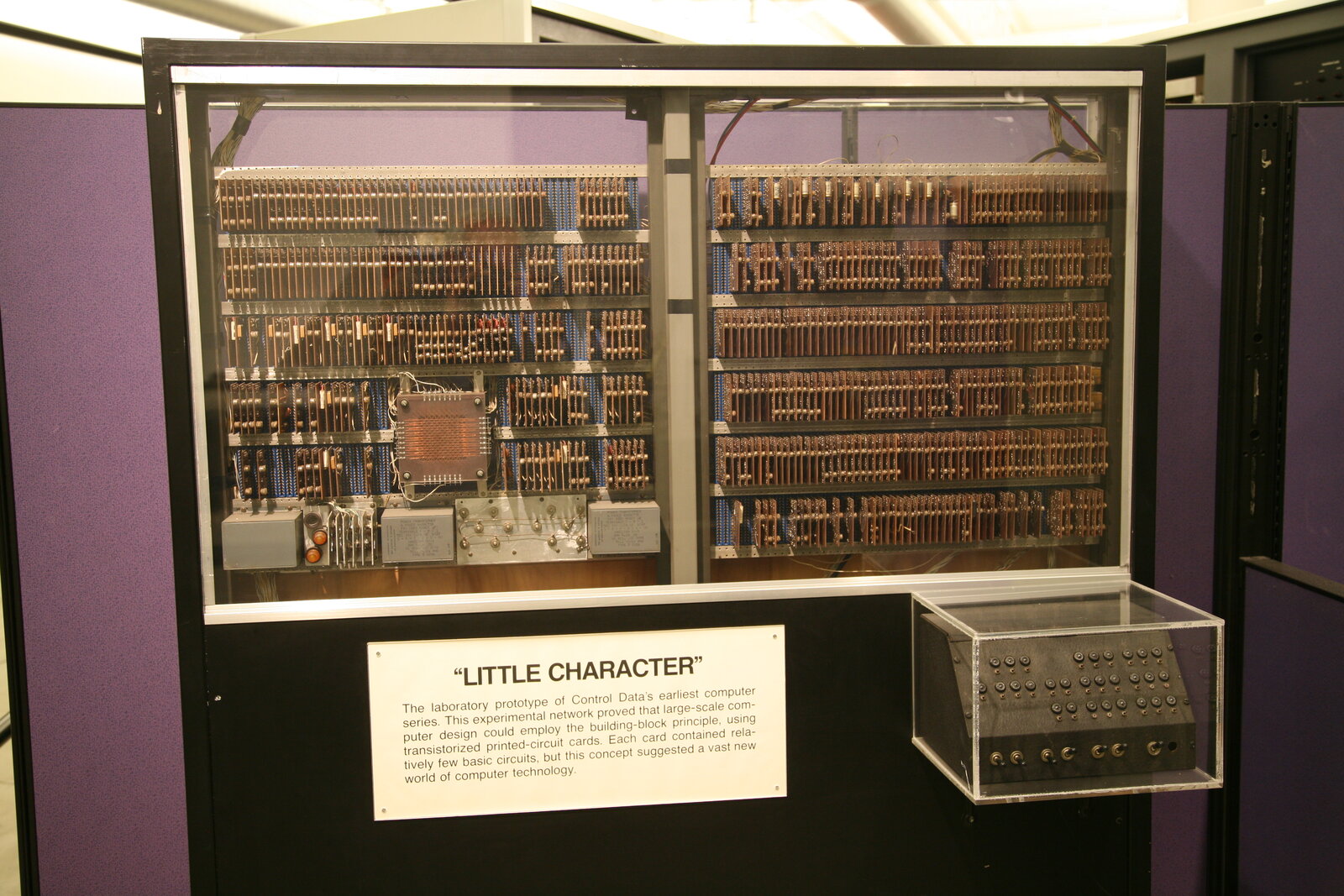
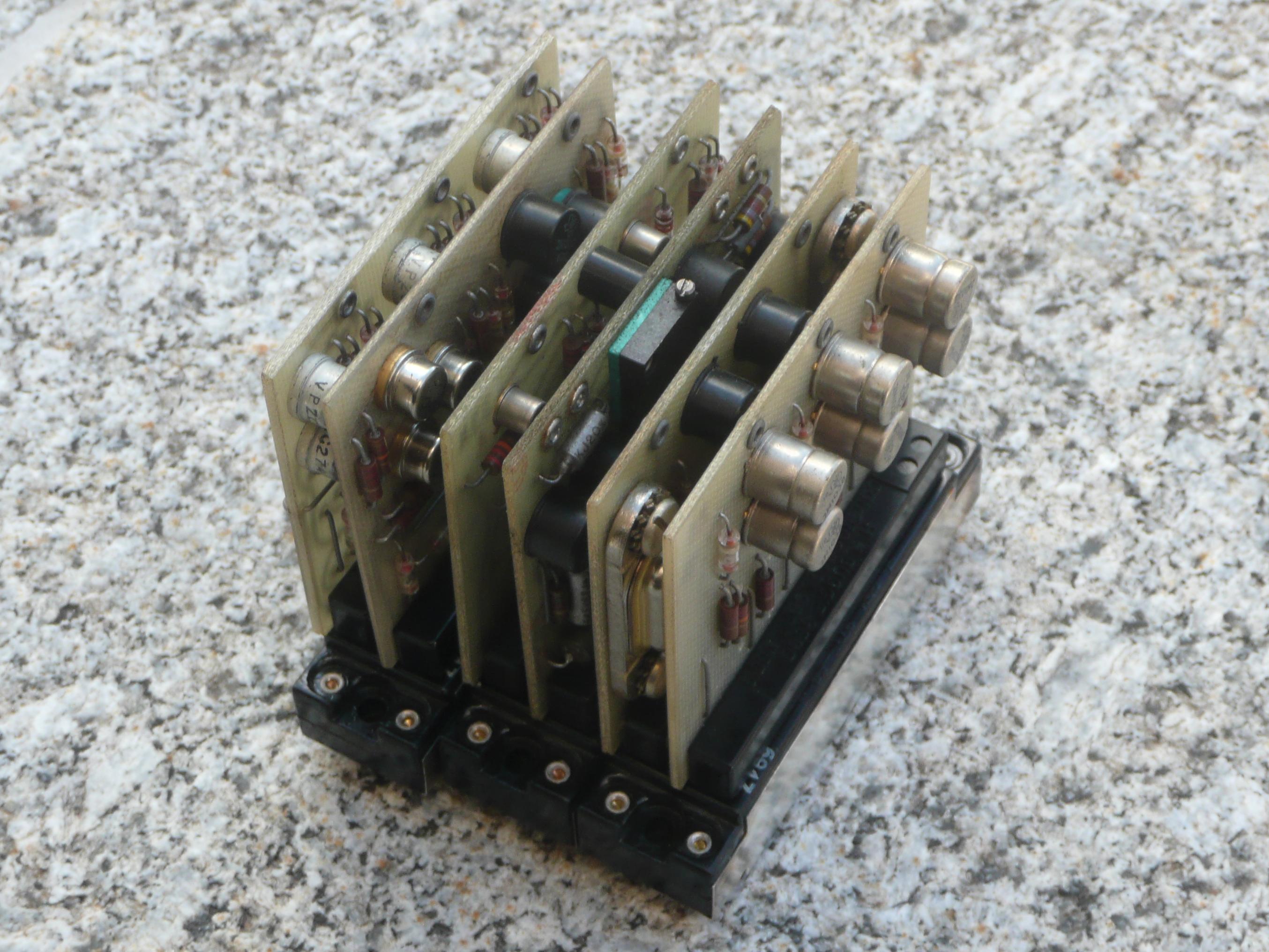
In early 1958, before CDC committed to a full production design, Cray built a prototype machine that the company nicknamed Little Character. Little Character was a 6-bit, 64-word transistor computer assembled on a small set of plug-in printed-circuit modules (the CDC engineers called them “cordwood” modules, after the densely-packed firewood logs you might stack against a barn wall, because each module held its components packed in vertical rows behind a single back face of a card edge connector). The point of Little Character was not to compute anything useful. It was to prove to the still-uncertain CDC board, and to Norris and Mullaney, that the modular cordwood approach – a small set of perhaps a dozen standard circuit-board types, used in different combinations across an entire computer – would work at production scale, that transistor logic was reliable enough to commit to, and that Cray could build a working prototype out of components and tools the new company could afford. The machine was demonstrated, the board approved the production design, and CDC committed to a single product in 1958: a 48-bit transistor scientific computer which would be called the CDC 1604.10
The “1604” name was chosen, by Cray’s own (laughing) recollection in a later oral history, by combining “501 Park Avenue” – the original CDC office address in Minneapolis – with “1103,” the ERA / UNIVAC machine the new computer was meant to surpass. The company’s own engineers later said the addition was probably apocryphal.
Building the 1604
The 1604 was, by the architectural standards of 1958, a conservative machine. It did not introduce radically new ideas. What it did was take a well-understood scientific-computer architecture – 48-bit word, single-address instruction format, hardware floating-point arithmetic, magnetic-core random-access memory of about 32 000 words – and implement it more cheaply, more reliably, and at less than half the price of the contemporary IBM 7090.
The word format was 48 bits. Two 24-bit instructions were packed into each word. Each instruction had a 6-bit operation code, a 3-bit index-register specifier, and a 15-bit address field. There were six 15-bit index registers. There were sixty-two basic instructions. The arithmetic was floating point, in a 1-sign / 11-exponent / 36-fraction format. Memory was magnetic-core in two banks, with a basic configuration of 32 768 words and an option to expand to 65 536. The memory cycle time was 6.4 microseconds; effective memory access – after pipelining of the two instruction halves – was about 4.8 microseconds. The basic operation rate was approximately 100 thousand single-address operations per second.11
The machine contained roughly 25 000 germanium transistors and 100 000 diodes. The choice of germanium rather than silicon was a cost decision: in 1958-59 silicon transistors were two or three times the price of comparable-spec germanium ones. CDC had bought a substantial stock of inexpensive germanium transistors in 1958 in anticipation of the production run. Charles Murray, in The Supermen, recounts a frequently-told CDC origin story in which Cray and the early production team obtained their first transistors at “the Radio Shack of its day” prices (one popular account names the supplier and quotes a thirty-seven-cent unit price, with subsequent doubling once General Transistor realised what they were being used for). The story is repeated everywhere; primary-source confirmation is harder to obtain. Whether or not the thirty-seven-cent figure is exactly right, the broader point – that CDC’s transistor sourcing was opportunistic, low-cost, and an early example of the kind of supply-chain hustling that would later define the integrated-circuit industry – is well attested.12
The total power draw of the production 1604 was about 5.5 kilowatts, against roughly 50 to 60 kilowatts for the tube-era IBM 709. (The 1604’s true contemporary was IBM’s transistorised 7090, announced in 1958 and first installed in December 1959, which had its own substantial reduction in power draw versus the 709.) The 1604’s heat-removal approach was simple forced air; it did not need the extensive water cooling that later machines like the IBM 360/91 or Cray’s own CDC 7600 would require.
The cordwood-module construction, prototyped in Little Character, was used throughout the production 1604. A 1604 contained roughly seven hundred plug-in cordwood modules drawn from a library of about a dozen standard module types. Each module was a small printed-circuit card with components arranged in vertical rows behind a single edge connector. The standardisation made debugging easier (a faulty module could be swapped for a spare in seconds) and lowered manufacturing costs. The same module library was reused, with minor variations, in CDC’s smaller 12-bit machine the CDC 160 and its successors the 160-A and the 924 – so the modular investment paid back across multiple products.
The first 1604 prototype was working in CDC’s Bloomington laboratory by mid-1959. CDC publicly announced the machine on 16 October 1959 – a corporate press release rather than a major industry conference; no Joint Computer Conference was held that month, the WJCC having taken place in San Francisco in March and the EJCC about to convene in Boston in December. The first production unit was completed in late December 1959 and delivered to its first customer in January 1960.
That customer was the U.S. Navy, specifically the Naval Postgraduate School at Monterey, where the machine was to be used for what the Navy then called numerical fluid mechanics (today we would say computational fluid dynamics) and, before long, numerical weather prediction.
Spanagel Hall, January 1960
The Naval Postgraduate School at Monterey had been making the case for a major new digital computer since 1957, when its small ERA 1101 was already showing signs of saturation. The school’s faculty had been pursuing several lines of computational research, including hydrodynamic-stability calculations under the direction of Captain Paul M. Wolff, an officer with both an engineering background and an interest in numerical weather prediction. Wolff had been following the early Princeton work of Charney, Phillips, and the JNWPU at Suitland (already covered in our post on Phillips’s first GCM and elsewhere in this series). He had argued, in a series of internal Navy memoranda from 1957 onward, that operational weather forecasting for the U.S. Pacific Fleet was a problem ideally suited to digital computing – if one could get the right machine. By the time CDC was ready to ship the 1604, Wolff had managed the procurement so as to be the natural first customer.13
The 1604’s serial number 001 was crated in CDC’s Bloomington plant in December 1959, shipped by rail to California in early January 1960, and installed in Spanagel Hall, Room 101A, a basement classroom that had been adapted to host the machine. The complete installation took several days. Cray himself travelled from Minnesota to supervise. He wired several of the cabinet-to-cabinet interconnects personally and, by Wolff’s later recollection in an oral history, refused to leave Monterey until the machine had completed its formal acceptance test (a sustained run of a sample numerical-integration program against pre-computed correct answers). The acceptance signature is in the Naval Postgraduate School’s archive: serial number 001, CDC 1604, January 1960, accepted by Captain Paul M. Wolff for the Navy and certified by S. R. Cray for Control Data Corporation.
The machine cost the Navy approximately one million dollars in 1960 dollars, including memory, peripherals, software, and a year of CDC field-engineering support. By comparison, an IBM 7090 with a similar memory configuration cost around 2.9 million dollars in the same year. The 1604’s price was a major part of its commercial success: it was, by a considerable margin, the cheapest serious scientific computer on the market in 1960.14
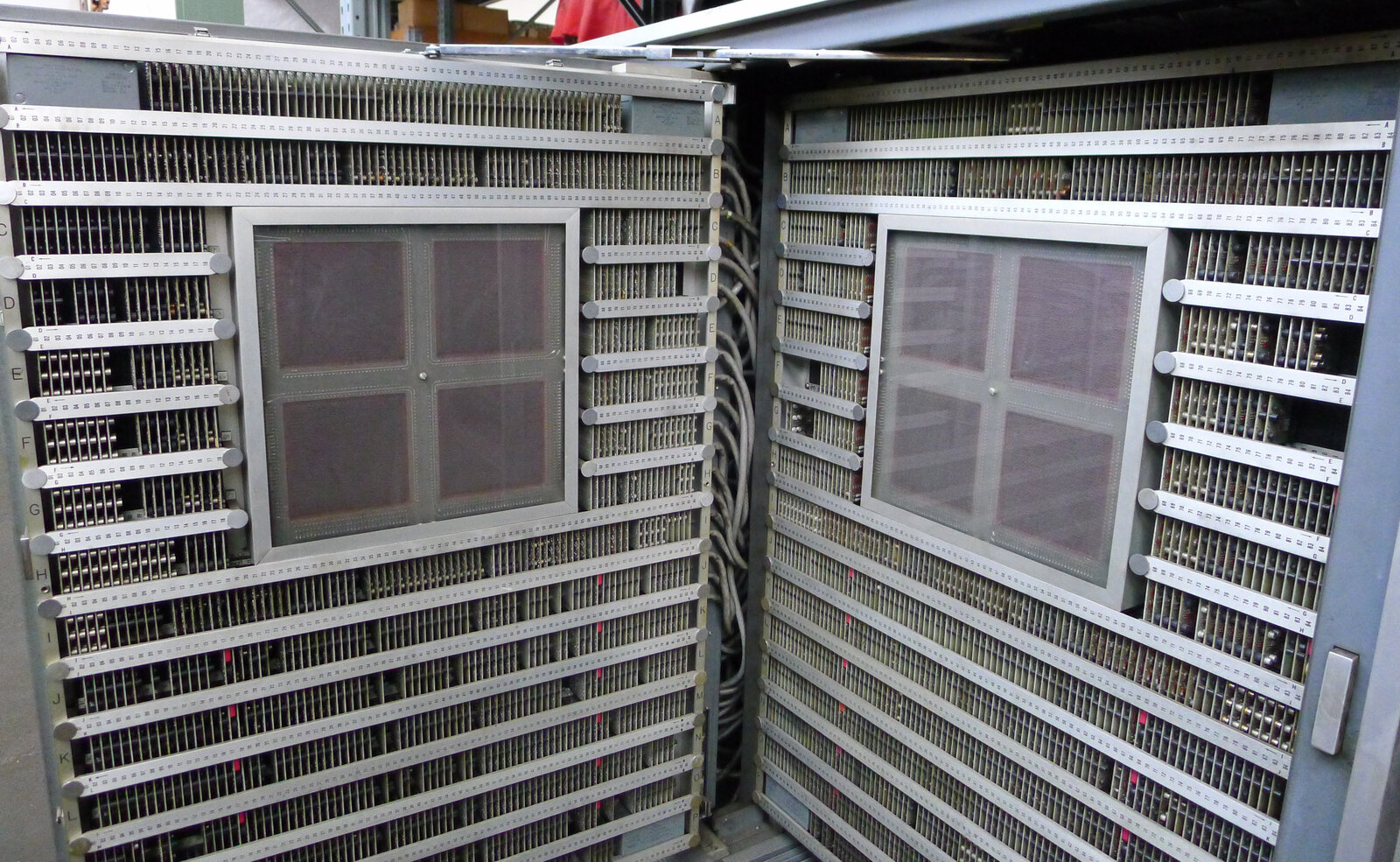
The forecast at Monterey
The 1604 was operational at the Naval Postgraduate School from January 1960 onward. By August 1960, eight months after delivery, Wolff’s NANWEP team at the school had ported and run a numerical weather prediction model on the machine. Their first product – a single-cycle barotropic forecast for the North Pacific, displayed as a contour map of pressure deviations – was, by Wolff’s later account in his Naval annual report, “the first surface weather map produced by a computer.” This was a careful claim: ENIAC had run a barotropic forecast at Aberdeen in 1950, but ENIAC’s output was a column of numbers; Norman Phillips’s 1956 GCM at the Institute for Advanced Study had been computed on the IAS machine but its output was hand-contoured by graduate students. Wolff’s machine had read the input data, integrated the equations, gridded the output, and produced a contour map suitable for direct briefing – all without a human in the loop between the input data and the printed forecast. That had not been done before.2
In 1961 the Navy renamed Wolff’s operation the Fleet Numerical Weather Facility (FNWF) and gave it formal operational status. By December 1961, FNWF was producing daily forecast products distributed by teleprinter to more than one hundred U.S. Navy ships and shore stations across the Pacific. CDC’s 1963 sales brochure, marketing the 1604 to other potential weather-forecasting customers, quoted FNWF’s per-cycle workload at “approximately two billion arithmetic operations per analysis-and-forecast cycle.” The machine ran continuously on three shifts. It was the U.S. military’s first operational weather computer.
Crucially – and this is important to flag because the popular literature is often confused on the point – FNWF, not the National Center for Atmospheric Research, was the home of the first 1604-based atmospheric work. NCAR was founded in 1960 and acquired its first computer, a CDC 3600, only in November 1963. (The 3600 was the larger 48-bit successor to the 1604, also designed by the Cray group.) The persistent claim that “the CDC 1604 was the first NCAR computer” appears in at least one prominent secondary source and is wrong. The NCAR history is a Cray-CDC story, but it begins with the 3600, not the 1604.15
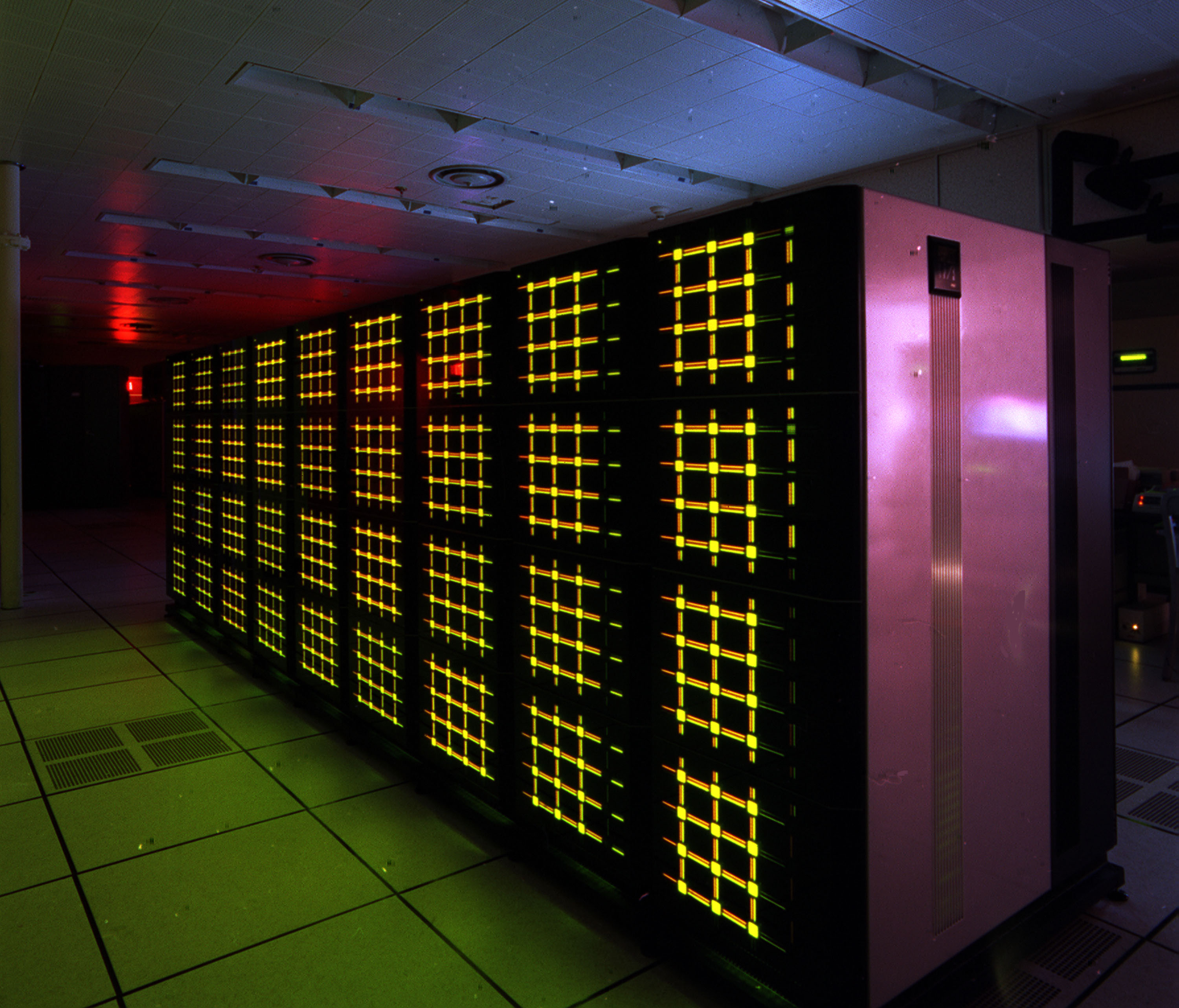
FNWF eventually outgrew its 1604 and acquired a CDC 3600 of its own in 1964, a CDC 6500 in 1969, and so on through the supercomputing generations. The original FNWF, in continuously updated form, is the lineal ancestor of today’s Fleet Numerical Meteorology and Oceanography Center (FNMOC) – the U.S. Navy’s principal operational meteorology and oceanography facility, headquartered at the same Monterey site, today running modern HPC clusters and contributing to the global ensemble forecasting community alongside ECMWF and NCEP. The first surface weather map produced by a computer, in August 1960 in Spanagel Hall Room 101A, is FNMOC’s foundational document.
The customer list
Beyond Monterey, the 1604 sold to a wide and varied set of customers. CDC sold roughly fifty 1604 systems between January 1960 and the end of production around 1964. Some highlights:
- U.S. Navy Bureau of Ships purchased ten 1604s to outfit shore-based fleet command centres. This included FOCCPAC (Fleet Operational Control Center Pacific) in Hawaii, which by the late 1960s was running a cluster of four 1604s for combined operational fleet command, oceanography, and meteorological work.
- The U.S. Defense Atomic Support Agency (DASA) at the Pentagon used a 1604 during the Cuban Missile Crisis of October 1962 for nuclear-effects calculations and contingency-targeting work. The DASA 1604’s specific role during the crisis is partially declassified; the basic fact that the machine was running and that Cray’s CDC team was on standby for emergency support is in the public record.
- The National Security Agency acquired multiple 1604s between 1960 and 1963 – the NSA’s public Hall of Honor materials list deliveries of 1604 systems in September 1960, February 1961, March 1962, January 1963, and July 1963. The NSA was also CDC’s largest single customer through the 1960s and would later be a principal customer for the CDC 6600.
- The University of Minnesota acquired a 1604 in 1961 for general scientific computing across its faculties. Several other universities followed: University of Illinois (which used its 1604 for the PLATO III computer-assisted instruction system, an early time-sharing educational platform that pioneered many concepts of online learning), the University of Wisconsin, and the University of Pennsylvania.
- The U.S. Air Force Minuteman I intercontinental ballistic missile programme used pairs of 1604s as redundant ground-station computers for missile control calculations.
- Marathon Oil ran one of the earliest text-mining applications, a programme called Masquerade that searched a corpus of internal technical reports for keyword combinations – an early ancestor of modern enterprise search.
- And, unusually for an American scientific computer of the early 1960s, the 1604 found its way to the Soviet Union.
The Soviet sale
By 1968, a CDC 1604A – the second-generation 1604 with expanded core memory and additional I/O channels – was operating at the Joint Institute for Nuclear Research in Dubna, a multinational physics laboratory north of Moscow founded in 1956 under Soviet leadership but with formal collaboration agreements involving fifteen Soviet-bloc and (later) non-bloc countries. The machine appears in JINR’s documented computing complex in Boris Shirikov’s 2006 history of computing at the institute. The most detailed primary-source account is Shirikov’s; a less reliable folklore version, attaching to the same machine, claims it was acquired indirectly from West Germany. The folklore version is not well attested; the cleaner statement, supportable from primary sources, is simply that the JINR Dubna 1604A was operational by 1968, was used for high-energy-physics simulations and accelerator control, and remained in service until the early 1980s.16
The U.S. interagency export-control fight of the 1969-1970 period, sometimes attached to this CDC sale in popular accounts, was actually about a different machine: the CDC 6400 that was eventually exported to the Yerevan Computer Centre in Soviet Armenia. The 6400 export licence was approved by the Department of Commerce in 1969 over Department of Defense objections and triggered a multi-year congressional hearings cycle on East-West technology transfer. The 1604A at Dubna preceded the 6400 sale and – to the extent the export-licence details are recoverable from declassified materials – was approved through a quieter procedure, possibly because Dubna’s status as a multilateral physics laboratory rather than a purely Soviet institution made the political calculation easier.
The longer political afterlife of the CDC export to JINR is interesting and partly speculative. The Soviet computer industry of the late 1960s was, even within the Iron Curtain, in some difficulty: the Soviet BESM-6 computer of 1968 was originally designed by Sergei Lebedev’s team in Moscow as an indigenous Soviet supercomputer, but its instruction set was modified during development to be partially compatible with Western (specifically CDC) software. The motivation for the partial compatibility appears to have been pragmatic – by 1968 the Soviet scientific community had real CDC machines (at least at Dubna), which gave them access to substantial CDC software libraries that an indigenously-incompatible BESM would have been unable to use. The BESM-6 should not be described as “a Soviet copy of the 1604” – the architectures are different and Lebedev’s design had significant original contributions – but the partial software compatibility is real and documented.17
The post will not pretend to settle the historiography of Soviet-era computer policy. The simple fact for the present narrative is that by 1968 a CDC 1604A was running in Dubna, and that fact was visible to the U.S. computing industry at the time as both a commercial success (CDC had sold a major scientific computer to the Soviet bloc, with U.S. government approval) and as a Cold War flashpoint that would shape export-control policy for the next two decades.
Chippewa Falls
Cray made one major personal demand of CDC during the early years of the company. In 1962, after the 1604 was in volume production and CDC was profitable for the first time, Cray told Norris that he wanted to move out of CDC’s Bloomington Minnesota headquarters and set up his own engineering laboratory in his hometown of Chippewa Falls, Wisconsin – about a hundred miles east of the Twin Cities, on the Chippewa River near the headwaters of the Mississippi.
Cray’s stated reasons were several. He wanted quiet. He wanted to be away from the daily corporate-management cadence of the Bloomington headquarters, which by 1962 was already filling up with non-engineering staff – accountants, marketing people, salesmen – whose presence Cray found mildly oppressive. He wanted to live in a small town. He had family in Chippewa Falls. There was also, less often discussed, a Cold War element: the early 1960s peak of nuclear-targeting anxiety had Cray (and a number of CDC’s senior engineers) genuinely concerned that the Twin Cities – with its Minneapolis-Saint Paul concentration of defence-electronics industry, the Honeywell weapons systems plant, the FMC munitions works, and the new CDC headquarters itself – would be targeted in a Soviet first strike. Cray built a substantial bomb shelter on his Chippewa Falls property in the early 1960s and reportedly dug a small extension into the basement bedrock, partly for additional protected workspace and partly (his Cray Research-era CEO John Rollwagen would later say in colourful telling) for “a place to think.” (Some of Rollwagen’s later embellishments of Cray’s personal habits – the famously elaborate tunnel, the ritual burning of canoes – have been challenged as embroidery by ex-CDC employees, particularly Jim Masocco, but the basic 1962 hometown move and the bomb shelter are well attested.)18
Norris agreed to the move, and CDC funded the construction of a small laboratory facility in Chippewa Falls. The building was modest: a single-storey light-industrial structure on the edge of town, with an engineering area, a small machine shop, and an office for Cray and a handful of trusted associates. The Chippewa Falls Laboratory became, for the rest of Cray’s tenure at CDC and for the early years of his subsequent company Cray Research, his effective fiefdom. Major design decisions on the CDC 6600 (1964), the CDC 7600 (1969), and the cancelled CDC 8600 all happened in Chippewa Falls. CDC marketing and corporate sales happened in Bloomington; CDC architecture happened in Wisconsin.
The decentralisation was not unique to Cray. Norris held a strong view, articulated in many of his later writings and oral histories, that engineering organisations should be small and that creative engineers should be left alone. Norris’s CDC, through the 1960s, had multiple semi-autonomous engineering laboratories scattered across the upper Midwest – the Chippewa Falls Lab being the most famous, but also peripheral-equipment labs at Brainerd Minnesota, software groups in Twin Cities suburbs, and so on. The principle, as Norris repeatedly stated, was that the company’s job was to keep the engineering teams supplied with budget and shielded from corporate distractions. The often-quoted line attributed to Cray himself, expressing the same principle, is the well-attested five-year-goal / one-year-goal formulation: “Five-year goal: build the biggest computer in the world. One-year goal: build one-fifth of the above.” The ratio is the engineering lesson; the calmness behind the formulation is the Cray-Norris cultural consensus that produced it.
Frank Mullaney
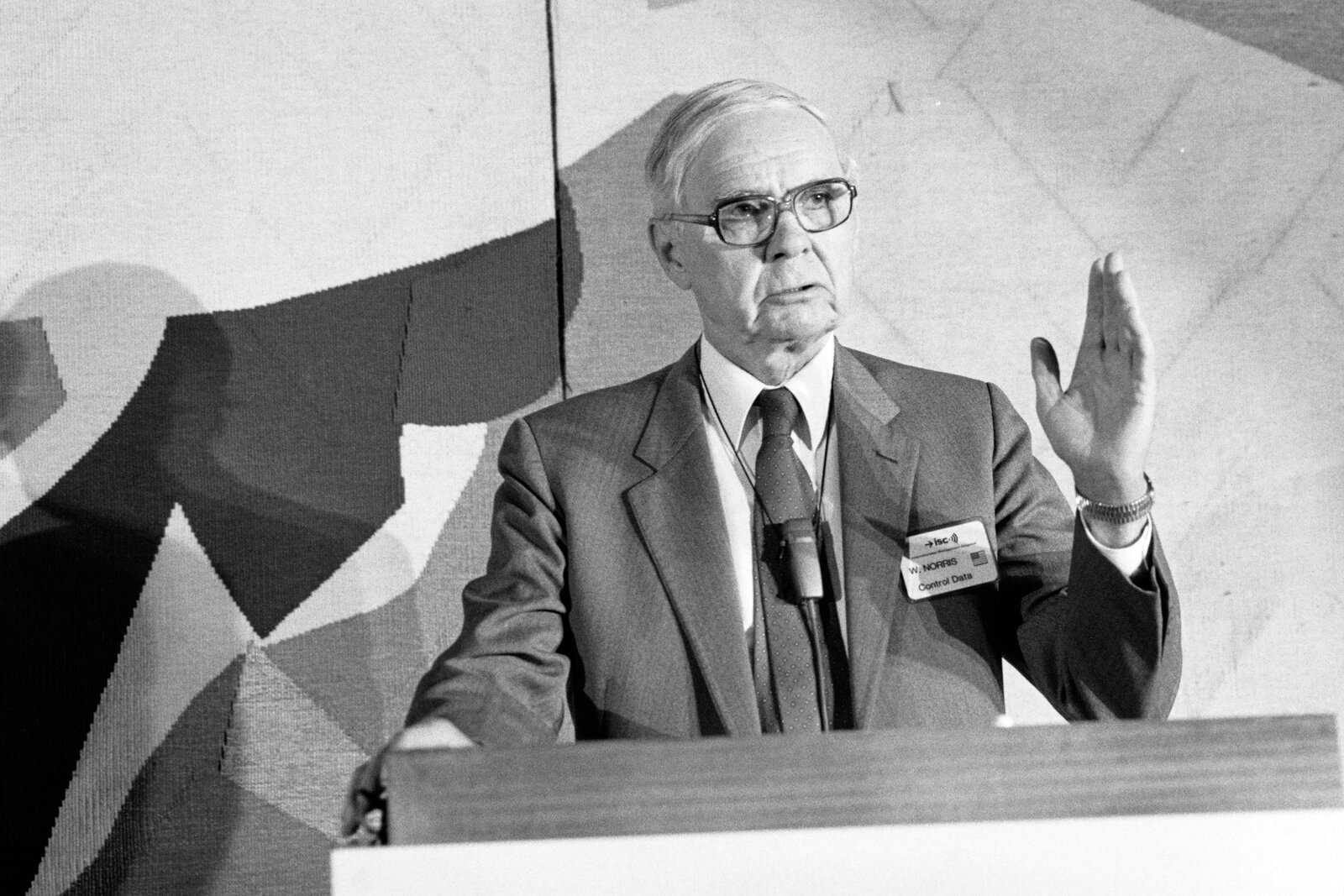
The third founder of CDC, the man whose Charles Babbage Institute oral history is the single best primary-source account of the founding, is the least famous of the three. Frank C. Mullaney was born in St. Paul Minnesota in 1923, the son of a jeweller. He earned a B.S.E.E. at the University of Minnesota in 1943. During the war he served as a Naval officer at the Key West sonar base, where (he later remembered with some annoyance) his immediate superior in Miami repeatedly squashed his transfer orders to the Pacific theater without telling him, so that Mullaney spent the entire war in Florida instead of in combat. After demobilisation he worked briefly in industry, then joined ERA in June 1947 on a tip from his brother-in-law. By 1957 he was Norris’s chief lieutenant in the St. Paul scientific-computing operation.
Mullaney’s distinct contribution to CDC was that he was the engineer who first hired Seymour Cray onto Task 29, the ERA project that gave Cray his major early-career promotion. As Mullaney later described it in his CBI oral history: “Seymour had only been there a couple of weeks before I knew we had something very unusual there.” The recognition was characteristic. Mullaney was, by all accounts, a quiet, observant, deeply technical engineer who chose to spend his career building other people’s projects rather than his own. He was a CDC founder, board member, senior engineering executive, and the supervisor of CDC’s early software-development organisation. He retired from CDC in the late 1970s and died in 2001.
His CBI oral history, recorded in 1986, runs to several hundred pages of transcript and is the canonical primary source for the period that Charles Murray’s 1997 book The Supermen later drew on heavily. The transcript is held at the Charles Babbage Institute at the University of Minnesota, where the bulk of CDC’s surviving corporate archive is also held – nearly all of which remains under restricted-use terms today.19
CDC after the 1604
The CDC 1604 sold approximately fifty units between 1960 and 1964. Its profits financed the development of CDC’s full product line. The progression is direct:
- CDC 160 / 160-A (1960-1962): a 12-bit, desk-side small computer using the same cordwood module library, designed by Cray as a low-cost peripheral controller and small scientific computer.
- CDC 924 (1961-1963): a 24-bit machine, used by NASA among others.
- CDC 1604-A (1962-1963): an upgrade of the original 1604 with expanded core memory and additional I/O channels – the version that ended up at JINR Dubna and at several other late-1960s installations.
- CDC 3600 (1963): a 48-bit transistor scientific computer larger and faster than the 1604, with two-million-instructions-per-second peak rate. NCAR’s first computer; also FNWF’s second-generation machine.
- CDC 6600 (1964): the first true supercomputer. Ten parallel functional units, RISC-like instruction set, three megaflops peak. The breakthrough machine that would force IBM to respond.
The architectural philosophy that produced the 6600 – the standardised module library, the small autonomous engineering team in Chippewa Falls, the willingness to undercut IBM on price and outpace IBM on speed – was settled by the time the 1604 shipped in January 1960. Everything CDC did for the next decade was a continuation of decisions that had already been made.
Coda
CDC ran for another thirty years after the 1604 shipped. At its peak in the early 1980s the company had approximately five billion dollars in annual revenue and sixty thousand employees, briefly the second-largest computer company in the United States after IBM. It survived a major IBM antitrust settlement in 1973 (CDC received approximately eighty million dollars in cash and assets, including the transfer of IBM’s Service Bureau Corporation) and used the proceeds to fund a sustained 1970s and 1980s diversification into time-sharing services, peripherals, and the PLATO computer-based-education system that Norris championed personally as part of his late-career conviction that technology should be deployed for social impact. Norris stepped down in 1986, having been at CDC’s helm for twenty-nine years. He won the National Medal of Technology that same year. He died of Parkinson’s disease at his Bloomington Minnesota home on 21 August 2006 at age ninety-five.
Frank Mullaney died in 2001.
Seymour Cray left CDC in 1972 after the company killed his proposed CDC 8600 design. He founded Cray Research, Inc. with two hundred and fifty thousand dollars of CDC’s seed money and Norris’s personal blessing – a remarkably amicable departure considering that Cray’s new company would compete directly with CDC for the next decade. Cray Research shipped the Cray-1 in 1976 and the Cray-2 in 1985. Cray himself left Cray Research in 1989 over a strategic disagreement on multi-processor design and founded a third company, Cray Computer Corporation, in Colorado Springs, which delivered a single Cray-3 prototype (named Graywolf) to NCAR on 24 May 1993 as a loaner evaluation unit. Cray Computer Corporation went bankrupt in March 1995 before completing the follow-on Cray-4. On Sunday, 22 September 1996, Cray was driving his Jeep Cherokee on Interstate 25 near the U.S. Air Force Academy north of Colorado Springs when the vehicle was struck by another car merging into his lane. The Jeep rolled three times. Cray was admitted to Penrose Hospital with severe head and chest injuries. He died there two weeks later, on 5 October 1996, aged seventy-one. He had never given a major public speech, never written a memoir, and never sought publicity. The CDC archive holds perhaps a dozen photographs of him from the entire 1957-1972 period, most of them corporate publicity shots taken under sufferance.
The CDC 1604 itself survives in fragments. Three machines are known to be intact in museum collections: one at the Computer History Museum in Mountain View (a CDC 1604-A acquired in 1996), one at the Deutsches Technikmuseum in Berlin (a 1604A that operated in East Germany until April 1991 and is the source of the in-body image in this post), and one at the Naval Postgraduate School in Monterey (preserved in a small archival display in the school’s library). The Monterey machine carries the manufacturer’s serial-number plate stamped 001. Captain Paul Wolff died in 2004; his copy of the 1960 acceptance certificate is in the school’s archive next to the machine.
The Fleet Numerical Weather Facility, founded around the 1604 in 1960, became the Fleet Numerical Oceanography Center in 1976 and the Fleet Numerical Meteorology and Oceanography Center in 1993. FNMOC today operates HPE Cray supercomputers, runs the U.S. Navy’s global atmospheric model NAVGEM, contributes to ensemble products for combined U.S. Navy / NCEP / ECMWF operational forecasting, and remains – after sixty-six years of continuous operation, three site renamings, and seven hardware generations – at the same Monterey site where Cray and Wolff stood next to a freshly-installed digital computer in January 1960. Spanagel Hall is still standing. Room 101A is now a teaching classroom.
Footnotes
References
Primary scholarly histories:
- Charles J. Murray, The Supermen: The Story of Seymour Cray and the Technical Wizards Behind the Supercomputer (Wiley, 1997). The canonical popular history of Seymour Cray’s career and Control Data Corporation.
- James E. Thornton, Design of a Computer: The Control Data 6600 (Scott Foresman, 1970). The 6600 design book; its introductory chapters cover the 1604 architectural genealogy.
- Emerson W. Pugh, Memories That Shaped an Industry: Decisions Leading to IBM System/360 (MIT Press, 1984). Standard reference on IBM’s response to CDC.
- G. Trogemann, A. Y. Nitussov, and W. Ernst, eds., Computing in Russia: The History of Computer Devices and Information Technology Revealed (Vieweg, 2001). Soviet-bloc computing context.
- David Alan Grier, When Computers Were Human (Princeton University Press, 2005). Pre-CDC scientific-computing context.
Primary technical and archival sources:
- Frank C. Mullaney CBI oral history (1986), Charles Babbage Institute, University of Minnesota.
- Seymour Cray CBI oral history (undated), CBI.
- William C. Norris CBI oral history (undated), CBI.
- CDC corporate archive (CBI, restricted-use access).
- CDC 1604 sales brochure (1963), held at CBI and the Computer History Museum.
- Captain Paul M. Wolff “Fleet Numerical Weather Facility Annual Report” (U.S. Navy, 1960 and subsequent years), Naval Postgraduate School archive.
- Boris N. Shirikov, History of Computing at JINR Dubna (JINR, 2006).
- James V. Boone, The WWII Cryptologic Heritage of the United States’ Computer and Communications Industries, NSA Center for Cryptologic History.
Web archives consulted (accessed 2026-05-04):
- “CDC 1604,” “Control Data Corporation,” “Engineering Research Associates,” “ERA 1101,” “Seymour Cray,” “William C. Norris,” “Frank Mullaney,” “BESM-6,” “Joint Institute for Nuclear Research,” “PLATO (computer system),” “Fleet Numerical Meteorology and Oceanography Center,” Wikipedia.
- Computer History Museum: Storage Engine timeline (“1604: The First All-Transistor Scientific Computer”); Revolution exhibit on supercomputers.
- Charles Babbage Institute, University of Minnesota: CDC corporate-history holdings, oral-history transcripts.
- John Markoff, “Seymour Cray, Computer Industry Pioneer and Founder of Cray Research, Dies at 71,” New York Times, 6 October 1996.
- IEEE Computer Society Computer Pioneer Award biographies of Cray (1979) and Norris (1990s).
- National Security Agency public Hall of Honor materials.
- FNMOC public history materials at fnmoc.navy.mil.
-
CDC 1604 architecture and Serial #1 delivery: Charles J. Murray, The Supermen: The Story of Seymour Cray and the Technical Wizards Behind the Supercomputer (Wiley, 1997), chapters on Cray’s CDC years; James E. Thornton, Design of a Computer: The Control Data 6600 (Scott Foresman, 1970), introductory chapter on the 1604; “CDC 1604,” Wikipedia; Computer History Museum, “1604: The First All-Transistor Scientific Computer,” Storage Engine timeline. ↩
-
Fleet Numerical Weather Facility and the August 1960 first-computer-generated surface weather map: Captain Paul M. Wolff, “FNWF Annual Report” (U.S. Navy, 1960 and subsequent years), in the Naval Postgraduate School archive; CDC 1604 sales brochure (1963), reproduced in CHM Storage Engine; “Fleet Numerical Meteorology and Oceanography Center – History,” public materials at fnmoc.navy.mil; Wolff oral history (Computer History Museum, undated). ↩ ↩2
-
Engineering Research Associates founding 1946: “Engineering Research Associates,” Wikipedia; Charles Babbage Institute oral histories with Norris and Mullaney; James V. Boone, The WWII Cryptologic Heritage of the United States’ Computer and Communications Industries (NSA Center for Cryptologic History); Erwin Tomash IEEE biographical materials. ↩
-
ATLAS / ERA 1101 architecture and significance: “ERA 1101,” Wikipedia; Charles Babbage Institute archival holdings on ERA / NSA collaboration; David Alan Grier, When Computers Were Human (Princeton University Press, 2005), chapter on early Navy computing. ↩
-
ERA / Sperry-Rand acquisition 1952 and subsequent years: Charles J. Murray, The Supermen (1997); “Engineering Research Associates,” “Remington Rand,” “Sperry Corporation,” Wikipedia; CBI oral histories with Norris and Mullaney. ↩
-
CDC founding origin: Frank Mullaney CBI oral history (1986), Charles Babbage Institute, University of Minnesota; Charles J. Murray, The Supermen (1997); “Control Data Corporation,” Wikipedia. ↩
-
CDC founding date and seven canonical founders: “Control Data Corporation,” Wikipedia, citing the 8 July 1957 incorporation and the 14 August 1957 announcement; CBI archival materials; Murray (1997). ↩
-
CDC IPO of 600,000 shares at one dollar each via Kalman and Company under Minnesota Blue Sky exemption: Murray (1997); CBI oral histories; “Control Data Corporation,” Wikipedia. ↩
-
Cray biographical details: John Markoff, “Seymour Cray, Computer Industry Pioneer and Founder of Cray Research, Dies at 71,” New York Times, 6 October 1996 – which is the canonical correction of the WWII narrative; “Seymour Cray,” Wikipedia; Murray (1997); IEEE Computer Pioneer Award biographical materials. ↩
-
Little Character prototype (1958) and the cordwood module library: Murray (1997); Thornton (1970); CBI Cray oral history. ↩
-
CDC 1604 architecture: “CDC 1604,” Wikipedia; Thornton (1970); CDC marketing brochures held at CBI and CHM. ↩
-
Germanium transistor sourcing and the “thirty-seven cents” anecdote: Murray (1997). The anecdote is repeated in many secondary sources but primary-source confirmation is hard to obtain. Treat as period anecdote rather than as documented purchase records. ↩
-
Captain Paul M. Wolff and the procurement of the 1604 for the Naval Postgraduate School: Wolff oral history (Computer History Museum); Naval Postgraduate School archival materials; FNMOC public history materials. ↩
-
1604 vs IBM 7090 pricing: “CDC 1604,” “IBM 7090,” Wikipedia; CDC sales materials at CBI; Murray (1997). ↩
-
NCAR’s first computer was the CDC 3600 in November 1963, not the 1604: NCAR institutional history; “CDC 3000 series,” Wikipedia; Akira Kasahara and Warren Washington oral histories at the National Center for Atmospheric Research, which describe the early NCAR computing facility. ↩
-
JINR Dubna CDC 1604A: Boris N. Shirikov, History of Computing at JINR Dubna (JINR, 2006), partly translated and excerpted in IEEE Annals of the History of Computing; “Joint Institute for Nuclear Research,” Wikipedia. ↩
-
BESM-6 and partial CDC compatibility: “BESM-6,” Wikipedia; Sergei Lebedev biographical materials; G. Trogemann, A. Y. Nitussov, and W. Ernst, Computing in Russia: The History of Computer Devices and Information Technology Revealed (Vieweg, 2001). ↩
-
Cray’s Chippewa Falls move 1962, the bomb shelter, and the Rollwagen embellishments: Murray (1997); Markoff (1996); Jim Masocco interview materials; CBI Cray oral history. The “five-year goal / one-year goal” Cray quote is well attested across multiple oral-history sources and Murray (1997). ↩
-
Frank Mullaney: CBI oral history (1986); FamilySearch genealogical records; Murray (1997). Mullaney’s specific role in hiring Cray onto ERA Task 29 is the central anecdote of his oral history. ↩